About Hakan Bagci Hakan Bagci Professor, Electrical and Computer Engineering computational electromagnetics numerical methods large-scale simulation High Performance Computing electromagnetics photonics optics Professor Bagci is a highly accomplished researcher in the field of computational electromagnetics (CEM). His research focuses on the theoretical and applied aspects of CEM. Events Presented Events Feb 20 - Feb 26, 2022 Multi-physics Simulation of Plasmonic Photoconductive Devices and Antennas Hakan Bagci, Professor, Electrical and Computer Engineering Feb 20, 12:00 - 13:00 B9 L2 R2322 H1 Multiphysics Simulation Terahertz (THz) frequency electromagnetic fields have numerous applications ranging from wireless communications to imaging systems and nondestructive testing, to material characterization. One of the main obstacles in the way of widespread industrial use of THz technologies is the difficulty of implementing compact and frequency-stable THz sources that can operate at room temperatures. Among a variety of possible options, photoconductive devices (PCDs) satisfy these conditions. Indeed, they have become one of the most promising candidates for THz source generation since recent advances in fabrication techniques, such as metasurface integration and nanostructured surface inclusions have significantly increased their optical-to-THz conversion efficiency and made them polarization insensitive. Sep 26 - Oct 2, 2021 Accurate and Efficient Methods to Simulate Electromagnetic Systems Hakan Bagci, Professor, Electrical and Computer Engineering Sep 28, 16:00 - 17:30 B9 L2 R2322 Simulation tools are often enablers of cutting-edge research in many fields of science and engineering. This also applies to the field of electromagnetics: Design and characterization of many electromagnetic systems and devices, which drive technological advances in areas such as communications, computing, biomedicine, and solar energy, would not be possible without simulation tools. Having said that, developing numerical methods for electromagnetic analysis of such complex systems is not a trivial task. Dimensions of these systems are large (longer than several wavelengths), their frequency of operation has a wide range, and their geometry has sub-wavelength features. When it comes to simulating these systems by solving the Maxwell equations (in differential or integral form), these characteristics translate into multiscale discretizations, large and often ill-conditioned matrix systems with millions of unknowns to be solved for, and long execution times. My research group at KAUST has been developing efficient, accurate, and robust electromagnetic solvers to address these challenges. In this talk, I will provide an overview of my group’s recent research activities. Technical part of my presentation will focus on two examples, where I talk about solvers we have developed to efficiently and accurately simulate photoconductive antennas (used in terahertz source generation) and plasmonic structures (with a wide range of applications from sensing to solar energy). I will provide results that demonstrate the benefits of these solvers over existing methods. I will conclude my talk with a brief description of my future research plans and a few slides about my research supervision, teaching activities, and international visibility of my research group. Nov 22 - Nov 28, 2020 Efficient and Accurate Numerical Methods for Transient Electromagnetic Analysis - 2020 Hakan Bagci, Professor, Electrical and Computer Engineering Nov 22, 12:00 - 13:00 KAUST Efficient numerical Methods Transient electromagnetic Electromagnetic devices and systems are at the heart of technological advances revolutionizing many fields of science and engineering including energy management, biomedical electronics, communications and computing, and even environmental monitoring and civil design. Many of these systems are electrically large, their frequency of operation has a wide dynamic range, their device components are geometrically intricate with dimensions varying by orders of magnitude, and finally their optimal design requires many repetitions of characterizations with different parameters. Nov 3 - Nov 9, 2019 Efficient and Accurate Numerical Methods for Transient Electromagnetic Analysis - 2019 Hakan Bagci, Professor, Electrical and Computer Engineering Nov 3, 12:00 - 13:00 B9 L2 H1 R2322 Hakan Bagci is an Associate Professor of Electrical Engineering (EE) and Principal Investigator of the Computational Electromagnetics Laboratory (CEML). His scientific contribution are in advancing high-speed and long-distance communication, energy transfer, and medical imaging. Bagci’s research interests are in various aspects of applied and theoretical computational electromagnetics with emphasis on Time-domain integral-equations and their fast marching-on-in-time-based solutions and solvers to the characterization of wave interactions on complex integrated and electrically large system of photonics and optics.
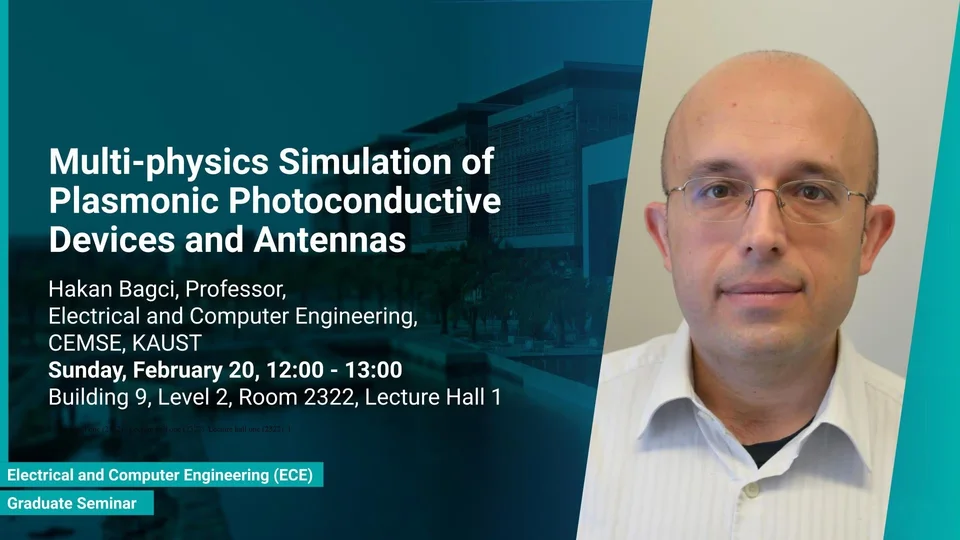
Multi-physics Simulation of Plasmonic Photoconductive Devices and Antennas Hakan Bagci, Professor, Electrical and Computer Engineering Feb 20, 12:00 - 13:00 B9 L2 R2322 H1 Multiphysics Simulation Terahertz (THz) frequency electromagnetic fields have numerous applications ranging from wireless communications to imaging systems and nondestructive testing, to material characterization. One of the main obstacles in the way of widespread industrial use of THz technologies is the difficulty of implementing compact and frequency-stable THz sources that can operate at room temperatures. Among a variety of possible options, photoconductive devices (PCDs) satisfy these conditions. Indeed, they have become one of the most promising candidates for THz source generation since recent advances in fabrication techniques, such as metasurface integration and nanostructured surface inclusions have significantly increased their optical-to-THz conversion efficiency and made them polarization insensitive.
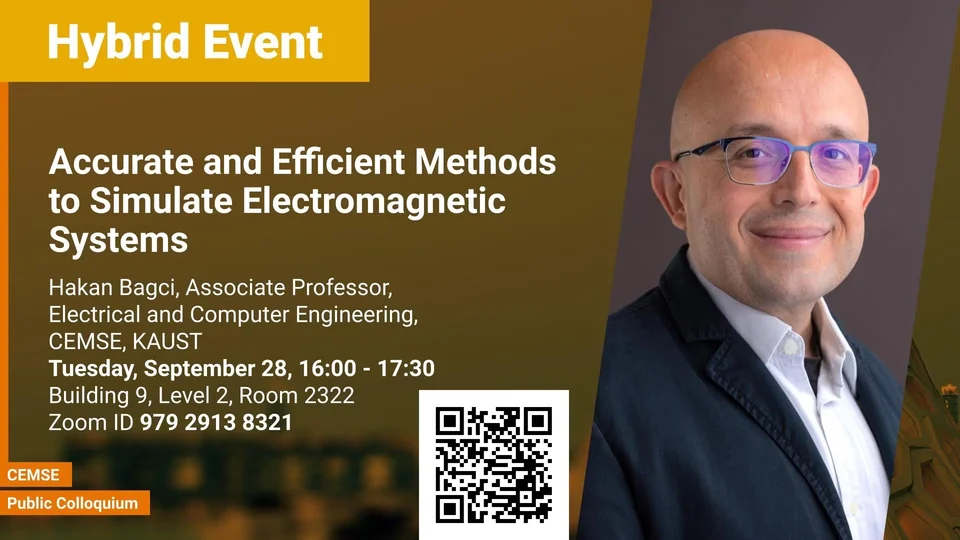
Accurate and Efficient Methods to Simulate Electromagnetic Systems Hakan Bagci, Professor, Electrical and Computer Engineering Sep 28, 16:00 - 17:30 B9 L2 R2322 Simulation tools are often enablers of cutting-edge research in many fields of science and engineering. This also applies to the field of electromagnetics: Design and characterization of many electromagnetic systems and devices, which drive technological advances in areas such as communications, computing, biomedicine, and solar energy, would not be possible without simulation tools. Having said that, developing numerical methods for electromagnetic analysis of such complex systems is not a trivial task. Dimensions of these systems are large (longer than several wavelengths), their frequency of operation has a wide range, and their geometry has sub-wavelength features. When it comes to simulating these systems by solving the Maxwell equations (in differential or integral form), these characteristics translate into multiscale discretizations, large and often ill-conditioned matrix systems with millions of unknowns to be solved for, and long execution times. My research group at KAUST has been developing efficient, accurate, and robust electromagnetic solvers to address these challenges. In this talk, I will provide an overview of my group’s recent research activities. Technical part of my presentation will focus on two examples, where I talk about solvers we have developed to efficiently and accurately simulate photoconductive antennas (used in terahertz source generation) and plasmonic structures (with a wide range of applications from sensing to solar energy). I will provide results that demonstrate the benefits of these solvers over existing methods. I will conclude my talk with a brief description of my future research plans and a few slides about my research supervision, teaching activities, and international visibility of my research group.
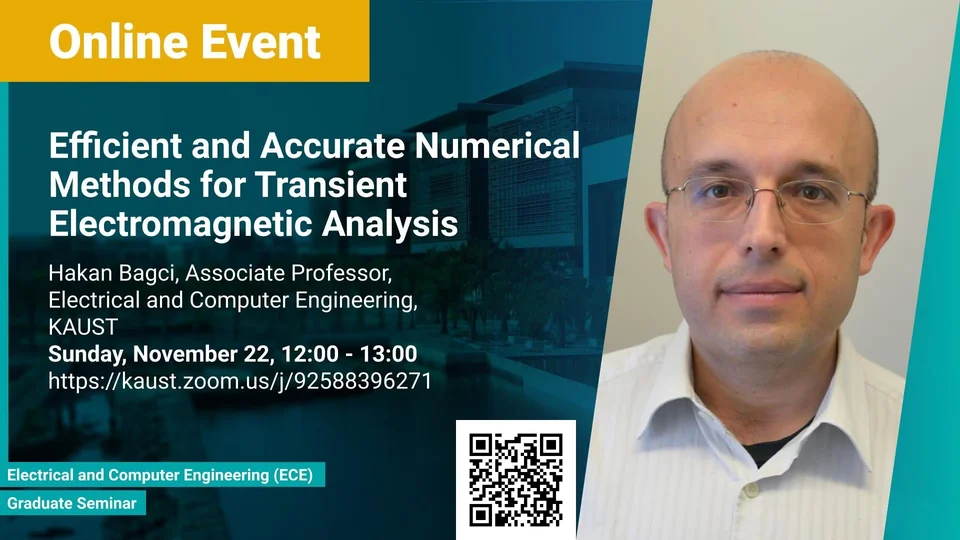
Efficient and Accurate Numerical Methods for Transient Electromagnetic Analysis - 2020 Hakan Bagci, Professor, Electrical and Computer Engineering Nov 22, 12:00 - 13:00 KAUST Efficient numerical Methods Transient electromagnetic Electromagnetic devices and systems are at the heart of technological advances revolutionizing many fields of science and engineering including energy management, biomedical electronics, communications and computing, and even environmental monitoring and civil design. Many of these systems are electrically large, their frequency of operation has a wide dynamic range, their device components are geometrically intricate with dimensions varying by orders of magnitude, and finally their optimal design requires many repetitions of characterizations with different parameters.
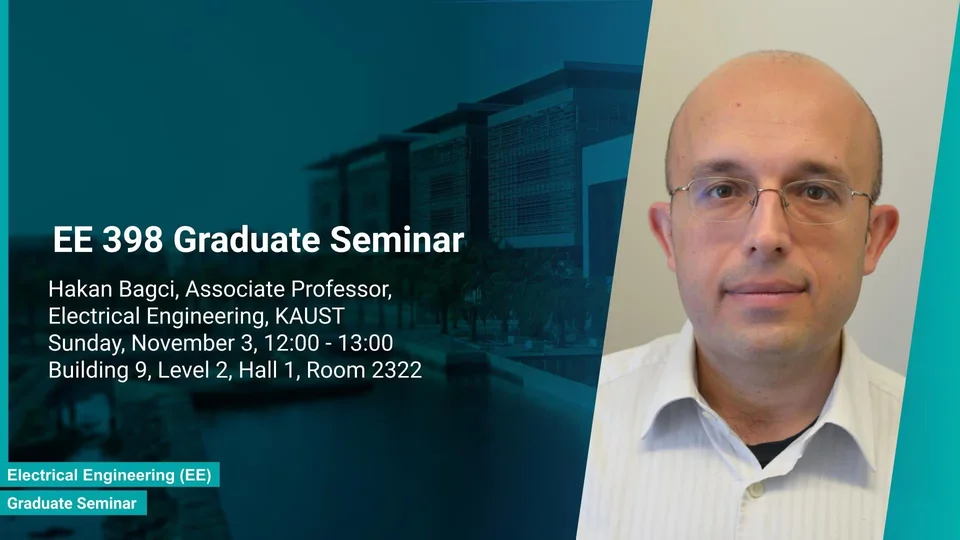
Efficient and Accurate Numerical Methods for Transient Electromagnetic Analysis - 2019 Hakan Bagci, Professor, Electrical and Computer Engineering Nov 3, 12:00 - 13:00 B9 L2 H1 R2322 Hakan Bagci is an Associate Professor of Electrical Engineering (EE) and Principal Investigator of the Computational Electromagnetics Laboratory (CEML). His scientific contribution are in advancing high-speed and long-distance communication, energy transfer, and medical imaging. Bagci’s research interests are in various aspects of applied and theoretical computational electromagnetics with emphasis on Time-domain integral-equations and their fast marching-on-in-time-based solutions and solvers to the characterization of wave interactions on complex integrated and electrically large system of photonics and optics.
Engage KAUST Academic Portal KAUST Repository ORCID Scopus Web of Science ShareClipboard Related Sites Electrical and Computer Engineering (ECE) Extreme Bandwidth Communication (XBCom) Computational Electromagnetics (CEM) Related Content Articles 16 Events 4 Related Links Hakan Bagci list of publications on Google Scholar