About Ivan Viola Ivan Viola Professor, Computer Science visual computing multi-scale 3D visualization modeling nanovisualization biology Professor Viola’s expertise lies in scientific visualization and visual computing. His research focuses on multiscale visualization and modeling of complex biological systems, ranging from cellular organisms to atomistic-level details. Events Presented Events Nov 16 - Nov 22, 2025 Gaussian Splatting: A Novel Paradigm for 3D Scene Representation and Rendering Ivan Viola, Professor, Computer Science Nov 17, 12:00 - 13:00 B9 L2 R2325 This talk will provide a comprehensive overview of 3D Gaussian Splatting, a novel and powerful technique for 3D scene representation and rendering. Apr 9 - Apr 15, 2023 Web-based 3D Visualization Ivan Viola, Professor, Computer Science Apr 10, 12:00 - 13:00 B9 L2 H2 H2 nanovisualization computer graphics 3D graphics WebGPU WebAssmbly In this seminar I will present how to create 3D computer graphics and visualization systems for the web, using WebAssmbly and WebGPU language specifications, which are new, bleeding-edge technologies. Previously, accelerated graphics on the web was based on JavaScript libraries, which is still very popular, but they do not offer detailed memory management and code optimization, necessary for systems requiring high memory load and high computational demands. WebAssembly and WebGPU can be compiled from the C++ or Rust code, which also allows the deployment of the same codebase either for web or for the desktop-based applications. Apr 3 - Apr 9, 2022 Visualization for DNA Nanotechnology Design and Simulations Ivan Viola, Professor, Computer Science Apr 4, 12:00 - 13:00 B9 R2322 H1 DNA Nanotechnology is a fascinating field that studies how to construct small biological structures entirely from DNA as a building material. The key insight is that DNA, if designed in a particular way, can construct complex 3D nanoscale structures entirely by means of self-assembly, governed by the base-pairing principle. Sep 13 - Sep 19, 2020 Automating Guidance in Nanovisualization - Graduate Seminar Ivan Viola, Professor, Computer Science Sep 14, 12:00 - 13:00 KAUST Research in visualization and computer graphics has developed techniques to geometrically model objects from our everyday life, or from various branches of industry and science, including modeling life-forms that are of submicron in size. These are not visible to the naked eye and most of us are unfamiliar with structures that form life organized in an assembly of biomolecules. Here visualization techniques can be of tremendous help to guide the viewers to familiarize themselves with what they see and make the engaging visual exploration of these complex structures to an intellectual enrichment. May 3 - May 9, 2020 Modeling and Automated Storytelling of Mesoscale Molecular Models Ivan Viola, Professor, Computer Science May 4, 12:00 - 13:00 KAUST multi-scale 3D visualization biological models In my talk, I will present techniques that allow biologists to model a mesocale entity in a rapid way in the timeframe of a few minutes to hours. This way we have created the first complete atomistic model of the SARS-CoV-2 virion that we are these days sharing with the worldwide scientific community. Mesoscale represents a scalar gap that is currently not possible to accurately image with neither microscopy nor X-ray crystallography approaches. For this purpose, scientists characterize it by observations from the surrounding nanoscale and the microscale. From this information, it is possible to reconstruct a three-dimensional model of a biological entity with a full atomistic model. The problem is that these models are enormously large and are not possible to model with traditional methods from computer graphics within a reasonable time.
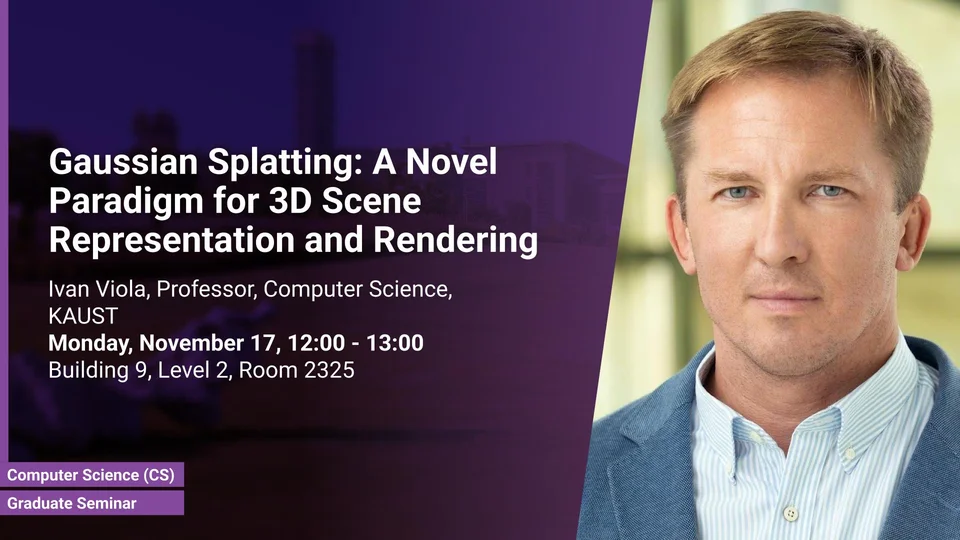
Gaussian Splatting: A Novel Paradigm for 3D Scene Representation and Rendering Ivan Viola, Professor, Computer Science Nov 17, 12:00 - 13:00 B9 L2 R2325 This talk will provide a comprehensive overview of 3D Gaussian Splatting, a novel and powerful technique for 3D scene representation and rendering.
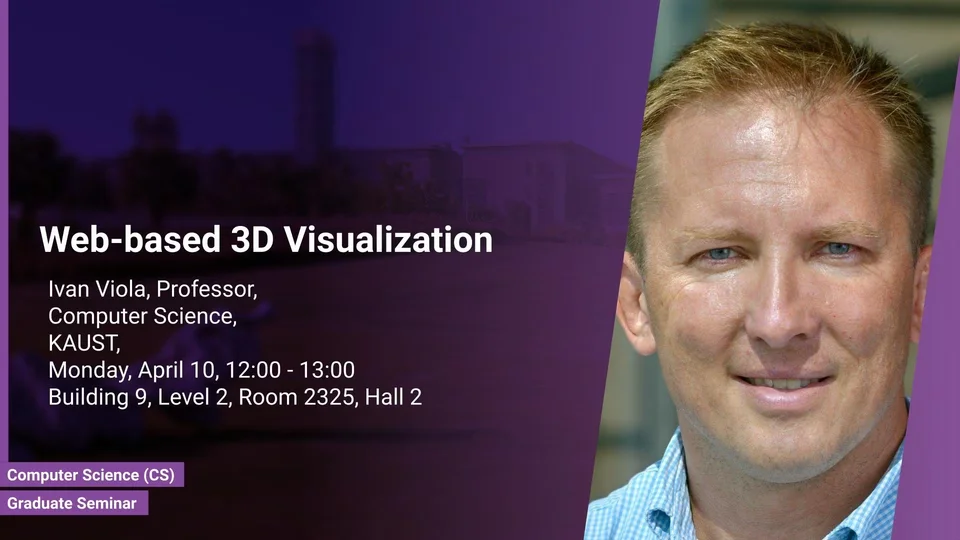
Web-based 3D Visualization Ivan Viola, Professor, Computer Science Apr 10, 12:00 - 13:00 B9 L2 H2 H2 nanovisualization computer graphics 3D graphics WebGPU WebAssmbly In this seminar I will present how to create 3D computer graphics and visualization systems for the web, using WebAssmbly and WebGPU language specifications, which are new, bleeding-edge technologies. Previously, accelerated graphics on the web was based on JavaScript libraries, which is still very popular, but they do not offer detailed memory management and code optimization, necessary for systems requiring high memory load and high computational demands. WebAssembly and WebGPU can be compiled from the C++ or Rust code, which also allows the deployment of the same codebase either for web or for the desktop-based applications.
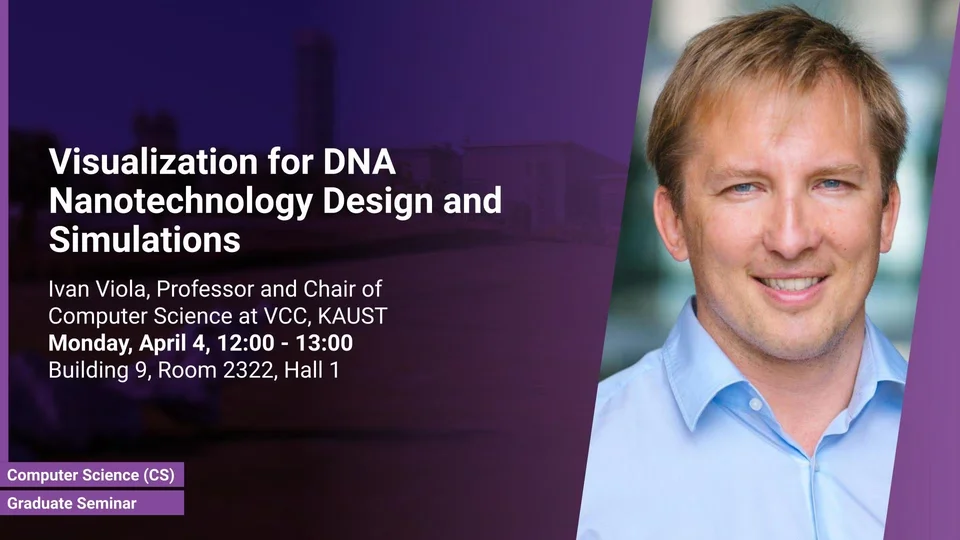
Visualization for DNA Nanotechnology Design and Simulations Ivan Viola, Professor, Computer Science Apr 4, 12:00 - 13:00 B9 R2322 H1 DNA Nanotechnology is a fascinating field that studies how to construct small biological structures entirely from DNA as a building material. The key insight is that DNA, if designed in a particular way, can construct complex 3D nanoscale structures entirely by means of self-assembly, governed by the base-pairing principle.
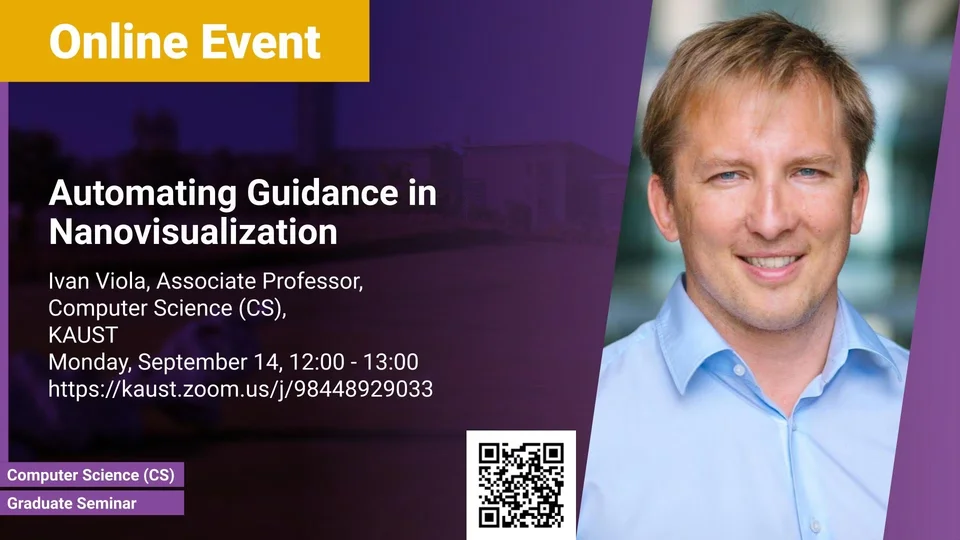
Automating Guidance in Nanovisualization - Graduate Seminar Ivan Viola, Professor, Computer Science Sep 14, 12:00 - 13:00 KAUST Research in visualization and computer graphics has developed techniques to geometrically model objects from our everyday life, or from various branches of industry and science, including modeling life-forms that are of submicron in size. These are not visible to the naked eye and most of us are unfamiliar with structures that form life organized in an assembly of biomolecules. Here visualization techniques can be of tremendous help to guide the viewers to familiarize themselves with what they see and make the engaging visual exploration of these complex structures to an intellectual enrichment.
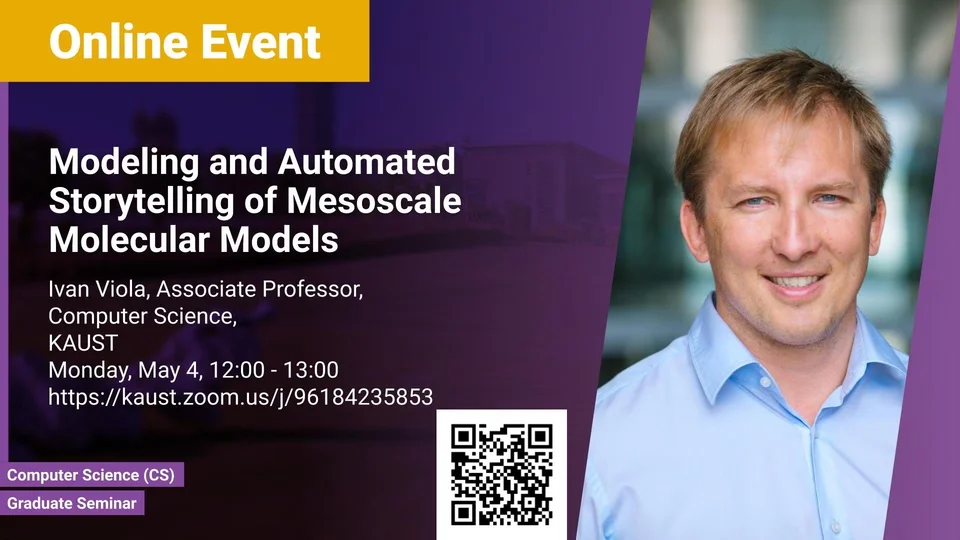
Modeling and Automated Storytelling of Mesoscale Molecular Models Ivan Viola, Professor, Computer Science May 4, 12:00 - 13:00 KAUST multi-scale 3D visualization biological models In my talk, I will present techniques that allow biologists to model a mesocale entity in a rapid way in the timeframe of a few minutes to hours. This way we have created the first complete atomistic model of the SARS-CoV-2 virion that we are these days sharing with the worldwide scientific community. Mesoscale represents a scalar gap that is currently not possible to accurately image with neither microscopy nor X-ray crystallography approaches. For this purpose, scientists characterize it by observations from the surrounding nanoscale and the microscale. From this information, it is possible to reconstruct a three-dimensional model of a biological entity with a full atomistic model. The problem is that these models are enormously large and are not possible to model with traditional methods from computer graphics within a reasonable time.
Engage ORCID KAUST Repository KAUST Academic Portal ShareClipboard Related Sites Computer Science (CS) Cell Visualization Summit (Cellvis) Nanovisualization (NANOVIS) Related Content Articles 19 Events 5 Related Links Professor Viola's Google Scholar profile