About Jan Haskovec Jan Haskovec Senior Research Scientist, Applied Mathematics and Computational Science random process transportation networks Differential equations Dynamical Systems Stochastic, partial and functional differential equations applied to study of dynamical processes in physics, biology and social sciences. Optimal transportation networks. Consensus formation with applications to engineering (swarm robotics). Events Presented Events Mar 26 - Apr 1, 2023 Mathematics of Emergent Phenomena in Networks and Collective Motion Jan Haskovec, Senior Research Scientist, Applied Mathematics and Computational Science Mar 26, 12:00 - 13:00 B9 L3 R3131 Emergence of nontrivial patterns via collective actions of many individual entities is an ever-present phenomenon in physics, biology and social sciences. It has numerous applications in engineering, for instance, in swarm robotics. I shall demonstrate how tools from mathematical modeling and analysis help us gain understanding of fundamental principles and mechanisms of emergence. I will present my recent results in consensus formation and flocking models, taking into account their realistic aspects - noise, latency, finite speed of information propagation and anticipation. Moreover, I will introduce a continuum modeling framework for biological network formation, where emergence takes place through the interaction of structure and medium. The models are formulated in terms of ordinary, stochastic and partial differential equations. I shall explain how mathematical analysis of the respective models contributes to the understanding of how individual rules generate and influence the patterns observed on the global scale. Finally, I will explain how requirements on robustness of the network can be incorporated into the mathematical model. Mar 5 - Mar 11, 2023 Functional Differential Equations in Models of Collective Behavior - Colloquium Jan Haskovec, Senior Research Scientist, Applied Mathematics and Computational Science Mar 7, 16:00 - 17:00 B4 L5 R5220 Functional Differential Equation Models collective behavioral analysis I will give an overview of recent results for models of collective behavior governed by functional differential equations. The talk will focus on models of interacting agents with applications in biology (flocking, swarming), social sciences (opinion formation) and engineering (swarm robotics), where latency (delay) plays a significant role. I will explain that there are two main sources of delay - inter-agent communications and information processing Nov 13 - Nov 19, 2022 Functional Differential Equations in Models of Collective Behavior - Graduate Seminar Jan Haskovec, Senior Research Scientist, Applied Mathematics and Computational Science Nov 15, 12:00 - 13:00 B9 L2 R2322 Functional Differential Equation The talk will give an overview of recent results for models of collective behavior governed by functional differential equations. It will focus on models of interacting agents with applications in biology (flocking, swarming), social sciences (opinion formation) and engineering (swarm robotics), where latency (delay) plays a significant role. Aug 28 - Sep 3, 2022 Emergence of transportation networks as a self-regulated process Jan Haskovec, Senior Research Scientist, Applied Mathematics and Computational Science Aug 30, 15:30 - 17:00 B1 L3 R3119 random process transportation networks In this talk, we shall explain how transportation networks emerge as a self-regulating process, with a particular focus on applications in biology (leaf venation in plants, neuronal networks in animals). We start by introducing a purely diffusive model with tensor-valued diffusivity, derived as a gradient flow of a broad class of entropy dissipations. The introduction of a prescribed electric potential leads to the Fokker-Planck equation. We show that with quadratic entropy density modeling Joule heating, the model is convex with respect to the diffusivity tensor.
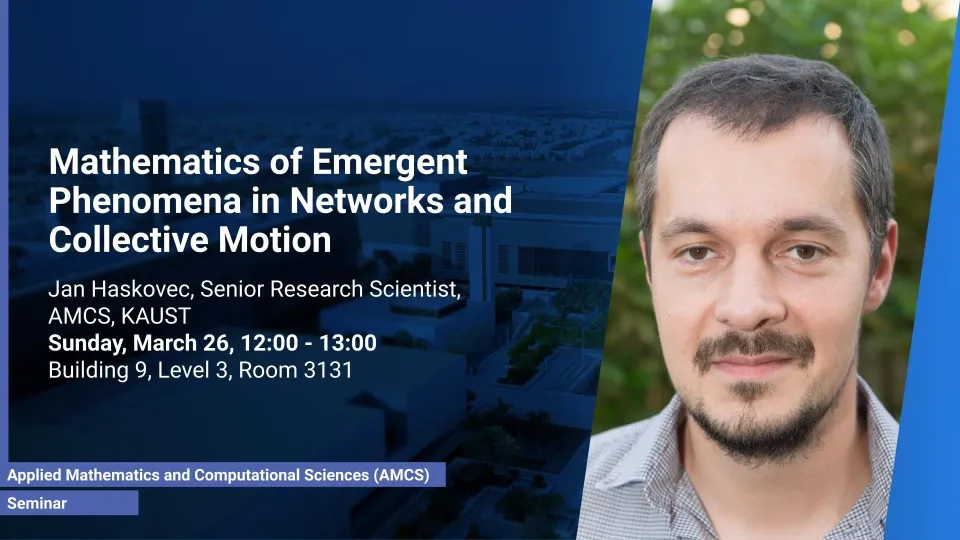
Mathematics of Emergent Phenomena in Networks and Collective Motion Jan Haskovec, Senior Research Scientist, Applied Mathematics and Computational Science Mar 26, 12:00 - 13:00 B9 L3 R3131 Emergence of nontrivial patterns via collective actions of many individual entities is an ever-present phenomenon in physics, biology and social sciences. It has numerous applications in engineering, for instance, in swarm robotics. I shall demonstrate how tools from mathematical modeling and analysis help us gain understanding of fundamental principles and mechanisms of emergence. I will present my recent results in consensus formation and flocking models, taking into account their realistic aspects - noise, latency, finite speed of information propagation and anticipation. Moreover, I will introduce a continuum modeling framework for biological network formation, where emergence takes place through the interaction of structure and medium. The models are formulated in terms of ordinary, stochastic and partial differential equations. I shall explain how mathematical analysis of the respective models contributes to the understanding of how individual rules generate and influence the patterns observed on the global scale. Finally, I will explain how requirements on robustness of the network can be incorporated into the mathematical model.
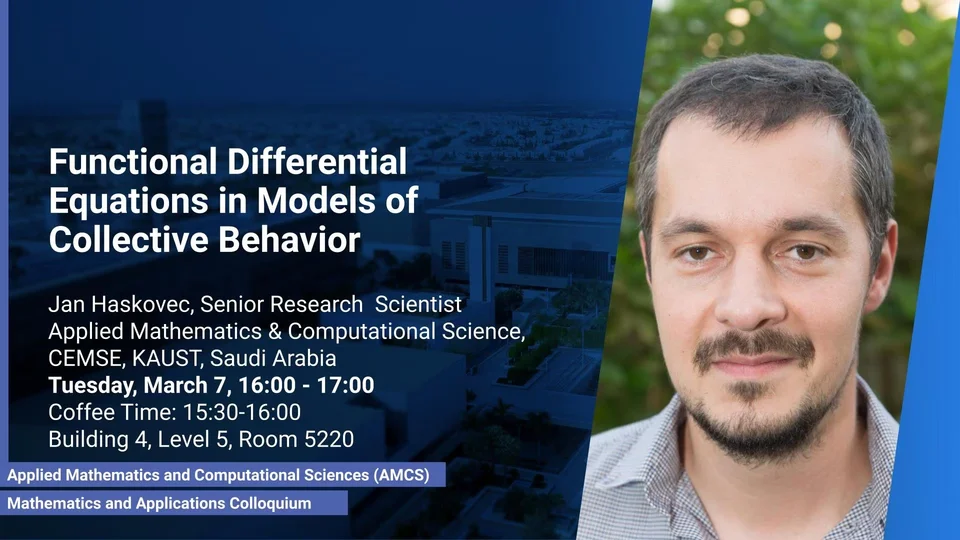
Functional Differential Equations in Models of Collective Behavior - Colloquium Jan Haskovec, Senior Research Scientist, Applied Mathematics and Computational Science Mar 7, 16:00 - 17:00 B4 L5 R5220 Functional Differential Equation Models collective behavioral analysis I will give an overview of recent results for models of collective behavior governed by functional differential equations. The talk will focus on models of interacting agents with applications in biology (flocking, swarming), social sciences (opinion formation) and engineering (swarm robotics), where latency (delay) plays a significant role. I will explain that there are two main sources of delay - inter-agent communications and information processing
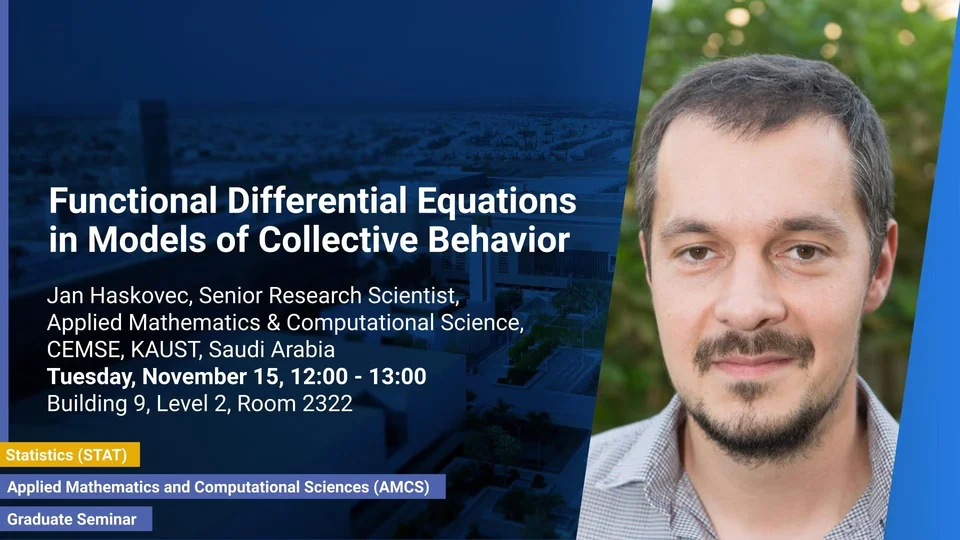
Functional Differential Equations in Models of Collective Behavior - Graduate Seminar Jan Haskovec, Senior Research Scientist, Applied Mathematics and Computational Science Nov 15, 12:00 - 13:00 B9 L2 R2322 Functional Differential Equation The talk will give an overview of recent results for models of collective behavior governed by functional differential equations. It will focus on models of interacting agents with applications in biology (flocking, swarming), social sciences (opinion formation) and engineering (swarm robotics), where latency (delay) plays a significant role.
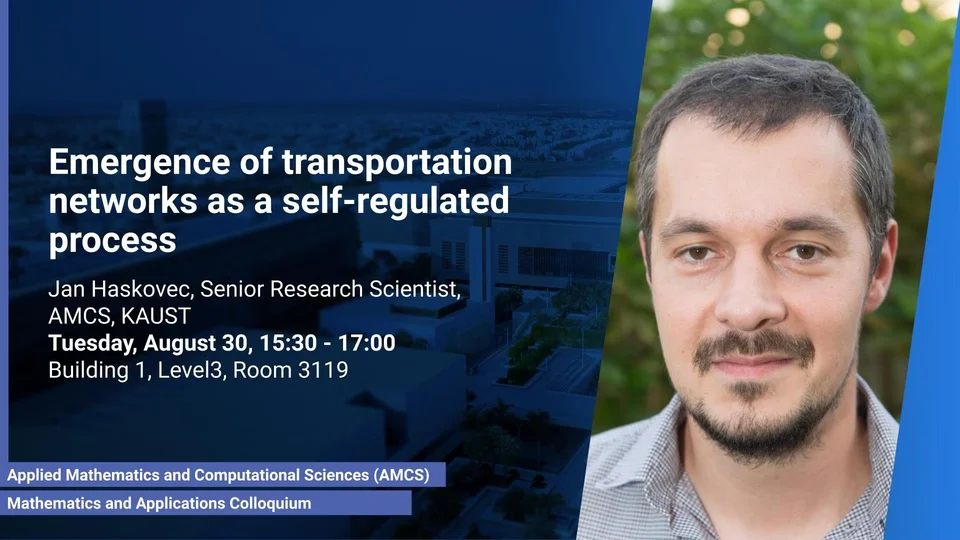
Emergence of transportation networks as a self-regulated process Jan Haskovec, Senior Research Scientist, Applied Mathematics and Computational Science Aug 30, 15:30 - 17:00 B1 L3 R3119 random process transportation networks In this talk, we shall explain how transportation networks emerge as a self-regulating process, with a particular focus on applications in biology (leaf venation in plants, neuronal networks in animals). We start by introducing a purely diffusive model with tensor-valued diffusivity, derived as a gradient flow of a broad class of entropy dissipations. The introduction of a prescribed electric potential leads to the Fokker-Planck equation. We show that with quadratic entropy density modeling Joule heating, the model is convex with respect to the diffusivity tensor.
Related Sites Applied Mathematics and Computational Science (AMCS) Related Content Events 4 Related Links Jan Haskovec list of publications on KAUST Repository Jan Haskovec profile on LinkedIn Jan Haskovec profile on Google Scholar Jan Haskovec profile on ResearchGate