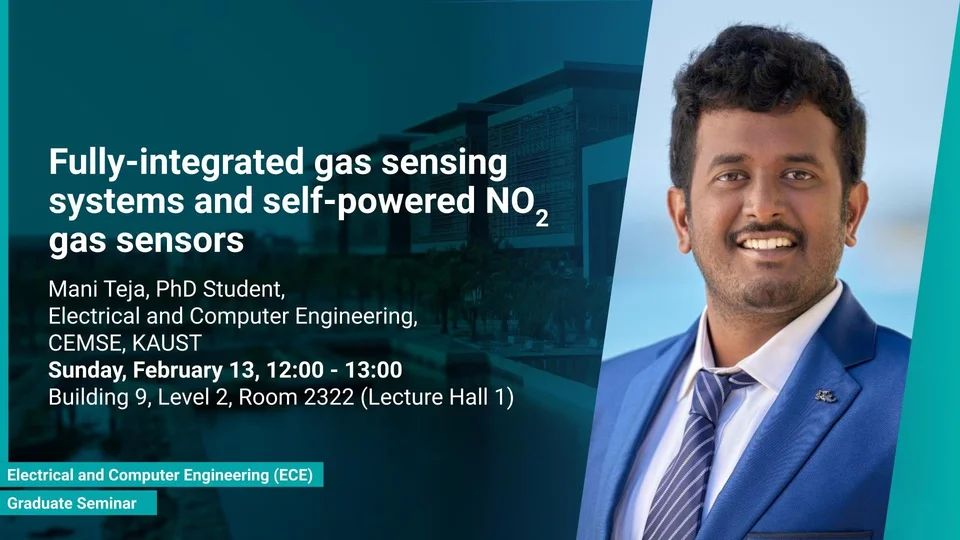
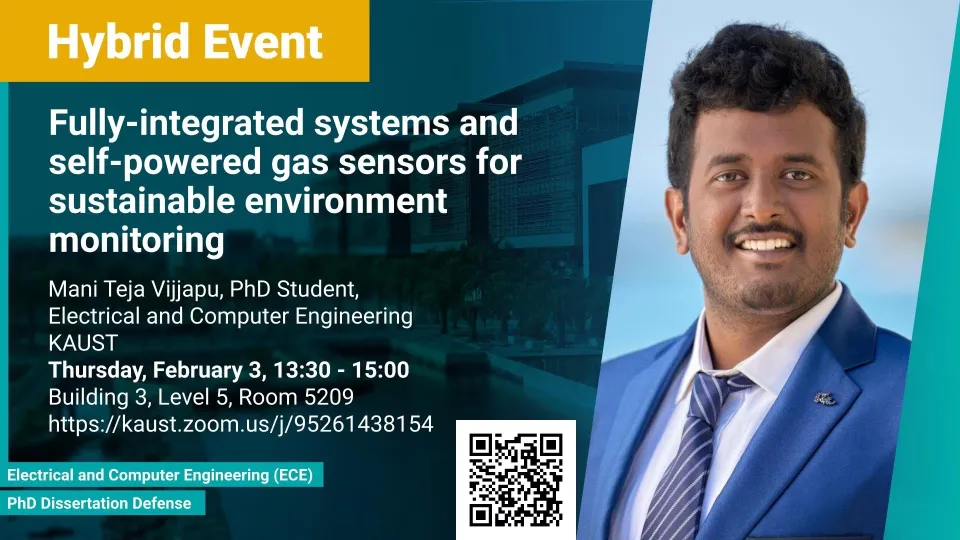
About Mani Teja Vijjapu Mani Teja Vijjapu Ph.D. Student, Electrical and Computer Engineering Gas Sensors fractional order capacitors memristors nano fabrication and characterization Mani Teja did his bachelors in Electronics and communications from Jawaharlal Technological University Anantapur, India in the year 2013. He worked as a research associate for Physical Research Laboratory, India for couple of years. He further continued to work as a research associate at IIT Madras, India. Later he pursued his masters in Solid state electronic devices from National Chiao-Tung University (NCTU), Taiwan and graduated in 2018. His Master’s thesis is focused on fabricating a binary synapse like memristor using atomic layer deposition. He did his summer internship at National Events Presented Events Feb 13 - Feb 19, 2022 Fully-integrated gas sensing systems and self-powered NO₂ gas sensors Mani Teja Vijjapu, Ph.D. Student, Electrical and Computer Engineering Feb 13, 12:00 - 13:00 B9 L2 R2322 H1 Fully integrated gas sensing systems Mobile devices for the personalized detection of health and environmental hazards are becoming the basis for futuristic sensing technologies. Jan 30 - Feb 5, 2022 Fully-integrated systems and self-powered gas sensors for sustainable environment monitoring Mani Teja Vijjapu, Ph.D. Student, Electrical and Computer Engineering Feb 3, 13:30 - 15:00 B3 L5 R5209 Mobile devices for the personalized detection of health and environmental hazards are becoming the basis for futuristic sensing technologies. In recent decades, air and environmental pollution levels have risen globally. Therefore, environmental protection must be strengthened by developing sensors that detect pollutants. The monitoring of these pollutants with high spatial coverage requires inexpensive electronic gas sensors and self-sustainable sensing systems that can be deployed everywhere. This dissertation reports on technological developments to provide solutions for inexpensive, compact, power-efficient, and easily deployable toxic gas sensors and integrated systems using semiconducting metal-oxide thin-film transistors (TFTs).
Fully-integrated gas sensing systems and self-powered NO₂ gas sensors Mani Teja Vijjapu, Ph.D. Student, Electrical and Computer Engineering Feb 13, 12:00 - 13:00 B9 L2 R2322 H1 Fully integrated gas sensing systems Mobile devices for the personalized detection of health and environmental hazards are becoming the basis for futuristic sensing technologies.
Fully-integrated systems and self-powered gas sensors for sustainable environment monitoring Mani Teja Vijjapu, Ph.D. Student, Electrical and Computer Engineering Feb 3, 13:30 - 15:00 B3 L5 R5209 Mobile devices for the personalized detection of health and environmental hazards are becoming the basis for futuristic sensing technologies. In recent decades, air and environmental pollution levels have risen globally. Therefore, environmental protection must be strengthened by developing sensors that detect pollutants. The monitoring of these pollutants with high spatial coverage requires inexpensive electronic gas sensors and self-sustainable sensing systems that can be deployed everywhere. This dissertation reports on technological developments to provide solutions for inexpensive, compact, power-efficient, and easily deployable toxic gas sensors and integrated systems using semiconducting metal-oxide thin-film transistors (TFTs).
Engage ORCID ShareClipboard Related Sites Electrical and Computer Engineering (ECE) Sensors (Sensors) Related Content Articles 2 Events 2 Related Links Research gate Google Scholar Personal Website LinkedIn