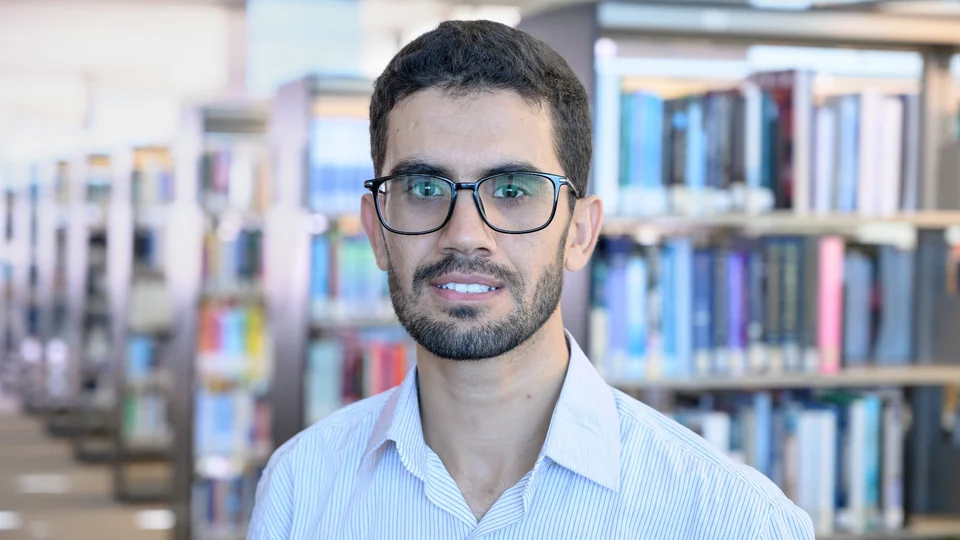
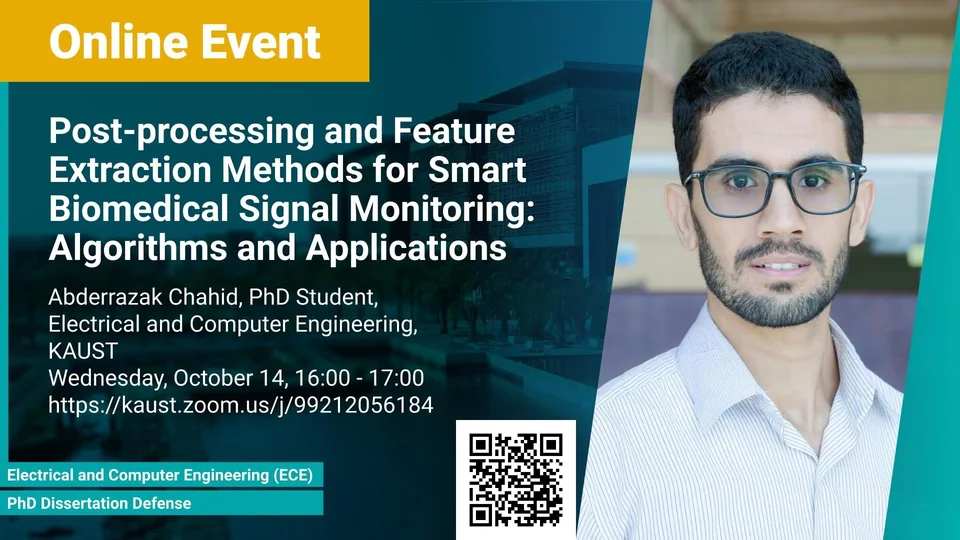
About Abderrazak Chahid Abderrazak Chahid Ph.D. Student, Electrical and Computer Engineering Signal processing machine learning image processing Deep learning optimization Abderrazak Chahid is a PhD candidate in Electrical and Computer Engineering department within CEMSE division. He obtained his Bachelor of Science degree in Electrical Engineering and Power Electronics from Sultan Moulay Slimane University in Morocco. He then got a Master degree in Electrical Engineering from the National School of Applied Sciences in Morocco before obtaining a second Master of Science degree in Embedded Systems from Lorraine University in France. Abderrazak is currently working on developing biomedical signal/image processing: MRS water suppression, MRI image denoising. He is Events Presented Events Oct 11 - Oct 17, 2020 Post-processing and Feature Extraction Methods for Smart Biomedical Signal Monitoring: Algorithms and Applications Abderrazak Chahid, Ph.D. Student, Electrical and Computer Engineering Oct 14, 16:00 - 17:00 KAUST Digital health solutions improve healthcare services and help achieve sustainable and higher standards of health and well-being. These solutions are mainly based on Digital Signal Processing (DSP) to record, interpret, and diagnose bio-signals such as Electrocardiogram (ECG) or Magnetoencephalography (MEG). In my thesis, a novel signal/image post-processing algorithm is proposed based on the Semi-Classical Signal Analysis method (SCSA) to enhance biomedical data quality. In addition, new feature extraction algorithms are proposed, based on the SCSA and the new Quantization-based Position Weight Matrix (QuPWM), which opens new tracks toward smart biomedical diagnosis and decision-making assistance in different fields such as predicting true Poly(A) regions in a DNA sequence, multiple hand gesture prediction. Jan 20 - Jan 26, 2019 Biomedical Signal Processing using the Squared Eigenfunctions of the Schrödinger Operator and Machine Learning Abderrazak Chahid, Ph.D. Student, Electrical and Computer Engineering Jan 24, 13:00 - 15:00 B1 B4 B4214 Signal processing machine learning image processing biomedicine Abstract The health of a human body is monitored through several physiological measurements such as the heart rate, the blood pressure, the oxygen saturation levels, brain activity, etc. These measurements are taken at predefined points in the body and recorded as temporal signals or colorful images. During the diagnosis phase, physicians analyze these records visually (sometimes it is not visual with the progress in medicine, better to say: sometimes visually) to take treatment decisions. These records are usually contaminated with noise. The origin of this noise may be diverse. For instance
Post-processing and Feature Extraction Methods for Smart Biomedical Signal Monitoring: Algorithms and Applications Abderrazak Chahid, Ph.D. Student, Electrical and Computer Engineering Oct 14, 16:00 - 17:00 KAUST Digital health solutions improve healthcare services and help achieve sustainable and higher standards of health and well-being. These solutions are mainly based on Digital Signal Processing (DSP) to record, interpret, and diagnose bio-signals such as Electrocardiogram (ECG) or Magnetoencephalography (MEG). In my thesis, a novel signal/image post-processing algorithm is proposed based on the Semi-Classical Signal Analysis method (SCSA) to enhance biomedical data quality. In addition, new feature extraction algorithms are proposed, based on the SCSA and the new Quantization-based Position Weight Matrix (QuPWM), which opens new tracks toward smart biomedical diagnosis and decision-making assistance in different fields such as predicting true Poly(A) regions in a DNA sequence, multiple hand gesture prediction.
Biomedical Signal Processing using the Squared Eigenfunctions of the Schrödinger Operator and Machine Learning Abderrazak Chahid, Ph.D. Student, Electrical and Computer Engineering Jan 24, 13:00 - 15:00 B1 B4 B4214 Signal processing machine learning image processing biomedicine Abstract The health of a human body is monitored through several physiological measurements such as the heart rate, the blood pressure, the oxygen saturation levels, brain activity, etc. These measurements are taken at predefined points in the body and recorded as temporal signals or colorful images. During the diagnosis phase, physicians analyze these records visually (sometimes it is not visual with the progress in medicine, better to say: sometimes visually) to take treatment decisions. These records are usually contaminated with noise. The origin of this noise may be diverse. For instance
Engage ORCID ShareClipboard Related Sites Electrical and Computer Engineering (ECE) Related Content Articles 1 Events 2 Related Links Estimation Modeling and ANalysis Group (EMANG) My personal website