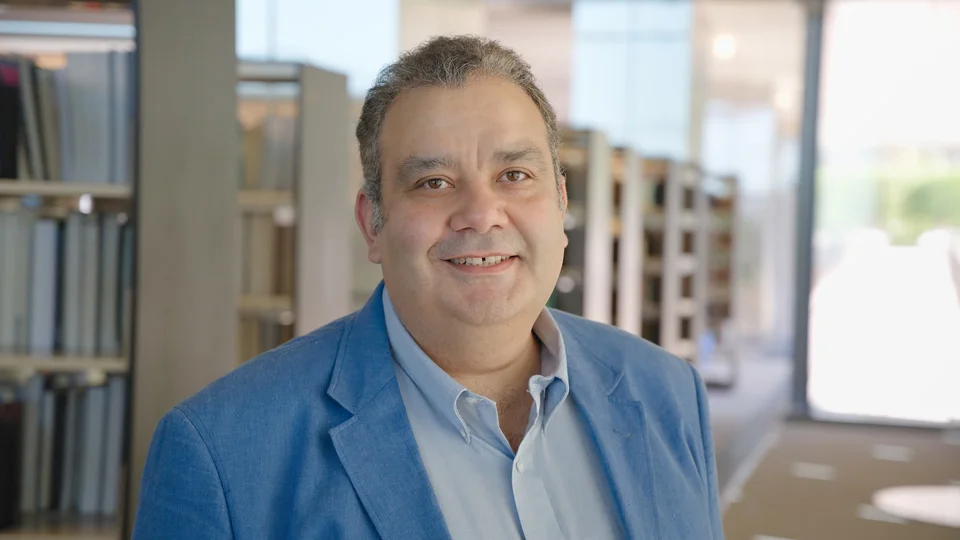
About Ahmed Eltawil Ahmed Eltawil Associate Dean for Research, Computer, Electrical and Mathematical Sciences and Engineering low power digital circuit Signal processing mobile systems embedded systems Wireless Communications Professor Eltawil is an expert in advanced wireless communications and energy-efficient computing architectures, with a particular focus on low-power mobile systems, machine-learning platforms, sensor and body area networks. His work bridges academic research and industry, translating innovative ideas into impactful technologies and successful startups. Events Presented Events Jan 22 - Jan 28, 2023 The Internet of Bodies: A Gateway to Holistic Healthcare - 2023-01-22 Ahmed Eltawil, Associate Dean for Research, Computer, Electrical and Mathematical Sciences and Engineering Jan 22, 12:00 - 13:00 B9 L2 R2322 The Internet of Bodies : The Internet of Bodies (IoBs) is an imminent extension to the vast Internet of Things domain, where wearable, ingestible, injectable, and implantable smart objects form a network in, on, and around the human body. Dec 4 - Dec 10, 2022 The Internet of Bodies: A Gateway to Holistic Healthcare - 2022-12-04 Ahmed Eltawil, Associate Dean for Research, Computer, Electrical and Mathematical Sciences and Engineering Dec 4, 12:00 - 13:00 B9 L2 R2322 H1 The Internet of Bodies The Internet of Bodies (IoBs) is an imminent extension to the vast Internet of Things domain, where wearable, ingestible, injectable, and implantable smart objects form a network in, on, and around the human body. Nov 8 - Nov 14, 2020 Developing smart systems to connect communities. Ahmed Eltawil, Associate Dean for Research, Computer, Electrical and Mathematical Sciences and Engineering Nov 8, 12:00 - 13:00 KAUST smart systems connect communities In this talk, we address fundamental questions that should be asked when contemplating future smart and connected systems, namely, How, Where and What? How can we design computing and communication nodes that best utilize resources in a way that is cognizant of both the abilities of the platform, as well as the requirements of the network? Where are the nodes deployed? By understanding the context of deployment, one can architect unique solutions that are currently unimaginable. With the transformation to diverse applications such as body area networking, critical infrastructure monitoring, precision agriculture, autonomous driving etc., the need for innovative solutions becomes even more amplified. What benefit can be inferred from the data gathered by nodes in the capacity of computing, communication and sensing? The talk will discuss how recent advances in wireless computing and communication nodes can be harnessed to serve the multitude of deployment scenarios required to empower communities of the future with smart and connected systems. Jan 26 - Feb 1, 2020 Low power approaches to communication and computing system design Ahmed Eltawil, Associate Dean for Research, Computer, Electrical and Mathematical Sciences and Engineering Jan 26, 12:00 - 13:00 B9 L2 R2322 low power communication computing system In this talk we discuss approaches to low power design for advanced communication and computing platforms. Specifically, we present the concept of cognitive power management, where contrary to common approaches that assume a 100% error free hardware, the algorithm is made aware of the statistical error performance of the underlying hardware platform. By accounting for hardware errors at the system level, the explorable power management design space is significantly expanded, leading to novel power saving schemes that deliver expected application performance at much lower power consumption. Sample case studies including LTE system design and in-memory computing platforms will be presented and discussed. Dec 1 - Dec 7, 2019 Enabling smart and connected systems Ahmed Eltawil, Associate Dean for Research, Computer, Electrical and Mathematical Sciences and Engineering Dec 1, 12:00 - 13:00 B9 L2 H1 R2322 The talk will discuss how recent advances in wireless computing and communication nodes can be harnessed to serve the multitude of deployment scenarios required to empower communities of the future with smart and connected systems. In this talk, we address fundamental questions that should be asked when contemplating future smart and connected systems, namely, How, Where and What? (1) How can we design computing and communication nodes that best utilize resources in a way that is cognizant of both the abilities of the platform, as well as the requirements of the network? (2) Where are the nodes deployed? By understanding the context of deployment, one can architect unique solutions that are currently unimaginable. With the transformation to diverse applications such as body area networking, critical infrastructure monitoring, precision agriculture, autonomous driving, etc., the need for innovative solutions becomes even more amplified. (3) What benefit can be inferred from the data gathered by nodes in the capacity of computing, communication, and sensing?
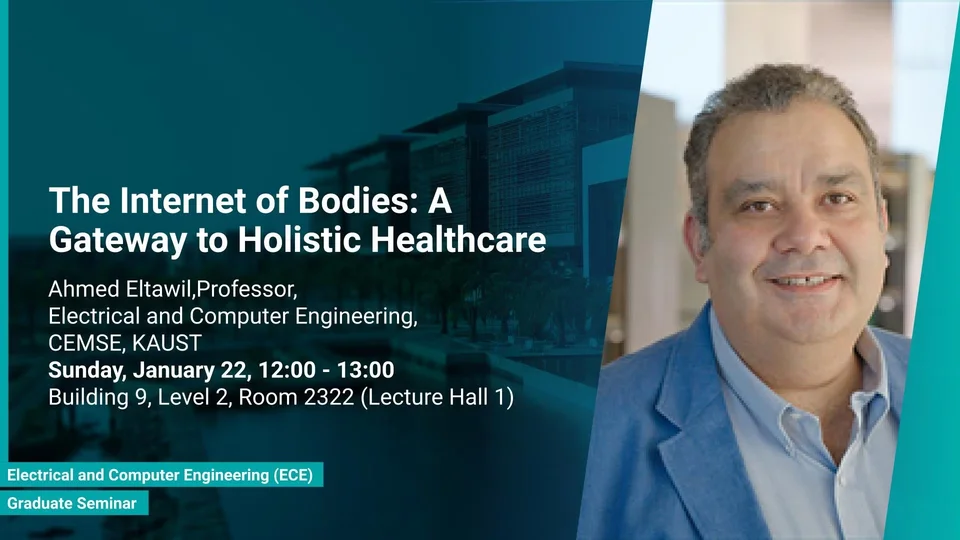
The Internet of Bodies: A Gateway to Holistic Healthcare - 2023-01-22 Ahmed Eltawil, Associate Dean for Research, Computer, Electrical and Mathematical Sciences and Engineering Jan 22, 12:00 - 13:00 B9 L2 R2322 The Internet of Bodies : The Internet of Bodies (IoBs) is an imminent extension to the vast Internet of Things domain, where wearable, ingestible, injectable, and implantable smart objects form a network in, on, and around the human body.
Ahmed Eltawil, Associate Dean for Research, Computer, Electrical and Mathematical Sciences and Engineering
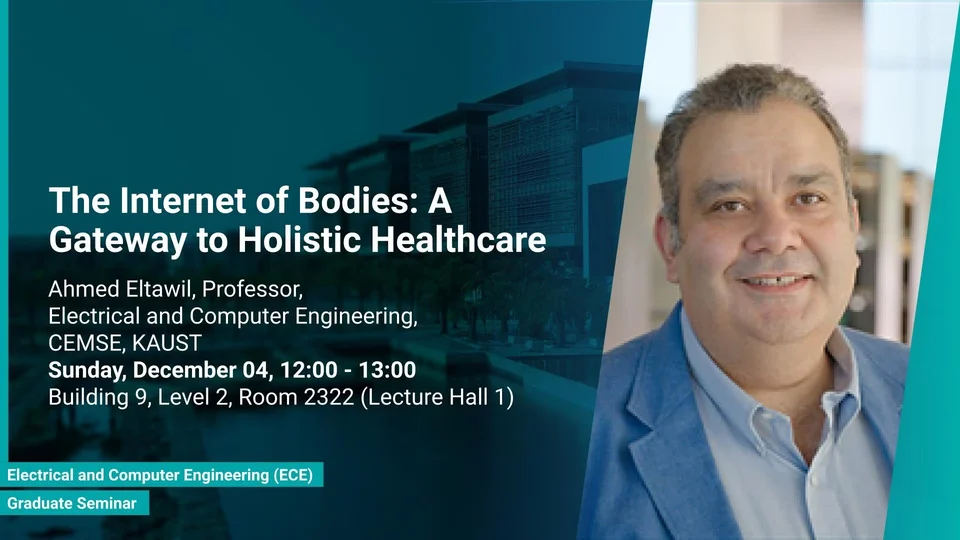
The Internet of Bodies: A Gateway to Holistic Healthcare - 2022-12-04 Ahmed Eltawil, Associate Dean for Research, Computer, Electrical and Mathematical Sciences and Engineering Dec 4, 12:00 - 13:00 B9 L2 R2322 H1 The Internet of Bodies The Internet of Bodies (IoBs) is an imminent extension to the vast Internet of Things domain, where wearable, ingestible, injectable, and implantable smart objects form a network in, on, and around the human body.
Ahmed Eltawil, Associate Dean for Research, Computer, Electrical and Mathematical Sciences and Engineering
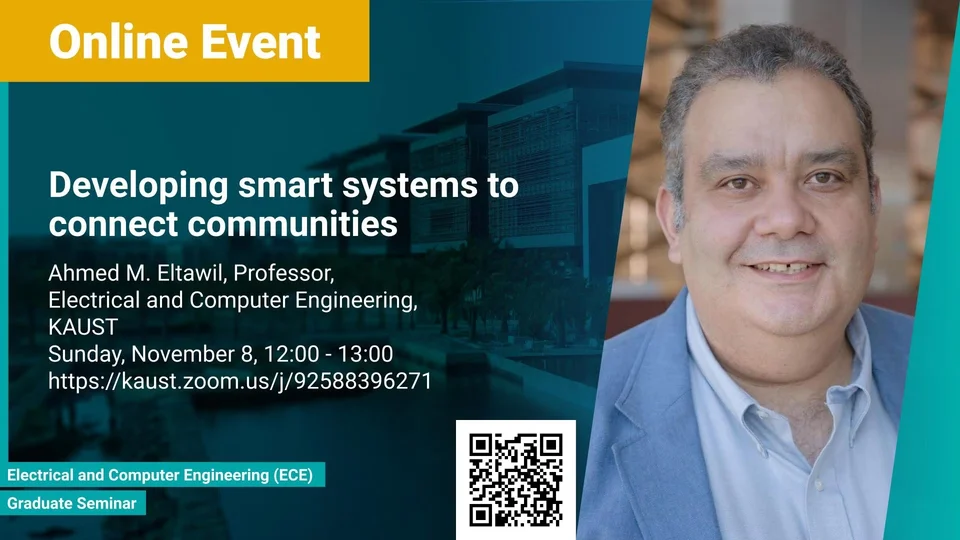
Developing smart systems to connect communities. Ahmed Eltawil, Associate Dean for Research, Computer, Electrical and Mathematical Sciences and Engineering Nov 8, 12:00 - 13:00 KAUST smart systems connect communities In this talk, we address fundamental questions that should be asked when contemplating future smart and connected systems, namely, How, Where and What? How can we design computing and communication nodes that best utilize resources in a way that is cognizant of both the abilities of the platform, as well as the requirements of the network? Where are the nodes deployed? By understanding the context of deployment, one can architect unique solutions that are currently unimaginable. With the transformation to diverse applications such as body area networking, critical infrastructure monitoring, precision agriculture, autonomous driving etc., the need for innovative solutions becomes even more amplified. What benefit can be inferred from the data gathered by nodes in the capacity of computing, communication and sensing? The talk will discuss how recent advances in wireless computing and communication nodes can be harnessed to serve the multitude of deployment scenarios required to empower communities of the future with smart and connected systems.
Ahmed Eltawil, Associate Dean for Research, Computer, Electrical and Mathematical Sciences and Engineering
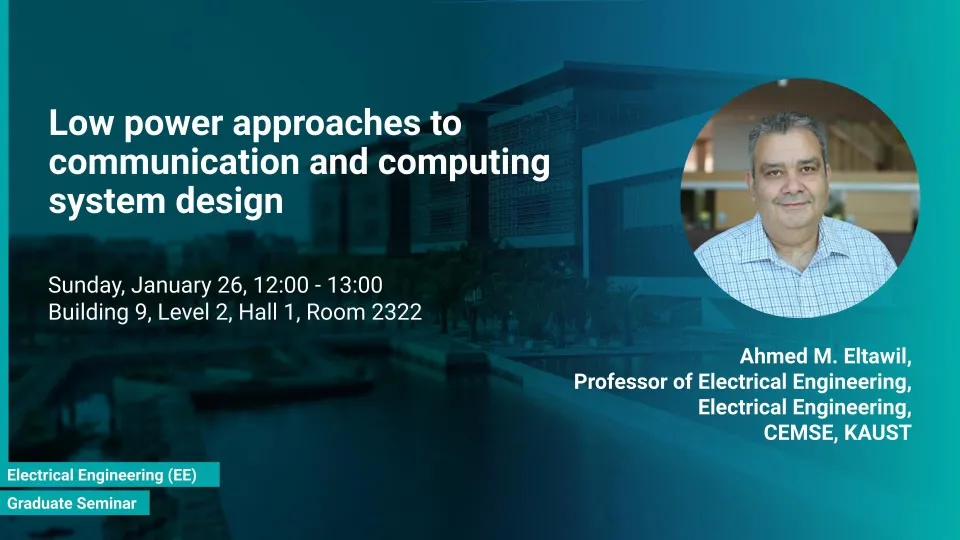
Low power approaches to communication and computing system design Ahmed Eltawil, Associate Dean for Research, Computer, Electrical and Mathematical Sciences and Engineering Jan 26, 12:00 - 13:00 B9 L2 R2322 low power communication computing system In this talk we discuss approaches to low power design for advanced communication and computing platforms. Specifically, we present the concept of cognitive power management, where contrary to common approaches that assume a 100% error free hardware, the algorithm is made aware of the statistical error performance of the underlying hardware platform. By accounting for hardware errors at the system level, the explorable power management design space is significantly expanded, leading to novel power saving schemes that deliver expected application performance at much lower power consumption. Sample case studies including LTE system design and in-memory computing platforms will be presented and discussed.
Ahmed Eltawil, Associate Dean for Research, Computer, Electrical and Mathematical Sciences and Engineering
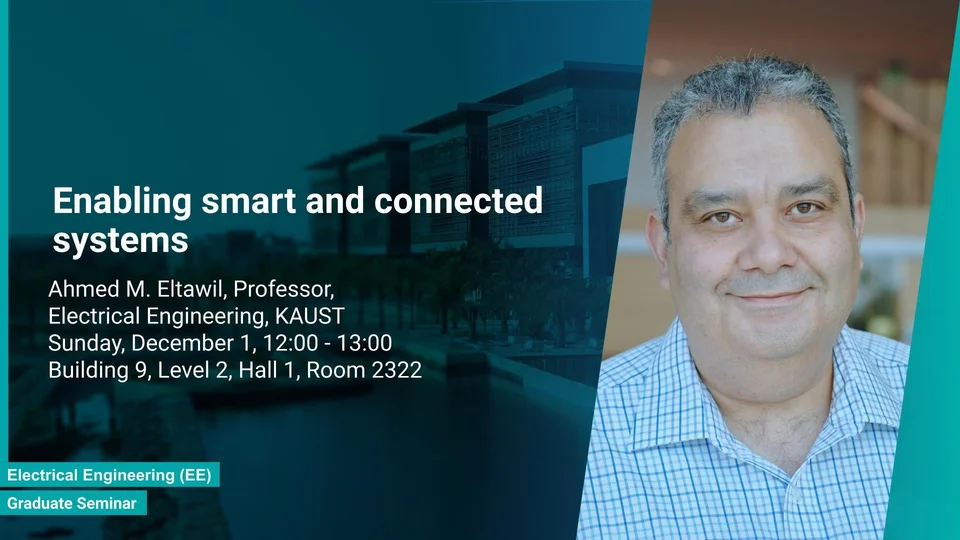
Enabling smart and connected systems Ahmed Eltawil, Associate Dean for Research, Computer, Electrical and Mathematical Sciences and Engineering Dec 1, 12:00 - 13:00 B9 L2 H1 R2322 The talk will discuss how recent advances in wireless computing and communication nodes can be harnessed to serve the multitude of deployment scenarios required to empower communities of the future with smart and connected systems. In this talk, we address fundamental questions that should be asked when contemplating future smart and connected systems, namely, How, Where and What? (1) How can we design computing and communication nodes that best utilize resources in a way that is cognizant of both the abilities of the platform, as well as the requirements of the network? (2) Where are the nodes deployed? By understanding the context of deployment, one can architect unique solutions that are currently unimaginable. With the transformation to diverse applications such as body area networking, critical infrastructure monitoring, precision agriculture, autonomous driving, etc., the need for innovative solutions becomes even more amplified. (3) What benefit can be inferred from the data gathered by nodes in the capacity of computing, communication, and sensing?
Ahmed Eltawil, Associate Dean for Research, Computer, Electrical and Mathematical Sciences and Engineering
Engage ORCID KAUST Repository KAUST Academic Portal IEEE Xplore DBLP Scopus ShareClipboard Related Sites Electrical and Computer Engineering (ECE) Communication and Computing Systems Lab (CCSL) Related Content Articles 11 Projects 18 Events 5 Related Links Publications on Google Scholar Publications on researchgate LinkedIn Profile