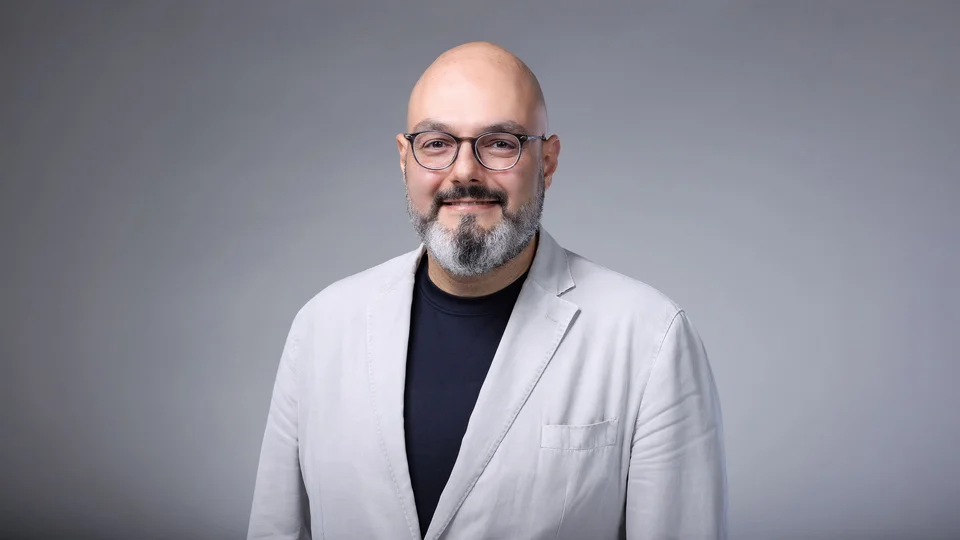
About Bernard Ghanem Bernard Ghanem Professor, Electrical and Computer Engineering semantic analysis UAV artificial intelligence machine learning Professor Ghanem's research focuses on computer vision and machine learning, emphasizing large-scale video understanding, vision for automated navigation and theoretical foundations. Events Presented Events Apr 10 - Apr 16, 2022 Six years of ActivityNet: Progress and Remaining Challenges for Temporal Activity Localization Bernard Ghanem, Professor, Electrical and Computer Engineering Apr 10, 14:00 - 16:00 B9 L2 H2 Recognizing and localizing human activities in long-form untrimmed video is one of the most important applications of computer vision. This remains a difficult problem given the many challenges inherent to untrimmed video ranging from its large-scale nature to the need for rich video representation and context modeling. In an effort to better understand this problem, ActivityNet was proposed in 2015 to provide a large-scale benchmark to train and evaluate activity localization methods. Since then, it has become a standard in the community, and its annual workshop at CVPR has become a popular venue for research groups to compete and present their newest approaches. Despite the advances in the past several years, the performance of activity localization methods in video remains limited, especially in comparison with human performance. In this colloquium, I will give a compact view of the progress made in the task of temporal activity localization, identify some key remaining challenges, and present some future directions. Feb 21 - Feb 27, 2021 On Adversarial Network Attacks, Robustness, and Certification Bernard Ghanem, Professor, Electrical and Computer Engineering Feb 25, 12:00 - 13:00 KAUST Abstract The outstanding performance of deep neural networks (DNNs), for visual recognition tasks in particular, has been demonstrated on many large-scale benchmarks. This performance has immensely strengthened the line of research that aims to understand and analyze the driving reasons behind the effectiveness of these networks. One important aspect of this analysis has gained much attention, namely the sensitivity of a DNN to perturbations. This has spawned a thrust in the research community, which focuses on developing adversarial attacks that fool a DNN, training strategies that make DNNs Nov 29 - Dec 5, 2020 Research at the Image and Video Understanding Lab (IVUL) - Graduate Seminar - CS Bernard Ghanem, Professor, Electrical and Computer Engineering Nov 30, 12:00 - 13:00 KAUST In this talk, I will give an overview of research done in the Image and Video Understanding Lab (IVUL) at KAUST. At IVUL, we work on topics that are important to the computer vision (CV) and machine learning (ML) communities, with emphasis on three research themes: Theme 1 (Video Understanding), Theme 2 (Visual Computing for Automated Navigation), Theme 3 (Fundamentals/Foundations). Sep 13 - Sep 19, 2020 Research at the Image and Video Understanding Lab (IVUL) - Graduate Seminar - ECE Bernard Ghanem, Professor, Electrical and Computer Engineering Sep 13, 12:00 - 13:00 KAUST research image Video Understanding Lab IVUL In this talk, I will give an overview of research done in the Image and Video Understanding Lab (IVUL) at KAUST. At IVUL, we work on topics that are important to the computer vision (CV) and machine learning (ML) communities, with emphasis on three research themes: Theme 1 (Video Understanding): We aim to extract meaningful semantic information from large-scale video data by tackling research problems such as object tracking, activity detection, moment retrieval, and language grounding in video. Theme 2 (Visual Computing for Automated Navigation): We develop methodology to enable more accurate, reliable, and robust perception of the visual world for automated navigation applications (e.g. self-driving cars and UAVs). In this theme, we tackle research problems such as object tracking, segmentation, and detection in 3D data, as well as transfer learning from simulation (sim2real). Theme 3 (Fundamentals/Foundations): In this theme, we tackle fundamental research problems in CV and ML that transcend specific applications with focus on deep network theory/analysis (e.g. robustness, certification, and interpretability) and structured optimization methods for large-scale CV/ML problems. Throughout the talk, I will highlight some of the interesting projects at IVUL to encourage students to get interested in the research field. Mar 29 - Apr 4, 2020 EE+CS Graduate Seminar: Deep Graph Convolutional Networks Bernard Ghanem, Professor, Electrical and Computer Engineering Mar 29, 12:00 - 13:00 KAUST Deep learning GCN In this talk, I will present a line of work done at the Image and Video Understanding Lab (IVUL), which focuses on developing deep graph convolutional networks (DeepGCNs). A GCN is a deep learning network that processes generic graph inputs, thus extending the impact of deep learning to irregular grid data including 3D point clouds and meshes, social graphs, protein interaction graphs, etc. By adapting architectural operations from the CNN realm and reformulating them for graphs, we were the first to show that GCNs can go as deep as CNNs. Developing such a high capacity deep learning platform for generic graphs opens up many opportunities for exciting research, which spans applications in the field of computer vision and beyond, architecture design, and theory. In this talk, I will showcase some of the GCN research done at IVUL and highlight some interesting research questions for future work. Feb 10 - Feb 16, 2019 ML Hub Seminar Series | The Machine Learning (ML) Hub Bernard Ghanem, Professor, Electrical and Computer Engineering Feb 13, 12:00 - 13:00 B9 H2 R2325 machine learning The Machine Learning Hub @ KAUST is designed to be the one-stop-shop for machine learning (ML) and artificial intelligence (AI) at KAUST. It is an informal forum for exchanging ideas in these areas, including (but not limited to) theoretical foundations, systems, tools, and applications. It will be providing several offerings to the KAUST community interested in ML and AI, including a regular seminar series where new research in the field is presented, an online social forum dedicated to AI and ML discussions, announcements, brainstorming, collaborations, and hands-on activities (e.g
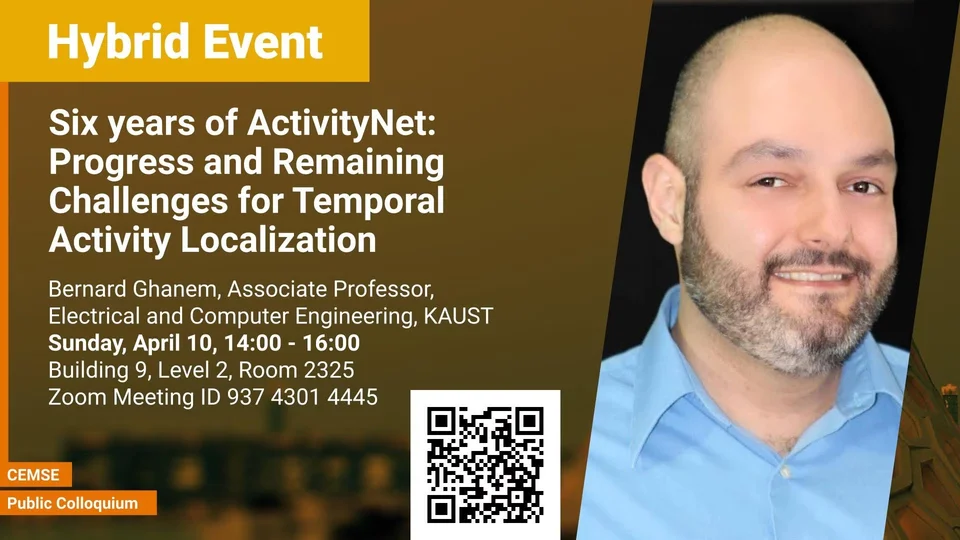
Six years of ActivityNet: Progress and Remaining Challenges for Temporal Activity Localization Bernard Ghanem, Professor, Electrical and Computer Engineering Apr 10, 14:00 - 16:00 B9 L2 H2 Recognizing and localizing human activities in long-form untrimmed video is one of the most important applications of computer vision. This remains a difficult problem given the many challenges inherent to untrimmed video ranging from its large-scale nature to the need for rich video representation and context modeling. In an effort to better understand this problem, ActivityNet was proposed in 2015 to provide a large-scale benchmark to train and evaluate activity localization methods. Since then, it has become a standard in the community, and its annual workshop at CVPR has become a popular venue for research groups to compete and present their newest approaches. Despite the advances in the past several years, the performance of activity localization methods in video remains limited, especially in comparison with human performance. In this colloquium, I will give a compact view of the progress made in the task of temporal activity localization, identify some key remaining challenges, and present some future directions.
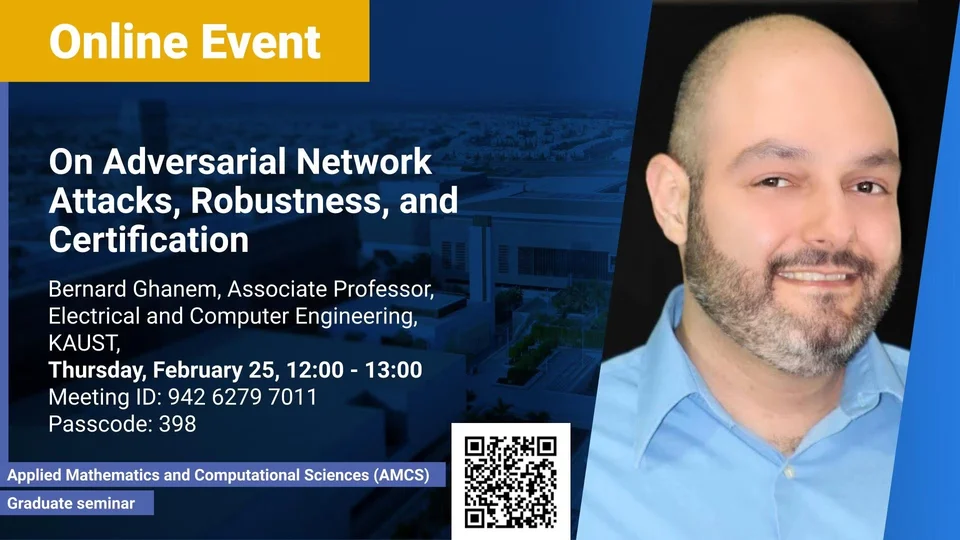
On Adversarial Network Attacks, Robustness, and Certification Bernard Ghanem, Professor, Electrical and Computer Engineering Feb 25, 12:00 - 13:00 KAUST Abstract The outstanding performance of deep neural networks (DNNs), for visual recognition tasks in particular, has been demonstrated on many large-scale benchmarks. This performance has immensely strengthened the line of research that aims to understand and analyze the driving reasons behind the effectiveness of these networks. One important aspect of this analysis has gained much attention, namely the sensitivity of a DNN to perturbations. This has spawned a thrust in the research community, which focuses on developing adversarial attacks that fool a DNN, training strategies that make DNNs
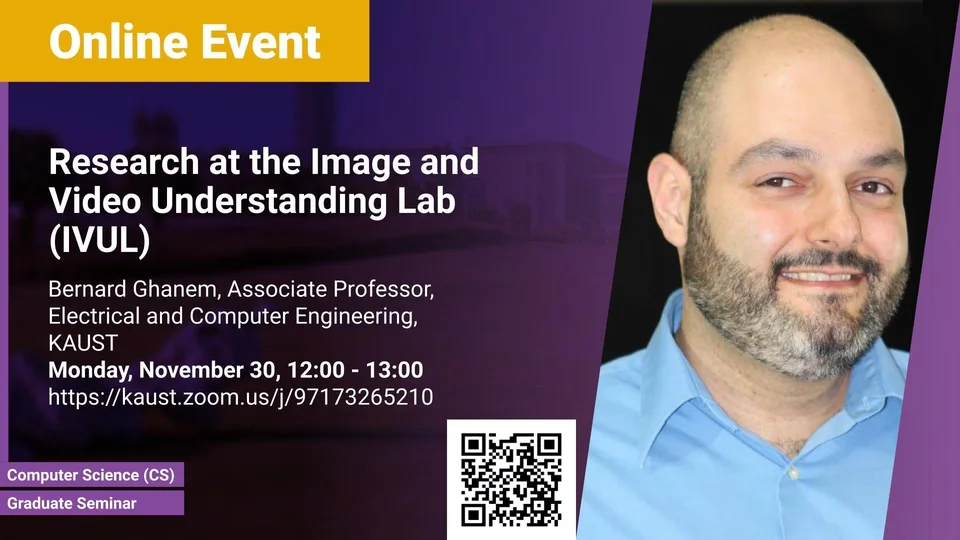
Research at the Image and Video Understanding Lab (IVUL) - Graduate Seminar - CS Bernard Ghanem, Professor, Electrical and Computer Engineering Nov 30, 12:00 - 13:00 KAUST In this talk, I will give an overview of research done in the Image and Video Understanding Lab (IVUL) at KAUST. At IVUL, we work on topics that are important to the computer vision (CV) and machine learning (ML) communities, with emphasis on three research themes: Theme 1 (Video Understanding), Theme 2 (Visual Computing for Automated Navigation), Theme 3 (Fundamentals/Foundations).
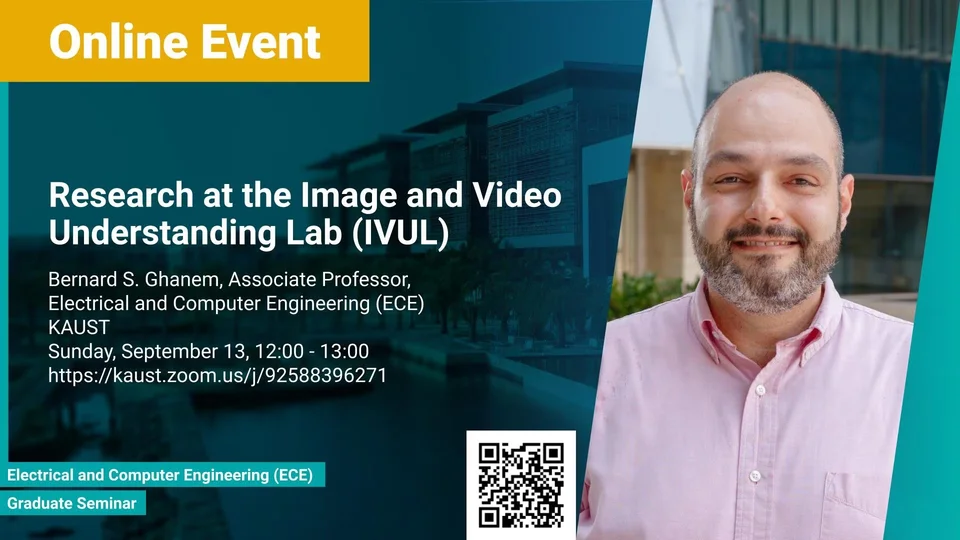
Research at the Image and Video Understanding Lab (IVUL) - Graduate Seminar - ECE Bernard Ghanem, Professor, Electrical and Computer Engineering Sep 13, 12:00 - 13:00 KAUST research image Video Understanding Lab IVUL In this talk, I will give an overview of research done in the Image and Video Understanding Lab (IVUL) at KAUST. At IVUL, we work on topics that are important to the computer vision (CV) and machine learning (ML) communities, with emphasis on three research themes: Theme 1 (Video Understanding): We aim to extract meaningful semantic information from large-scale video data by tackling research problems such as object tracking, activity detection, moment retrieval, and language grounding in video. Theme 2 (Visual Computing for Automated Navigation): We develop methodology to enable more accurate, reliable, and robust perception of the visual world for automated navigation applications (e.g. self-driving cars and UAVs). In this theme, we tackle research problems such as object tracking, segmentation, and detection in 3D data, as well as transfer learning from simulation (sim2real). Theme 3 (Fundamentals/Foundations): In this theme, we tackle fundamental research problems in CV and ML that transcend specific applications with focus on deep network theory/analysis (e.g. robustness, certification, and interpretability) and structured optimization methods for large-scale CV/ML problems. Throughout the talk, I will highlight some of the interesting projects at IVUL to encourage students to get interested in the research field.
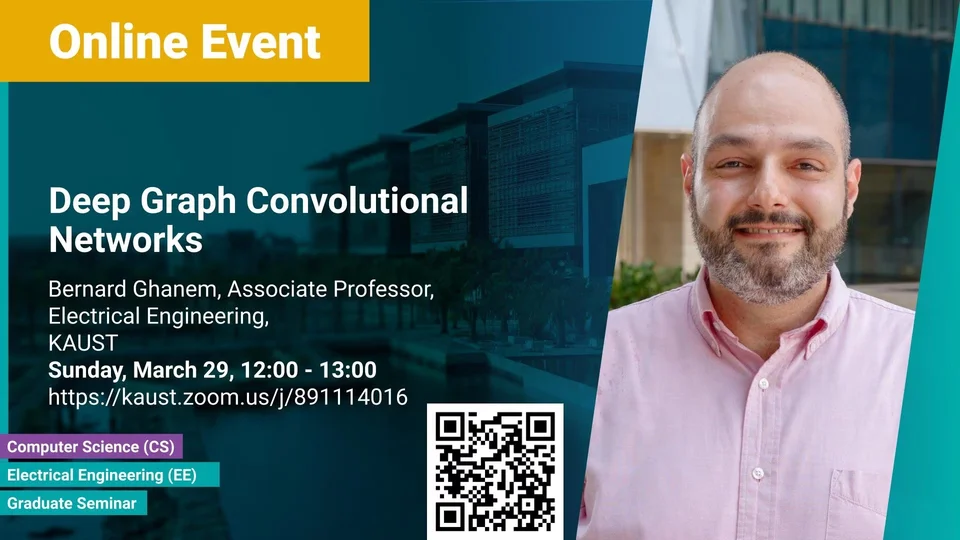
EE+CS Graduate Seminar: Deep Graph Convolutional Networks Bernard Ghanem, Professor, Electrical and Computer Engineering Mar 29, 12:00 - 13:00 KAUST Deep learning GCN In this talk, I will present a line of work done at the Image and Video Understanding Lab (IVUL), which focuses on developing deep graph convolutional networks (DeepGCNs). A GCN is a deep learning network that processes generic graph inputs, thus extending the impact of deep learning to irregular grid data including 3D point clouds and meshes, social graphs, protein interaction graphs, etc. By adapting architectural operations from the CNN realm and reformulating them for graphs, we were the first to show that GCNs can go as deep as CNNs. Developing such a high capacity deep learning platform for generic graphs opens up many opportunities for exciting research, which spans applications in the field of computer vision and beyond, architecture design, and theory. In this talk, I will showcase some of the GCN research done at IVUL and highlight some interesting research questions for future work.
ML Hub Seminar Series | The Machine Learning (ML) Hub Bernard Ghanem, Professor, Electrical and Computer Engineering Feb 13, 12:00 - 13:00 B9 H2 R2325 machine learning The Machine Learning Hub @ KAUST is designed to be the one-stop-shop for machine learning (ML) and artificial intelligence (AI) at KAUST. It is an informal forum for exchanging ideas in these areas, including (but not limited to) theoretical foundations, systems, tools, and applications. It will be providing several offerings to the KAUST community interested in ML and AI, including a regular seminar series where new research in the field is presented, an online social forum dedicated to AI and ML discussions, announcements, brainstorming, collaborations, and hands-on activities (e.g
Engage KAUST Repository Scopus Web of Science ORCID DBLP IEEE Xplore LinkedIn ShareClipboard Related Sites Electrical and Computer Engineering (ECE) Computer Science (CS) Image and Video Understanding Lab (IVUL) Center of Excellence for Generative AI (GenAI) Related Content Articles 71 Events 6 Related Links Bernard Ghanem list of publications on Google Scholar Bernard Ghanem's personal website