About Jung-Wook Min Jung-Wook Min Research Scientist, Photonics Laboratory nanomaterials GaN Photonics and optoelectronics molecular beam epitaxy Large bandgap group-III nitride Introduction Jung-Wook Min is a Research Scientist at Photonics Laboratory in the Division of Computer, Electrical and Mathematical Science and Engineering (CEMSE) at King Abdullah University of Science and Technology (KAUST). He received his M.S. and a Ph.D. degree in the Department of Physics and Photon Science at Gwangju Institute of Science and Technology (GIST), Republic of Korea, in 2012 and 2016. He has 10 years of hands-on experiences of refurbishment, modification and maintenance of various type of III-N and III-As/P MBE chambers and has been focused on the epitaxial growth of III Articles Related News March 2021 Huafan Zhang's tutorial article was selected as an Editor's Pick 1 min read · Fri, Mar 26 2021 News Huafan Zhang, a Ph.D. student at KAUST Photonics Laboratory recently published her comprehensive tutorial article in AIP's Journal of Applied Physics. The article titled "InGaN-based nanowires development for energy harvesting and conversion applications" was selected as the Editor's Pick. The tutorial "teaches the essential development of nitrogen-plasma-assisted molecular-beam-epitaxy grown InGaN nanowires as an application-inspired platform for energy harvesting and conversion applications by growing dislocation- and strain-relieved axial InGaN-based nanowires." The article is featured July 2018 Semiconductor Today features "KAUST demonstrates nanowire GRINSCH diode for efficient UV-LED/laser applications" 1 min read · Mon, Jul 23 2018 News "AlGaN-based light-emitting devices are promising ultraviolet light sources to replace the existing UV gas lasers and UV lamps containing toxic substances (mercury). However, the performance of AlGaN-based UV emitters are limited, and in particular high-power UV laser diodes (emitting below 330nm) have not yet been reported. Moreover, the threshold operating voltages of reported UV laser diodes (>330nm) are quite high, surpassing 25V in lasing mode with high series resistance due to poor hole injection efficiency." "These limitations in device performance are attributed to several factors such
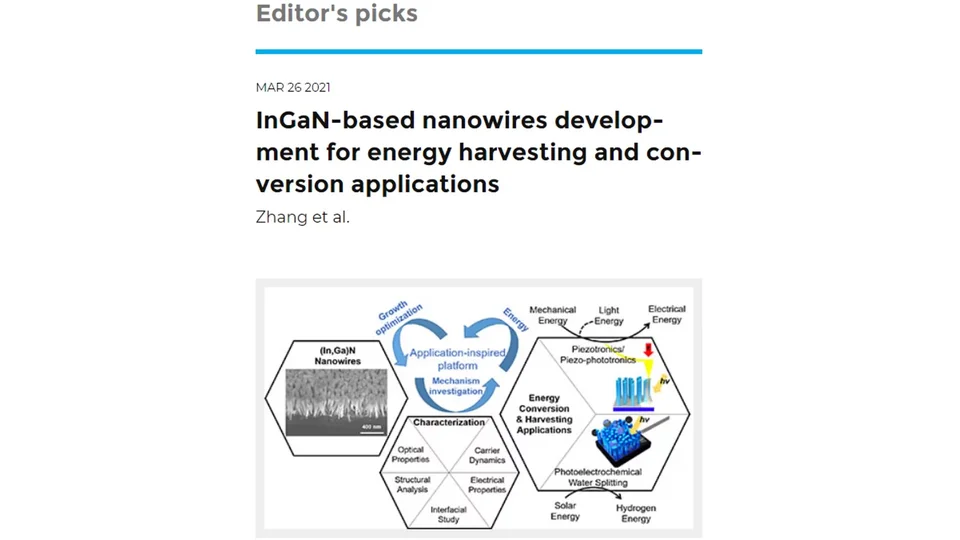
Huafan Zhang's tutorial article was selected as an Editor's Pick 1 min read · Fri, Mar 26 2021 News Huafan Zhang, a Ph.D. student at KAUST Photonics Laboratory recently published her comprehensive tutorial article in AIP's Journal of Applied Physics. The article titled "InGaN-based nanowires development for energy harvesting and conversion applications" was selected as the Editor's Pick. The tutorial "teaches the essential development of nitrogen-plasma-assisted molecular-beam-epitaxy grown InGaN nanowires as an application-inspired platform for energy harvesting and conversion applications by growing dislocation- and strain-relieved axial InGaN-based nanowires." The article is featured
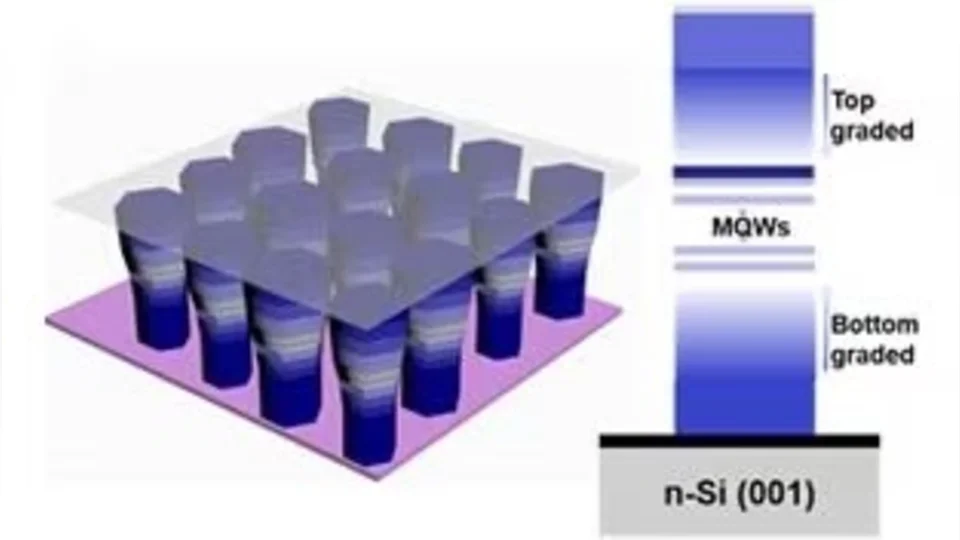
Semiconductor Today features "KAUST demonstrates nanowire GRINSCH diode for efficient UV-LED/laser applications" 1 min read · Mon, Jul 23 2018 News "AlGaN-based light-emitting devices are promising ultraviolet light sources to replace the existing UV gas lasers and UV lamps containing toxic substances (mercury). However, the performance of AlGaN-based UV emitters are limited, and in particular high-power UV laser diodes (emitting below 330nm) have not yet been reported. Moreover, the threshold operating voltages of reported UV laser diodes (>330nm) are quite high, surpassing 25V in lasing mode with high series resistance due to poor hole injection efficiency." "These limitations in device performance are attributed to several factors such
Related Sites Electrical and Computer Engineering (ECE) Photonics Laboratory (Photonics) Related Content Articles 2 Events 1