About Liang Chen Liang Chen Research Scientist, Electrical and Computer Engineering computational physics electromagnetics electronic transport nanostructures photoconductive antennas Education Ph.D., Microelectronics and Solid-State Electronics, Shanghai Institute of Microsystem and Information Technology (SIMIT), Chinese Academy of Sciences (CAS), Shanghai, China, 2012 M.S., Microelectronics and Solid-State Electronics, Shanghai Institute of Microsystem and Information Technology (SIMIT), Chinese Academy of Sciences (CAS), Shanghai, China, 2009 B.S., Applied Physics, Southeast University, Nanjing, China, 2007 Professional Appointments Postdoctoral Research Fellow in Electrical and Computer Engineering, Division of Computer, Electrical and Mathematical Science and Events Presented Events Sep 12 - Sep 18, 2021 Multiphysics Simulation of Semiconductor Optoelectronic Devices Liang Chen, Research Scientist, Electrical and Computer Engineering Sep 12, 12:00 - 13:00 KAUST Multiphysics Simulation In this talk, I will introduce a simulator specifically formulated and implemented for photoconductive terahertz devices enhanced with nanostructures. The fundamental challenge in formulating this simulator is the rigorous modeling of the coupling mentioned above. My talk will focus on this aspect as well as the general concerns in building mathematical models for various physical processes and their numerical discretization. To this end, I will introduce a discontinuous Galerkin framework that can efficiently discretize the multiscale mathematical models formulated for coupled semiconductor physics and electromagnetics. Furthermore, I will present numerical results which demonstrate the applicability of this framework in characterizations of photoconductive terahertz antennas and photomixers. Apr 7 - Apr 13, 2019 Multiphysics Simulation of Semiconductor-based Terahertz Devices Liang Chen, Research Scientist, Electrical and Computer Engineering Apr 7, 12:00 - 13:00 B9 H1 computational physics electromagnetics electronic transport nanostructures photoconductive antennas Semiconductor-based terahertz (THz) devices such as photoconductive antennas (PCAs) and photomixers (PMs) are widely studied as promising candidates of THz source generation and signal detection. Recent experimental research has shown that using nanostructures in the design of these devices dramatically enhances their optical-to-THz conversion efficiency, possibly allowing their use in widespread industrial applications. However, the nanostructures also increase the complexity of design and fabrication.
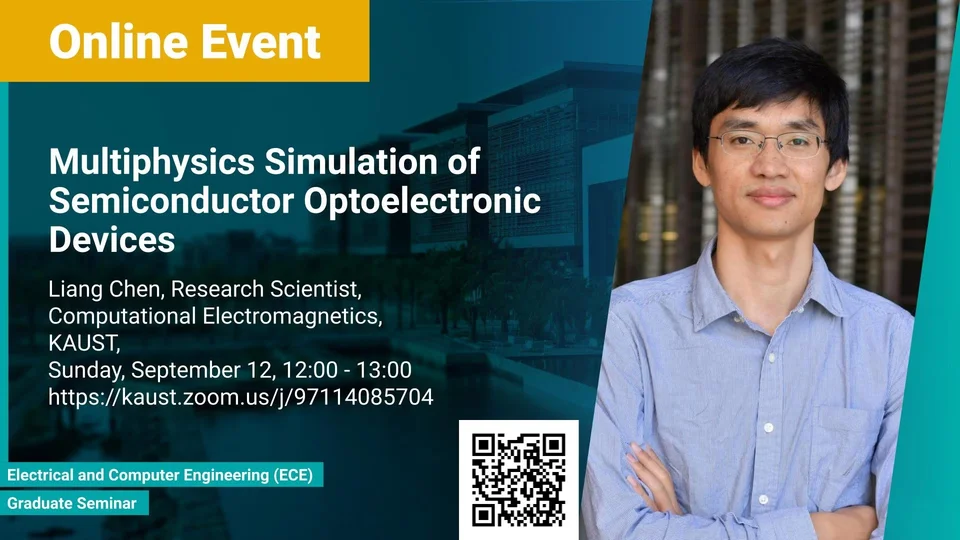
Multiphysics Simulation of Semiconductor Optoelectronic Devices Liang Chen, Research Scientist, Electrical and Computer Engineering Sep 12, 12:00 - 13:00 KAUST Multiphysics Simulation In this talk, I will introduce a simulator specifically formulated and implemented for photoconductive terahertz devices enhanced with nanostructures. The fundamental challenge in formulating this simulator is the rigorous modeling of the coupling mentioned above. My talk will focus on this aspect as well as the general concerns in building mathematical models for various physical processes and their numerical discretization. To this end, I will introduce a discontinuous Galerkin framework that can efficiently discretize the multiscale mathematical models formulated for coupled semiconductor physics and electromagnetics. Furthermore, I will present numerical results which demonstrate the applicability of this framework in characterizations of photoconductive terahertz antennas and photomixers.
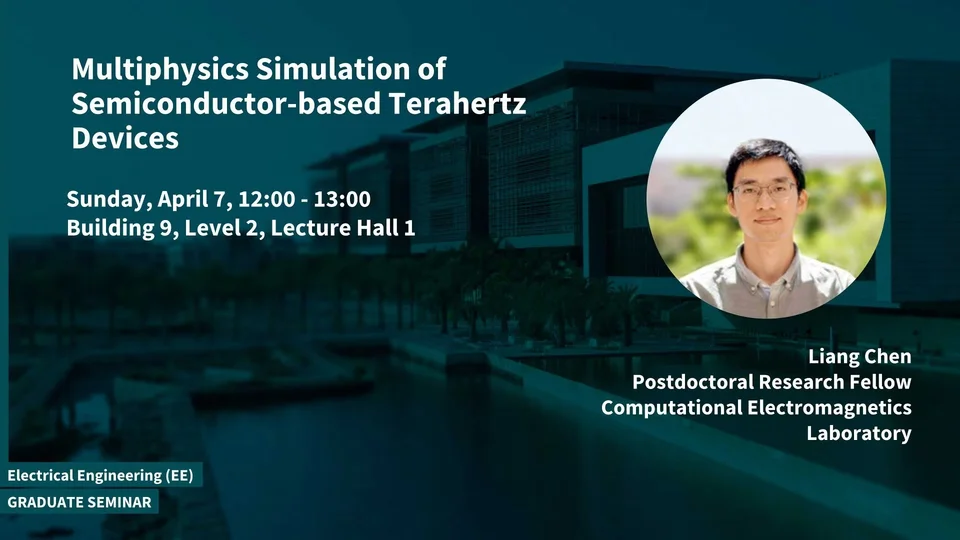
Multiphysics Simulation of Semiconductor-based Terahertz Devices Liang Chen, Research Scientist, Electrical and Computer Engineering Apr 7, 12:00 - 13:00 B9 H1 computational physics electromagnetics electronic transport nanostructures photoconductive antennas Semiconductor-based terahertz (THz) devices such as photoconductive antennas (PCAs) and photomixers (PMs) are widely studied as promising candidates of THz source generation and signal detection. Recent experimental research has shown that using nanostructures in the design of these devices dramatically enhances their optical-to-THz conversion efficiency, possibly allowing their use in widespread industrial applications. However, the nanostructures also increase the complexity of design and fabrication.
Engage ORCID ShareClipboard Related Sites Electrical and Computer Engineering (ECE) Computational Electromagnetics (CEM) Related Content Events 2 Related Links Google Scholar ORCID Computational Electromagnetics Group Computational Electromagnetics Group