About Mikhail Moshkov Mikhail Moshkov Professor, Applied Mathematics and Computational Science machine learning data mining discrete optimization algorithmic complexity Professor Moshkov specializes in various areas of discrete applied mathematics, theoretical computer science and operations research. He is the author or co-author of more than 200 research publications, including 10 books published by Springer. Events Presented Events Mar 16 - Mar 22, 2025 Extensions of Dynamic Programming for Combinatorial Optimization and Data Mining Mikhail Moshkov, Professor, Applied Mathematics and Computational Science Mar 20, 12:00 - 13:00 B9, L2, R2325 Dynamic programming is an efficient technique to solve optimization problems. It is based on decomposing the initial problem into simpler ones and solving these sub-problems beginning from the simplest ones. A conventional dynamic programming algorithm returns an optimal object from a given set of objects. Jan 21 - Jan 27, 2024 Decision Trees for Fault Diagnosis in Circuits and Switching Networks Mikhail Moshkov, Professor, Applied Mathematics and Computational Science Jan 22, 11:30 - 12:30 B9 L2 H2325 decision trees switching networks We study theoretical problems of fault diagnosis in circuits and switching networks, which are among the most fundamental models for computing Boolean functions. Sep 24 - Sep 30, 2023 Decision Trees for Fault Diagnosis in Circuits and Switching Networks - 2023-09-28 Mikhail Moshkov, Professor, Applied Mathematics and Computational Science Sep 28, 12:00 - 13:00 B9 L2 H2 We study theoretical problems of fault diagnosis in circuits and switching networks, which are among the most fundamental models for computing Boolean functions. Mar 12 - Mar 18, 2023 Decision Trees for Fault Diagnosis in Circuits and Switching Networks - 2023-03-13 Mikhail Moshkov, Professor, Applied Mathematics and Computational Science Mar 13, 12:00 - 13:00 B9 L3 R3128 We study theoretical problems of fault diagnosis in circuits and switching networks, which are among the most fundamental models for computing Boolean functions. We investigate two main cases: when the scheme (circuit or switching network) has the same mode of operation for both calculation and diagnostics, and when the scheme has two modes of operation -normal for calculation and special for diagnostics. Oct 2 - Oct 8, 2022 Extensions of Dynamic Programming for Combinatorial Optimization and Data Mining - 2022-10-04 Mikhail Moshkov, Professor, Applied Mathematics and Computational Science Oct 4, 12:00 - 13:00 B9 L2 R2322 Dynamic programming combinatorial optimization data mining Dynamic programming is an efficient technique to solve optimization problems. It is based on decomposing the initial problem into simpler ones and solving these sub-problems beginning from the simplest ones. A conventional dynamic programming algorithm returns an optimal object from a given set of objects. Feb 27 - Mar 5, 2022 Extensions of Dynamic Programming for Combinatorial Optimization and Data Mining - 2022-03-03 Mikhail Moshkov, Professor, Applied Mathematics and Computational Science Mar 3, 12:00 - 13:00 B9 L2 H2 Dynamic programming is an efficient technique to solve optimization problems. It is based on decomposing the initial problem into simpler ones and solving these sub-problems beginning from the simplest ones. A conventional dynamic programming algorithm returns an optimal object from a given set of objects. We developed extensions of dynamic programming which allow us (i) to describe the set of objects under consideration, (ii) to perform a multi-stage optimization of objects relative to different criteria, (iii) to count the number of optimal objects, (iv) to find the set of Pareto optimal points for the bi-criteria optimization problem, and (v) to study the relationships between two criteria. The considered applications include optimization of decision trees and decision rule systems as algorithms for problem-solving, as ways for knowledge representation, and as classifiers, optimization of element partition trees for rectangular meshes which are used in finite element methods for solving PDEs, and multi-stage optimization for such classic combinatorial optimization problems as matrix chain multiplication, binary search trees, global sequence alignment, and shortest paths. Jan 23 - Jan 29, 2022 Extensions of Dynamic Programming for Combinatorial Optimization and Data Mining - 2022-01-24 Mikhail Moshkov, Professor, Applied Mathematics and Computational Science Jan 24, 12:00 - 13:00 KAUST Dynamic programming is an efficient technique to solve optimization problems. It is based on decomposing the initial problem into simpler ones and solving these sub-problems beginning from the simplest ones. Apr 11 - Apr 17, 2021 Extensions of Dynamic Programming for Combinatorial Optimization and Data Mining - 2021 Mikhail Moshkov, Professor, Applied Mathematics and Computational Science Apr 15, 12:00 - 13:00 KAUST Dynamic programming is an efficient technique to solve optimization problems. It is based on decomposing the initial problem into simpler ones and solving these sub-problems beginning from the simplest ones. A conventional dynamic programming algorithm returns an optimal object from a given set of objects. We developed extensions of dynamic programming which allow us (i) to describe the set of objects under consideration, (ii) to perform a multi-stage optimization of objects relative to different criteria, (iii) to count the number of optimal objects, (iv) to find the set of Pareto optimal points for the bi-criteria optimization problem, and (v) to study the relationships between two criteria. The considered applications include optimization of decision trees and decision rule systems as algorithms for problem-solving, as ways for knowledge representation, and as classifiers, optimization of element partition trees for rectangular meshes which are used in finite element methods for solving PDEs, and multi-stage optimization for such classic combinatorial optimization problems as matrix chain multiplication, binary search trees, global sequence alignment, and shortest paths. Oct 4 - Oct 10, 2020 Extensions of Dynamic Programming for Combinatorial Optimization and Data Mining - 2020 Mikhail Moshkov, Professor, Applied Mathematics and Computational Science Oct 5, 12:00 - 13:00 KAUST We developed extensions of dynamic programming which allow us (i) to describe the set of objects under consideration, (ii) to perform a multi-stage optimization of objects relative to different criteria, (iii) to count the number of optimal objects, (iv) to find the set of Pareto optimal points for the bi-criteria optimization problem, and (v) to study the relationships between two criteria. Apr 12 - Apr 18, 2020 Extensions of Dynamic Programming for Combinatorial Optimization and Data Mining Mikhail Moshkov, Professor, Applied Mathematics and Computational Science Apr 13, 12:00 - 13:00 KAUST data mining Dynamic programming combinatorial optimization Dynamic programming is an efficient technique to solve optimization problems. It is based on decomposing the initial problem into simpler ones and solving these sub-problems beginning from the simplest ones. A conventional dynamic programming algorithm returns an optimal object from a given set of objects. We developed extensions of dynamic programming which allow us (i) to describe the set of objects under consideration, (ii) to perform a multi-stage optimization of objects relative to different criteria, (iii) to count the number of optimal objects,(iv) to find the set of Pareto optimal points for the bi-criteria optimization problem, and (v) to study the relationships between two criteria.
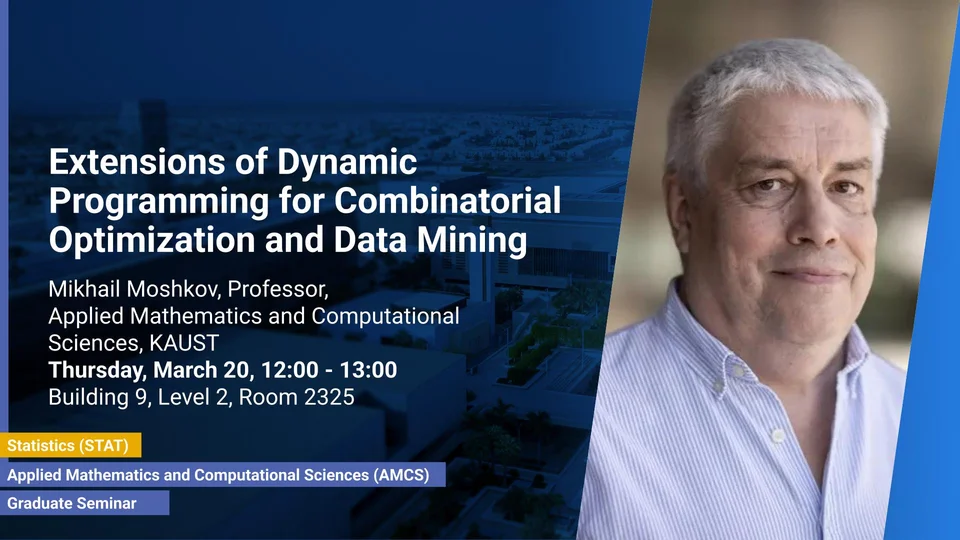
Extensions of Dynamic Programming for Combinatorial Optimization and Data Mining Mikhail Moshkov, Professor, Applied Mathematics and Computational Science Mar 20, 12:00 - 13:00 B9, L2, R2325 Dynamic programming is an efficient technique to solve optimization problems. It is based on decomposing the initial problem into simpler ones and solving these sub-problems beginning from the simplest ones. A conventional dynamic programming algorithm returns an optimal object from a given set of objects.
Decision Trees for Fault Diagnosis in Circuits and Switching Networks Mikhail Moshkov, Professor, Applied Mathematics and Computational Science Jan 22, 11:30 - 12:30 B9 L2 H2325 decision trees switching networks We study theoretical problems of fault diagnosis in circuits and switching networks, which are among the most fundamental models for computing Boolean functions.
Decision Trees for Fault Diagnosis in Circuits and Switching Networks - 2023-09-28 Mikhail Moshkov, Professor, Applied Mathematics and Computational Science Sep 28, 12:00 - 13:00 B9 L2 H2 We study theoretical problems of fault diagnosis in circuits and switching networks, which are among the most fundamental models for computing Boolean functions.
Decision Trees for Fault Diagnosis in Circuits and Switching Networks - 2023-03-13 Mikhail Moshkov, Professor, Applied Mathematics and Computational Science Mar 13, 12:00 - 13:00 B9 L3 R3128 We study theoretical problems of fault diagnosis in circuits and switching networks, which are among the most fundamental models for computing Boolean functions. We investigate two main cases: when the scheme (circuit or switching network) has the same mode of operation for both calculation and diagnostics, and when the scheme has two modes of operation -normal for calculation and special for diagnostics.
Extensions of Dynamic Programming for Combinatorial Optimization and Data Mining - 2022-10-04 Mikhail Moshkov, Professor, Applied Mathematics and Computational Science Oct 4, 12:00 - 13:00 B9 L2 R2322 Dynamic programming combinatorial optimization data mining Dynamic programming is an efficient technique to solve optimization problems. It is based on decomposing the initial problem into simpler ones and solving these sub-problems beginning from the simplest ones. A conventional dynamic programming algorithm returns an optimal object from a given set of objects.
Extensions of Dynamic Programming for Combinatorial Optimization and Data Mining - 2022-03-03 Mikhail Moshkov, Professor, Applied Mathematics and Computational Science Mar 3, 12:00 - 13:00 B9 L2 H2 Dynamic programming is an efficient technique to solve optimization problems. It is based on decomposing the initial problem into simpler ones and solving these sub-problems beginning from the simplest ones. A conventional dynamic programming algorithm returns an optimal object from a given set of objects. We developed extensions of dynamic programming which allow us (i) to describe the set of objects under consideration, (ii) to perform a multi-stage optimization of objects relative to different criteria, (iii) to count the number of optimal objects, (iv) to find the set of Pareto optimal points for the bi-criteria optimization problem, and (v) to study the relationships between two criteria. The considered applications include optimization of decision trees and decision rule systems as algorithms for problem-solving, as ways for knowledge representation, and as classifiers, optimization of element partition trees for rectangular meshes which are used in finite element methods for solving PDEs, and multi-stage optimization for such classic combinatorial optimization problems as matrix chain multiplication, binary search trees, global sequence alignment, and shortest paths.
Extensions of Dynamic Programming for Combinatorial Optimization and Data Mining - 2022-01-24 Mikhail Moshkov, Professor, Applied Mathematics and Computational Science Jan 24, 12:00 - 13:00 KAUST Dynamic programming is an efficient technique to solve optimization problems. It is based on decomposing the initial problem into simpler ones and solving these sub-problems beginning from the simplest ones.
Extensions of Dynamic Programming for Combinatorial Optimization and Data Mining - 2021 Mikhail Moshkov, Professor, Applied Mathematics and Computational Science Apr 15, 12:00 - 13:00 KAUST Dynamic programming is an efficient technique to solve optimization problems. It is based on decomposing the initial problem into simpler ones and solving these sub-problems beginning from the simplest ones. A conventional dynamic programming algorithm returns an optimal object from a given set of objects. We developed extensions of dynamic programming which allow us (i) to describe the set of objects under consideration, (ii) to perform a multi-stage optimization of objects relative to different criteria, (iii) to count the number of optimal objects, (iv) to find the set of Pareto optimal points for the bi-criteria optimization problem, and (v) to study the relationships between two criteria. The considered applications include optimization of decision trees and decision rule systems as algorithms for problem-solving, as ways for knowledge representation, and as classifiers, optimization of element partition trees for rectangular meshes which are used in finite element methods for solving PDEs, and multi-stage optimization for such classic combinatorial optimization problems as matrix chain multiplication, binary search trees, global sequence alignment, and shortest paths.
Extensions of Dynamic Programming for Combinatorial Optimization and Data Mining - 2020 Mikhail Moshkov, Professor, Applied Mathematics and Computational Science Oct 5, 12:00 - 13:00 KAUST We developed extensions of dynamic programming which allow us (i) to describe the set of objects under consideration, (ii) to perform a multi-stage optimization of objects relative to different criteria, (iii) to count the number of optimal objects, (iv) to find the set of Pareto optimal points for the bi-criteria optimization problem, and (v) to study the relationships between two criteria.
Extensions of Dynamic Programming for Combinatorial Optimization and Data Mining Mikhail Moshkov, Professor, Applied Mathematics and Computational Science Apr 13, 12:00 - 13:00 KAUST data mining Dynamic programming combinatorial optimization Dynamic programming is an efficient technique to solve optimization problems. It is based on decomposing the initial problem into simpler ones and solving these sub-problems beginning from the simplest ones. A conventional dynamic programming algorithm returns an optimal object from a given set of objects. We developed extensions of dynamic programming which allow us (i) to describe the set of objects under consideration, (ii) to perform a multi-stage optimization of objects relative to different criteria, (iii) to count the number of optimal objects,(iv) to find the set of Pareto optimal points for the bi-criteria optimization problem, and (v) to study the relationships between two criteria.
Engage ORCID KAUST Repository KAUST Academic Portal ShareClipboard Related Sites Applied Mathematics and Computational Science (AMCS) Computer Science (CS) Extensions of Dynamic Programming, Machine Learning, Discrete Optimization (TREES) Related Content Articles 25 Events 10