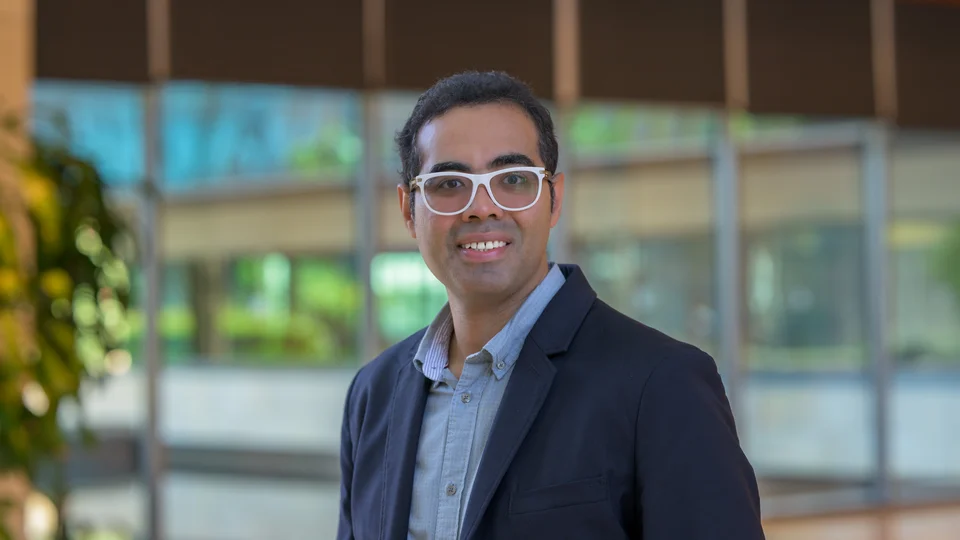
About Mohamed Elhoseiny Mohamed Elhoseiny Associate Professor, Computer Science artificial intelligence Computer Vision ChatGPT MiniGPT Professor Elhoseiny’s research focuses on developing affective artificial intelligence that understands and generates novel visual content. He has contributed to and led numerous seminal works of affective AI art creation. Events Presented Events Feb 22 - Feb 28, 2026 Towards Scalable and Structured Understanding in Visual LLMs Mohamed Elhoseiny, Associate Professor, Computer Science Feb 23, 12:00 - 13:00 B9 L2 R2325 LLM Visual Language Models VLMs visual computing In this talk, we explore a suite of recent advances toward scalable, structured video comprehension using Large Vision Language Models (Video LLMs). Apr 28 - May 4, 2024 Imaginative AI: A Decade+ Journey Towards Human-level imaginative AI skills transforming Species Discovery, Content Creation, Autonomous Agents, Healthcare, and Beyond Mohamed Elhoseiny, Associate Professor, Computer Science Apr 28, 15:00 - 16:30 B9 L2 H2 Most existing AI learning methods can be categorized into supervised, semi-supervised, and unsupervised methods. These approaches rely on defining empirical risks or losses on the provided labeled and/or unlabeled data. Beyond extracting learning signals from labeled/unlabeled training data, in this talk, I will cover a class of methods that I have been developing for over a decade, which can learn beyond the vocabulary that was trained on and can compose or create novel concepts. Mar 3 - Mar 9, 2024 Imaginative Vision Language Models: Towards human-level imaginative AI skills transforming species discovery, content creation, self-driving cars, and health both physical and emotional Mohamed Elhoseiny, Associate Professor, Computer Science Mar 4, 11:30 - 12:30 B9 L2 H2 Most existing AI learning methods can be categorized into supervised, semi-supervised, and unsupervised methods. These approaches rely on defining empirical risks or losses on the provided labeled and/or unlabeled data. Jan 29 - Feb 4, 2023 Prototypical Random Walk Learning Mechanisms for Few-shot Learning, Novel Visual Generation, and (Continual)? Zero-shot Recognition Mohamed Elhoseiny, Associate Professor, Computer Science Jan 30, 12:00 - 13:00 B9 L2 H2 H2 prototypical random walks zero-shot recognition In this talk, we will define prototypical random walks, a mechanism we introduced to improve visual classification with limited data (few-shot learning), and then developed the mechanism in a conceptually different way to facilitate novel image generation and unseen class recognition tasks. More specifically, in the few-shot learning setting, we will show how we can develop a random walk semi-supervised loss that enables the network to learn representations that are compact and well-separated. May 15 - May 21, 2022 It is Okay to not be Okay: Overcoming Emotional Bias in Affective Image Captioning by Contrastive Data Collection (ArtEmis 2.0) Mohamed Elhoseiny, Associate Professor, Computer Science May 16, 12:00 - 13:00 B9 R2322 H1 Datasets that capture the connection between vision, language, and affection are limited, causing a lack of understanding of the emotional aspect of human intelligence. As a step in this direction, the ArtEmis dataset was recently introduced as a large-scale dataset of emotional reactions to images along with language explanations of these chosen emotions. Mar 7 - Mar 13, 2021 ArtEmis: Affective Language for Visual Art Mohamed Elhoseiny, Associate Professor, Computer Science Mar 8, 12:00 - 13:00 KAUST We present a novel large-scale dataset and accompanying machine learning models aimed at providing a detailed understanding of the interplay between visual content, its emotional effect, and explanations for the latter in language. In contrast to most existing annotation datasets in computer vision, we focus on the affective experience triggered by visual artworks and ask the annotators to indicate the dominant emotion they feel for a given image and, crucially, to also provide a grounded verbal explanation for their emotion choice. Apr 5 - Apr 11, 2020 Deep Continual Learning Mohamed Elhoseiny, Associate Professor, Computer Science Apr 6, 12:00 - 13:00 KAUST Deep learning In this seminar, I will present some of the work I have done on Continual Deep Learning, among the research topics at the Vision-CAIR group. Continual learning aims to learn new tasks without forgetting previously learned ones. This is especially challenging when one cannot access data from previous tasks and when the model has a fixed capacity as adopted in modern deep learning techniques. Decreasing the gap towards human-level continual learning, we extended continual deep learning from multiple perspectives. The Hebb's learning theory from biology can be famously summarized as “Cells that fire together wire together.". Inspired by this theory from biology, we proposed Memory Aware Synapses (ECCV18) to quantify and reduce machine forgetting in a way that enables leveraging unlabeled data, which was not possible in former techniques. We later developed a Bayesian approach appearing at ICLR2020, where we explicitly modeled uncertainty parameters to orchestrates forgetting in continual learning. We showed in our ICLR2019 and ACCV18 works that task descriptors/ language can operate in continual learning visual tasks to improve learning efficiency and enable zero-shot task transfer. Beyond computer vision tasks, we recently developed an approach appearing at ICLR2020 we call "Compositional Language Continual Learning". We showed that disentangling syntax from semantics enables better compositional Seq2Seq learning and can significantly alleviate forgetting of tasks like machine translation. In the talk, I will go over these techniques and shed some light on future research possibilities.
Towards Scalable and Structured Understanding in Visual LLMs Mohamed Elhoseiny, Associate Professor, Computer Science Feb 23, 12:00 - 13:00 B9 L2 R2325 LLM Visual Language Models VLMs visual computing In this talk, we explore a suite of recent advances toward scalable, structured video comprehension using Large Vision Language Models (Video LLMs).
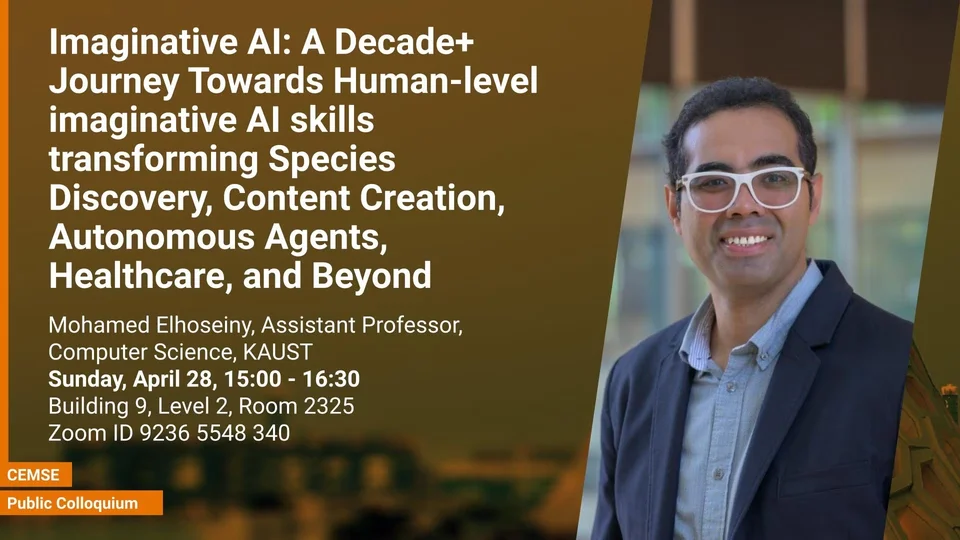
Imaginative AI: A Decade+ Journey Towards Human-level imaginative AI skills transforming Species Discovery, Content Creation, Autonomous Agents, Healthcare, and Beyond Mohamed Elhoseiny, Associate Professor, Computer Science Apr 28, 15:00 - 16:30 B9 L2 H2 Most existing AI learning methods can be categorized into supervised, semi-supervised, and unsupervised methods. These approaches rely on defining empirical risks or losses on the provided labeled and/or unlabeled data. Beyond extracting learning signals from labeled/unlabeled training data, in this talk, I will cover a class of methods that I have been developing for over a decade, which can learn beyond the vocabulary that was trained on and can compose or create novel concepts.
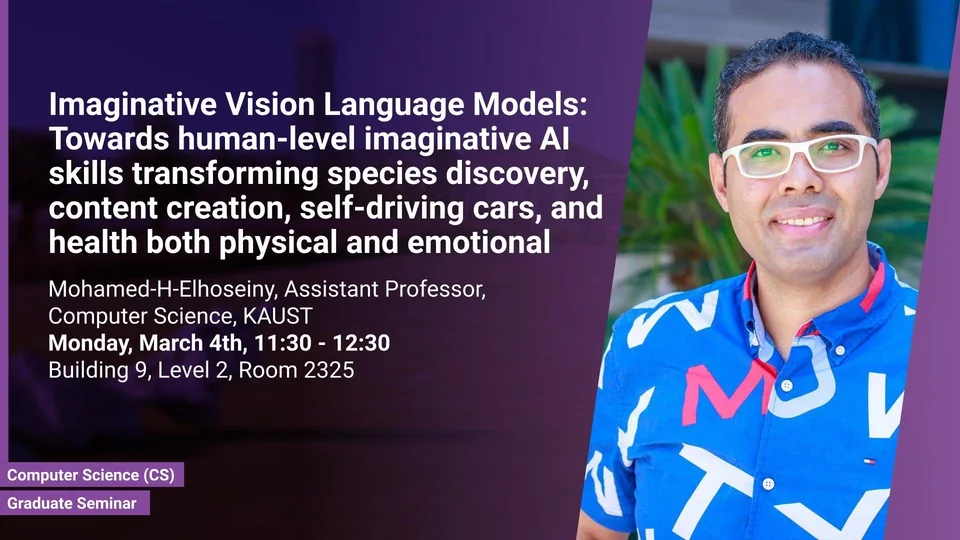
Imaginative Vision Language Models: Towards human-level imaginative AI skills transforming species discovery, content creation, self-driving cars, and health both physical and emotional Mohamed Elhoseiny, Associate Professor, Computer Science Mar 4, 11:30 - 12:30 B9 L2 H2 Most existing AI learning methods can be categorized into supervised, semi-supervised, and unsupervised methods. These approaches rely on defining empirical risks or losses on the provided labeled and/or unlabeled data.
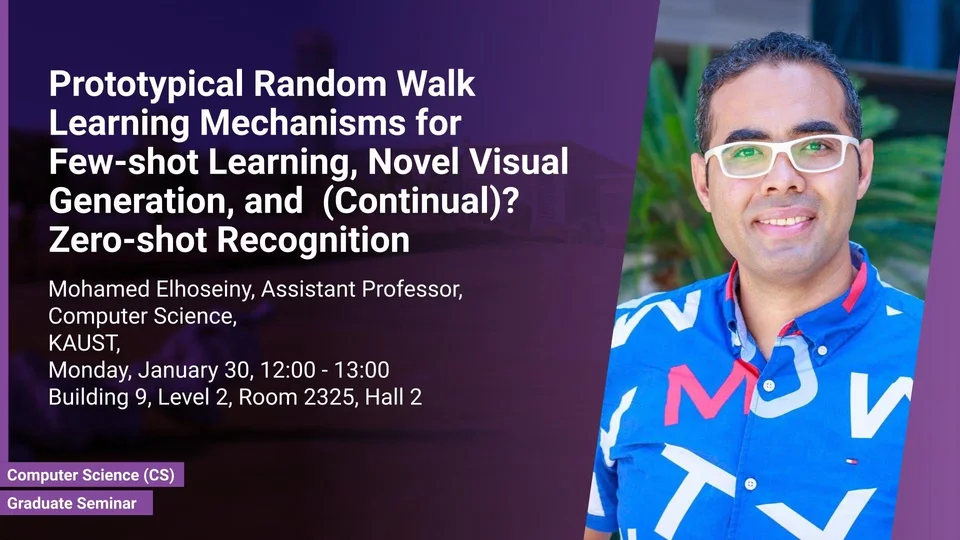
Prototypical Random Walk Learning Mechanisms for Few-shot Learning, Novel Visual Generation, and (Continual)? Zero-shot Recognition Mohamed Elhoseiny, Associate Professor, Computer Science Jan 30, 12:00 - 13:00 B9 L2 H2 H2 prototypical random walks zero-shot recognition In this talk, we will define prototypical random walks, a mechanism we introduced to improve visual classification with limited data (few-shot learning), and then developed the mechanism in a conceptually different way to facilitate novel image generation and unseen class recognition tasks. More specifically, in the few-shot learning setting, we will show how we can develop a random walk semi-supervised loss that enables the network to learn representations that are compact and well-separated.
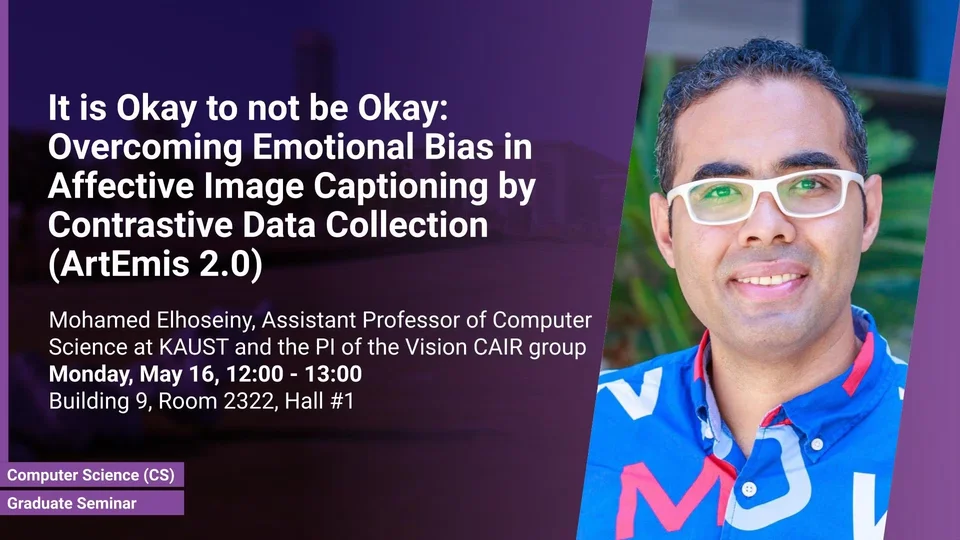
It is Okay to not be Okay: Overcoming Emotional Bias in Affective Image Captioning by Contrastive Data Collection (ArtEmis 2.0) Mohamed Elhoseiny, Associate Professor, Computer Science May 16, 12:00 - 13:00 B9 R2322 H1 Datasets that capture the connection between vision, language, and affection are limited, causing a lack of understanding of the emotional aspect of human intelligence. As a step in this direction, the ArtEmis dataset was recently introduced as a large-scale dataset of emotional reactions to images along with language explanations of these chosen emotions.
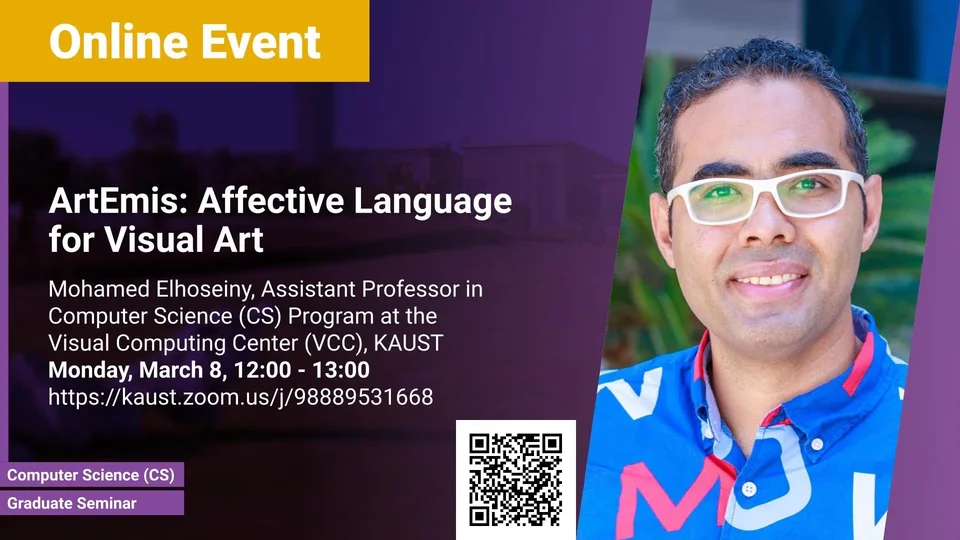
ArtEmis: Affective Language for Visual Art Mohamed Elhoseiny, Associate Professor, Computer Science Mar 8, 12:00 - 13:00 KAUST We present a novel large-scale dataset and accompanying machine learning models aimed at providing a detailed understanding of the interplay between visual content, its emotional effect, and explanations for the latter in language. In contrast to most existing annotation datasets in computer vision, we focus on the affective experience triggered by visual artworks and ask the annotators to indicate the dominant emotion they feel for a given image and, crucially, to also provide a grounded verbal explanation for their emotion choice.
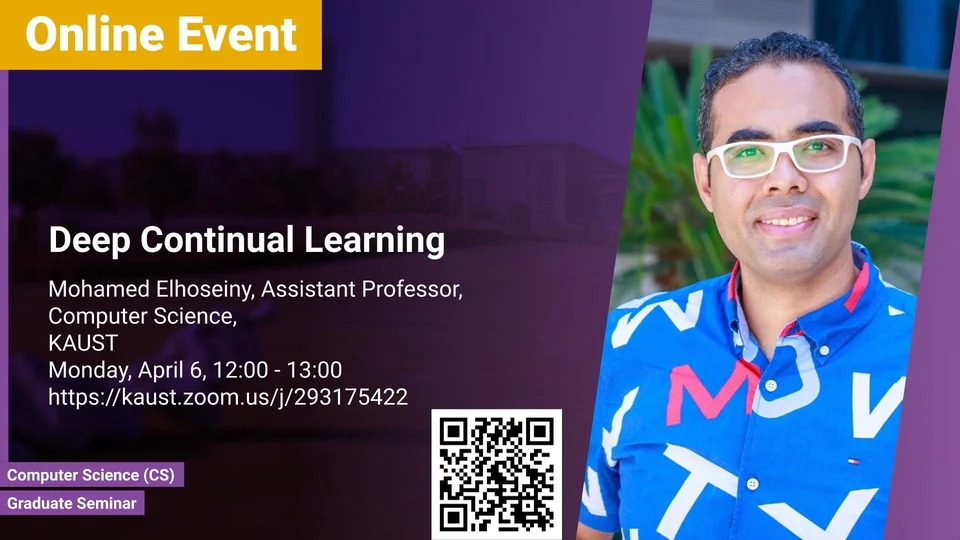
Deep Continual Learning Mohamed Elhoseiny, Associate Professor, Computer Science Apr 6, 12:00 - 13:00 KAUST Deep learning In this seminar, I will present some of the work I have done on Continual Deep Learning, among the research topics at the Vision-CAIR group. Continual learning aims to learn new tasks without forgetting previously learned ones. This is especially challenging when one cannot access data from previous tasks and when the model has a fixed capacity as adopted in modern deep learning techniques. Decreasing the gap towards human-level continual learning, we extended continual deep learning from multiple perspectives. The Hebb's learning theory from biology can be famously summarized as “Cells that fire together wire together.". Inspired by this theory from biology, we proposed Memory Aware Synapses (ECCV18) to quantify and reduce machine forgetting in a way that enables leveraging unlabeled data, which was not possible in former techniques. We later developed a Bayesian approach appearing at ICLR2020, where we explicitly modeled uncertainty parameters to orchestrates forgetting in continual learning. We showed in our ICLR2019 and ACCV18 works that task descriptors/ language can operate in continual learning visual tasks to improve learning efficiency and enable zero-shot task transfer. Beyond computer vision tasks, we recently developed an approach appearing at ICLR2020 we call "Compositional Language Continual Learning". We showed that disentangling syntax from semantics enables better compositional Seq2Seq learning and can significantly alleviate forgetting of tasks like machine translation. In the talk, I will go over these techniques and shed some light on future research possibilities.
Engage ORCID KAUST Repository IEEE Xplore DBLP ShareClipboard Related Sites Computer Science (CS) Center of Excellence for Generative AI (GenAI) Computer Vision- Core Artificial Intelligence Research (Vision-CAIR) Related Content Articles 14 Events 7 Related Links Publications on Google Scholar Publications on ResearchGate MiniGPT-4 project on GitHub Mohamed Elhoseiny's personal website