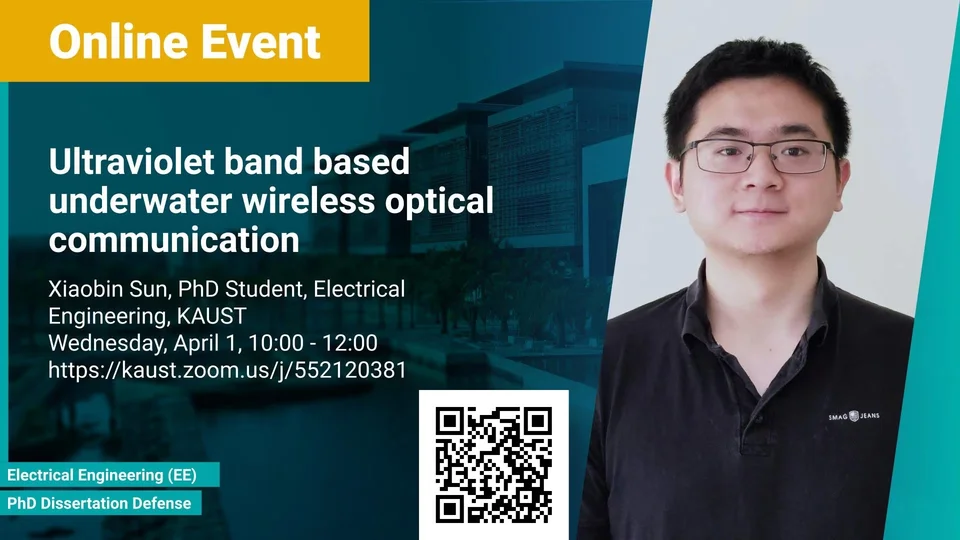
About Xiaobin Sun Xiaobin Sun Ph.D. Student, Electrical and Computer Engineering Optical communications optical wireless communicaitons communication networks photonics Xiaobin Sun is a Ph.D. student at Photonics Laboratory under the supervision of Professor Boon Ooi at King Abdullah University of Science and Technology (KAUST). Research Interests Sun's research interests include Semiconductor Optoelectronic device, Optical communication, including underwater optical wireless communications, visible-light communications. Invited Talks: Visible diode lasers for high bitrate underwater wireless optical communications Boon S. Ooi, Xiaobin Sun, Omar Alkhazragi, Yujian Guo, Tien Khee Ng, Mohamed-Slim Alouini Optical Fiber Communication Conference, M3I. 1 (OFC 2019 Events Presented Events Mar 29 - Apr 4, 2020 Ultraviolet band based underwater wireless optical communication Xiaobin Sun, Ph.D. Student, Electrical and Computer Engineering Apr 1, 10:00 - 12:00 KAUST Optical communications optical wireless communicaitons communication networks photonics Underwater wireless optical communication (UWOC) has attracted increasing interest for data transfer in various underwater activities, due to its order-of-magnitude higher bandwidth compared to conventional acoustic and radio-frequency (RF) technologies. Our studies pave the way for eventual applications of UWOC by relieving the strict requirements on PAT using UV-based NLOS. Such modality is much sought-after for implementing robust, secure, and high-speed UWOC links in harsh oceanic environments. This work was first started with the investigation of proper NLOS configurations. Path loss (PL) was chosen as a figure-of-merit for link performance. The effects of NLOS geometries, water turbidity, and transmission wavelength are evaluated by measuring the corresponding PL. The experimental results suggest that NLOS UWOC links are favorable for smaller azimuth angles, stronger water turbidity, and shorter transmission wavelength, as exemplified by the use of 375-nm wavelength. With the understanding of favorable NLOS UWOC configurations, we established a NLOS link consisting of an ultraviolet (UV) laser as the transmitter for enhanced light scattering and high sensitivity photomultiplier tube (PMT) as the receiver. A high data rate of 85 Mbit/s using on-off keying (OOK) in a 30-cm emulated highly turbid harbor water is demonstrated. Besides the underwater communication links, UV-based NLOS is also appealing to be the signal carrier for direct communication across wavy water-air interface. The trial results indicate link stability, which alleviates the issues brought about by the misalignment and mobility in harsh environments, paving the way towards real applications.
Ultraviolet band based underwater wireless optical communication Xiaobin Sun, Ph.D. Student, Electrical and Computer Engineering Apr 1, 10:00 - 12:00 KAUST Optical communications optical wireless communicaitons communication networks photonics Underwater wireless optical communication (UWOC) has attracted increasing interest for data transfer in various underwater activities, due to its order-of-magnitude higher bandwidth compared to conventional acoustic and radio-frequency (RF) technologies. Our studies pave the way for eventual applications of UWOC by relieving the strict requirements on PAT using UV-based NLOS. Such modality is much sought-after for implementing robust, secure, and high-speed UWOC links in harsh oceanic environments. This work was first started with the investigation of proper NLOS configurations. Path loss (PL) was chosen as a figure-of-merit for link performance. The effects of NLOS geometries, water turbidity, and transmission wavelength are evaluated by measuring the corresponding PL. The experimental results suggest that NLOS UWOC links are favorable for smaller azimuth angles, stronger water turbidity, and shorter transmission wavelength, as exemplified by the use of 375-nm wavelength. With the understanding of favorable NLOS UWOC configurations, we established a NLOS link consisting of an ultraviolet (UV) laser as the transmitter for enhanced light scattering and high sensitivity photomultiplier tube (PMT) as the receiver. A high data rate of 85 Mbit/s using on-off keying (OOK) in a 30-cm emulated highly turbid harbor water is demonstrated. Besides the underwater communication links, UV-based NLOS is also appealing to be the signal carrier for direct communication across wavy water-air interface. The trial results indicate link stability, which alleviates the issues brought about by the misalignment and mobility in harsh environments, paving the way towards real applications.
Related Sites Electrical and Computer Engineering (ECE) Photonics Laboratory (Photonics) Related Content Events 1