About Maxat Kulmanov Maxat Kulmanov Research Scientist (former), Bio-Ontology Research Group bioinformatics artificial intelligence machine learning neural network Semantic web Maxat Kulmanov is a Research Scientist in the Bio-Ontology Research Group at King Abdullah University of Science and Technology (KAUST). Research Interests Maxat's research interests include bioinformatics, knowledge representation and reasoning, machine learning, neural networks, semantic web, and algorithms. He is interested in knowledge discovery and data integration using artificial intelligence and semantic web technologies in biology and biomedicine. Professional Profile 2020-Present: Postdoctoral Research Fellow, Computational Bioscience Research Center, King Abdullah University of Events Presented Events Apr 5 - Apr 11, 2020 Predicting Single Gene Loss of Function Phenotypes Maxat Kulmanov, Research Scientist (former), Bio-Ontology Research Group Apr 6, 19:30 - 21:30 KAUST We developed and expanded novel methods for representation learning, predicting protein functions and their loss of function phenotypes. We use deep neural network algorithm and combine them with symbolic inference into neural-symbolic algorithms. Our work significantly improves previously developed methods for predicting protein functions through methodological advances in machine learning, incorporation of broader data types that may be predictive of functions, and improved systems for neural-symbolic integration. The methods we developed are generic and can be applied to other domains in which similar types of structured and unstructured information exist. In future, our methods can be applied to prediction of protein function for metagenomic samples in order to evaluate the potential for discovery of novel proteins of industrial value. Also our methods can be applied to the prediction of loss of function phenotypes in human genetics and incorporate the results in a variant prioritization tool that can be applied to diagnose patients with Mendelian disorders. Oct 7 - Oct 13, 2018 AI4GH Seminar Series | Predicting Protein Function and Phenotype Associations Maxat Kulmanov, Research Scientist (former), Bio-Ontology Research Group Oct 10, 12:00 - 13:00 B2 R5220 biology biomedicine artificial intelligence knowledge discovery data integration protein function prediction The amount of available protein sequences is rapidly increasing, mainly as a consequence of the development and application of high throughput sequencing technologies in the life sciences.
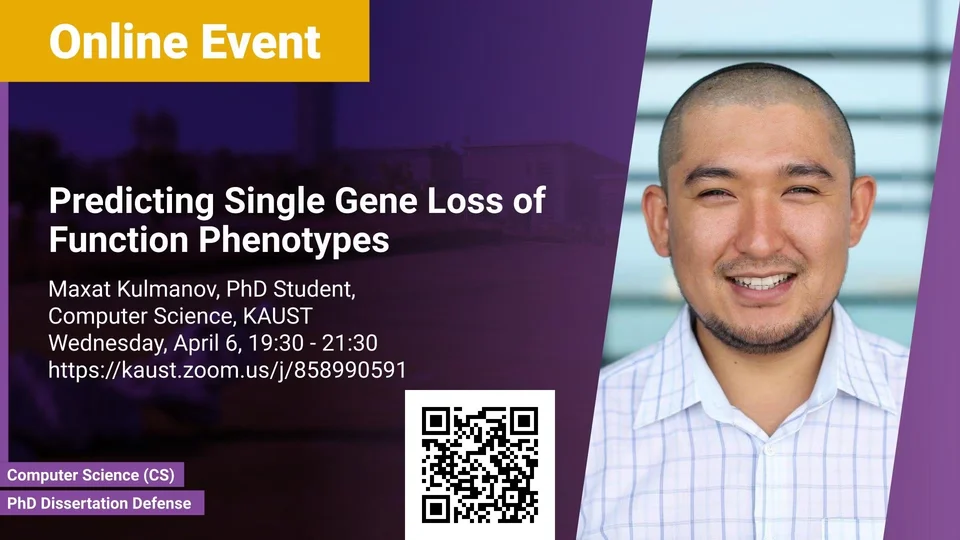
Predicting Single Gene Loss of Function Phenotypes Maxat Kulmanov, Research Scientist (former), Bio-Ontology Research Group Apr 6, 19:30 - 21:30 KAUST We developed and expanded novel methods for representation learning, predicting protein functions and their loss of function phenotypes. We use deep neural network algorithm and combine them with symbolic inference into neural-symbolic algorithms. Our work significantly improves previously developed methods for predicting protein functions through methodological advances in machine learning, incorporation of broader data types that may be predictive of functions, and improved systems for neural-symbolic integration. The methods we developed are generic and can be applied to other domains in which similar types of structured and unstructured information exist. In future, our methods can be applied to prediction of protein function for metagenomic samples in order to evaluate the potential for discovery of novel proteins of industrial value. Also our methods can be applied to the prediction of loss of function phenotypes in human genetics and incorporate the results in a variant prioritization tool that can be applied to diagnose patients with Mendelian disorders.
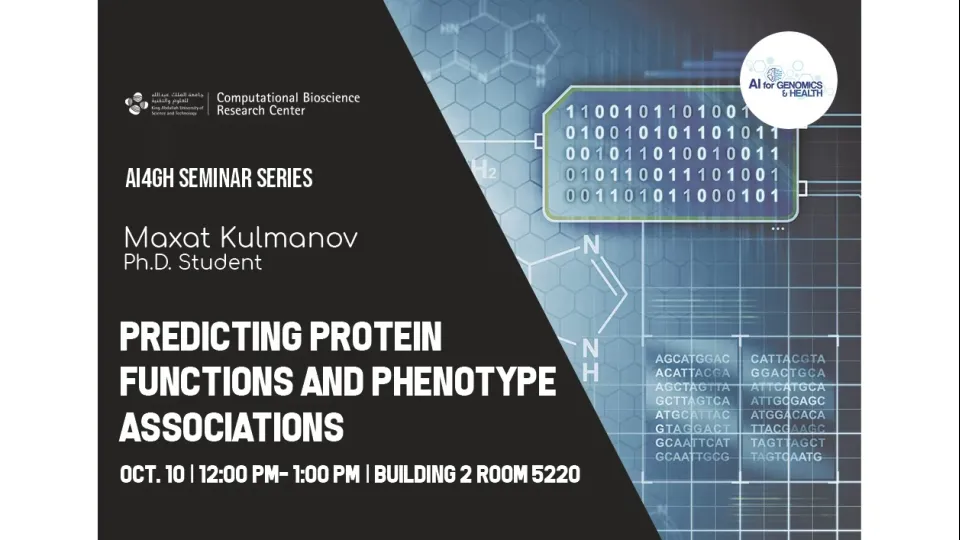
AI4GH Seminar Series | Predicting Protein Function and Phenotype Associations Maxat Kulmanov, Research Scientist (former), Bio-Ontology Research Group Oct 10, 12:00 - 13:00 B2 R5220 biology biomedicine artificial intelligence knowledge discovery data integration protein function prediction The amount of available protein sequences is rapidly increasing, mainly as a consequence of the development and application of high throughput sequencing technologies in the life sciences.
Engage ORCID ShareClipboard Related Sites Bio-Ontology Research Group (BORG) Computer Science (CS) Related Content Articles 11 Projects 2 Events 2 Related Links Publications list on ORCID Also view Publications in the KAUST Repository Publications on Google Scholar Dblp Computer science bibliography