About David Keyes David Keyes Professor, Applied Mathematics and Computational Science parellel computing numerical analysis computational science and engineering Partial Differential Equations spatial statistics machine learning quantum computing High Performance Computing scalable solvers software development David Keyes works at the interface of computational science and engineering and high performance computing, which he helped edit into the DNA of KAUST as a founding Dean in 2009 and then as director of the Extreme Computing Research Center. He currently serves as Senior Associate to the President, Chair of the KAUST RDIA Economies of the Future committee, and delegate to the Saudi Center for the Fourth Industrial Revolution. Events Presented Events Mar 8 - Mar 14, 2026 Extreme Computing Universals David Keyes, Professor, Applied Mathematics and Computational Science Mar 9, 12:00 - 13:00 B9 L2 R2325 HPC APIs extreme computing smart systems parallel computing software development This talk redefines "extreme" computing as operating under severe resource constraints rather than just massive scale, outlining universal algorithmic, hardware, and system-level strategies to overcome these challenges, illustrated by KAUST success stories. Apr 20 - Apr 26, 2025 The Earliest Arrival of Quantum Utility David Keyes, Professor, Applied Mathematics and Computational Science Apr 21, 12:00 - 13:00 B9, L2, R2325 The earliest advantageous uses of quantum computing will take the form of a quantum processing unit (QPU) attached to a traditional supercomputer. Supercomputers of the not too distant future will have thousands of GPUs and thousands of CPUs as today, along with one or more QPUs with thousands of qubits. Apr 6 - Apr 12, 2025 The Earliest Arrival of Quantum Advantage David Keyes, Professor, Applied Mathematics and Computational Science Apr 10, 12:00 - 13:00 B9 L2 R2325 quantum computing quantum processing unit supercomputers This talk outlines a "quantum first" strategy for future supercomputers, integrating QPUs, GPUs, and CPUs to optimize energy efficiency and accelerate scientific computing while addressing the current challenges and projecting the maturation of quantum computing by leveraging classical supercomputing advancements. Oct 22 - Oct 28, 2023 Efficient Computation Through Tuned Approximation David Keyes, Professor, Applied Mathematics and Computational Science Oct 23, 11:30 - 12:30 B9 L2 R2322 H1 computation approximation software Numerical software is being reinvented to provide opportunities to tune dynamically the accuracy of computation to the requirements of the application, resulting in savings of memory, time, and energy. Floating point computation in science and engineering has a history of “oversolving” relative to expectations for many models. So often are real datatypes defaulted to double precision that GPUs did not gain wide acceptance until they provided in hardware operations not required in their original domain of graphics. However, computational science is now reverting to employ lower precision arithmetic where possible. Many matrix operations considered at a blockwise level allow for lower precision and many blocks can be approximated with low rank near equivalents. Sep 4 - Sep 10, 2022 Low Rank Everywhere (Almost) David Keyes, Professor, Applied Mathematics and Computational Science Sep 6, 12:00 - 13:00 B9 L2 R2322 computational science low rank hierarchical low rank data sparsity Tile low-rank and hierarchical low-rank matrices can exploit the data sparsity that is discoverable all across computational science. We illustrate in large-scale applications and hybridize with similarly motivated mixed precision representations while featuring ECRC research in progress with many collaborators. Oct 10 - Oct 16, 2021 The Data-sparse Renaissance in Numerical Linear Algebra David Keyes, Professor, Applied Mathematics and Computational Science Oct 11, 12:00 - 13:00 B9 R2322 H1 A traditional goal of algorithmic optimality, squeezing out operations, has been superseded because of evolution in architecture. Algorithms must now squeeze memory, data transfers, and synchronizations, while extra operations on locally cached data cost relatively little time or energy. Hierarchically low-rank matrices realize a rarely achieved combination of optimal storage complexity and high-computational intensity in approximating a wide class of formally dense operators that arise in exascale applications. May 2 - May 8, 2021 Scalable Solvers: Universals and Innovations David Keyes, Professor, Applied Mathematics and Computational Science May 6, 12:00 - 13:00 KAUST Abstract As simulation and analytics enter the exascale era, numerical algorithms must span a widening gap between ambitious applications and austere architectures. We present fifteen universals for researchers in scalable solvers and some innovations that allow approaching lin-log complexity in storage and operation count in many important algorithmic kernels. Applications are becoming ambitious in many senses: large physical space, phase space or parameter dimensions; resolution of many scales of space and/or time; high fidelity physical modeling; linking together of multiple complex models Sep 20 - Sep 26, 2020 Data-sparse Algorithms for Large-scale Applications on Emerging Architectures David Keyes, Professor, Applied Mathematics and Computational Science Sep 21, 12:00 - 13:00 KAUST A traditional goal of algorithmic optimality, squeezing out operations, has been superseded because of evolution in architecture. Algorithms must now squeeze memory, data transfers, and synchronizations, while extra operations on locally cached data cost relatively little time or energy. Hierarchically low-rank matrices realize a rarely achieved combination of optimal storage complexity and high-computational intensity in approximating a wide class of formally dense operators that arise in exascale applications. They may be regarded as algebraic generalizations of the fast multipole method. Mar 1 - Mar 7, 2020 Data-sparse Methods for Large-scale Applications on Emerging Architectures David Keyes, Professor, Applied Mathematics and Computational Science Mar 2, 12:00 - 13:00 B9 L2 H1 R2322 hierarchical computations A traditional goal of algorithmic optimality, squeezing out operations, has been superseded because of evolution in architecture. Arithmetic operations no longer serve as a reasonable proxy for all aspects of complexity. Instead, algorithms must now squeeze memory, data transfers, and synchronizations, while extra operations on locally cached data represent only small costs in time and energy. Hierarchically low-rank matrices realize a rarely achieved combination of optimal storage complexity and high-computational intensity in approximating a wide class of formally dense operators that arise in applications for which exascale computers are being constructed. We describe modules of a KAUST-built software toolkit, Hierarchical Computations on Manycore Architectures (HiCMA), that illustrate these features and are building blocks of KAUST mission applications, such as matrix-free higher-order methods in optimization and large-scale spatial statistics. Early modules of this open-source project have undergone industrial-rigor testing are distributed in the software libraries of major vendors. May 21 - May 27, 2017 PCCFD - Predictive Complex Computational Fluid Dynamics David Keyes, Professor, Applied Mathematics and Computational Science May 22, 08:45 - May 24, 05:00 B9 L2 H1 CFD algorithms applied mathematics numerical analysis Computer science The PCCFD workshop will focus on cutting-edge research in the field of algorithmic development for CFD and multi-scale complex flow simulations. Apr 22 - May 5, 2012 Scalable Hierarchical Algorithms for eXtreme Computing Workshop David Keyes, Professor, Applied Mathematics and Computational Science Apr 28, 08:00 - Apr 30, 16:00 KAUST scientific computing The 2012 SHAX-C workshop focuses international expert attention on the prospects for the three great hierarchical algorithms of scientific computing: multigrid, fast transforms, and fast multipole methods. These methods are kernels in simulations based on formulations of partial differential equations, integral equations, and interacting particles – in short, they are scientific and engineering workhorses.
Extreme Computing Universals David Keyes, Professor, Applied Mathematics and Computational Science Mar 9, 12:00 - 13:00 B9 L2 R2325 HPC APIs extreme computing smart systems parallel computing software development This talk redefines "extreme" computing as operating under severe resource constraints rather than just massive scale, outlining universal algorithmic, hardware, and system-level strategies to overcome these challenges, illustrated by KAUST success stories.
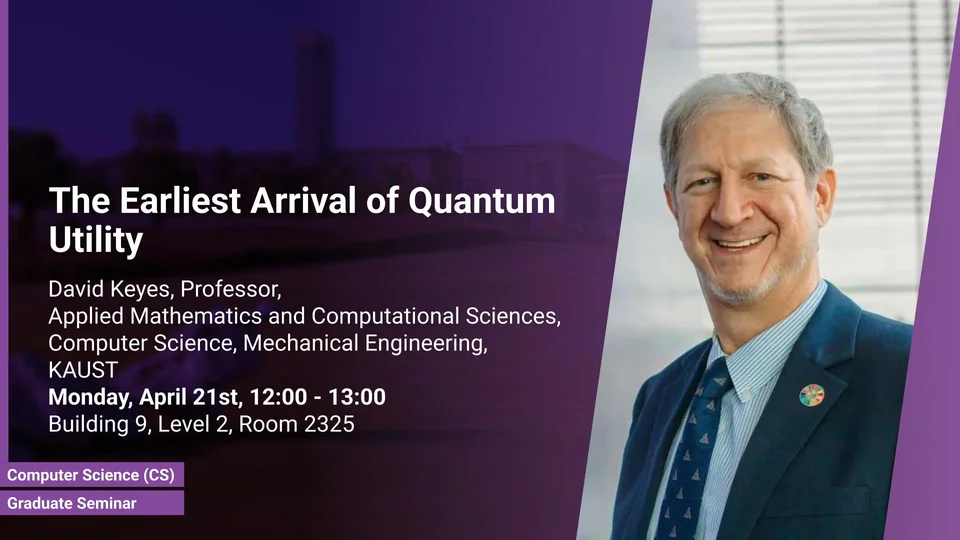
The Earliest Arrival of Quantum Utility David Keyes, Professor, Applied Mathematics and Computational Science Apr 21, 12:00 - 13:00 B9, L2, R2325 The earliest advantageous uses of quantum computing will take the form of a quantum processing unit (QPU) attached to a traditional supercomputer. Supercomputers of the not too distant future will have thousands of GPUs and thousands of CPUs as today, along with one or more QPUs with thousands of qubits.
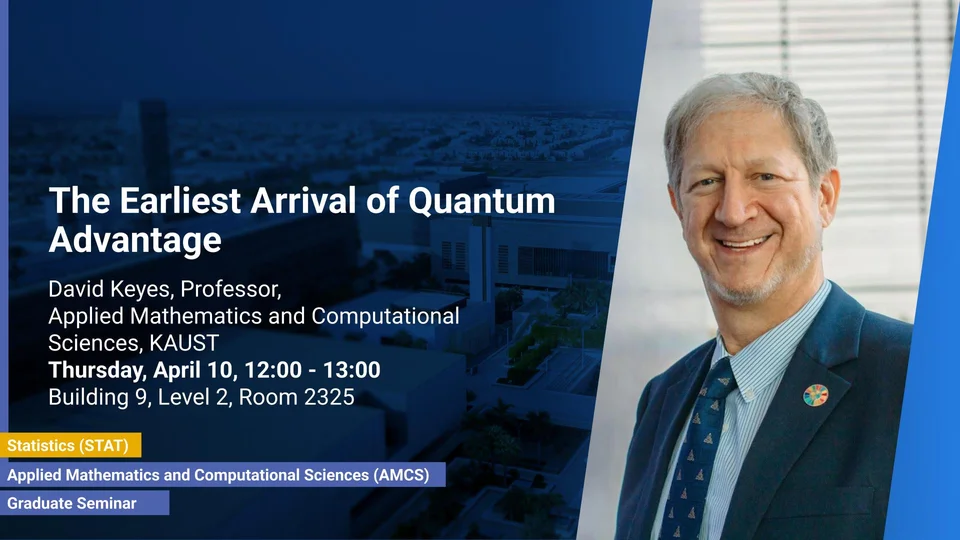
The Earliest Arrival of Quantum Advantage David Keyes, Professor, Applied Mathematics and Computational Science Apr 10, 12:00 - 13:00 B9 L2 R2325 quantum computing quantum processing unit supercomputers This talk outlines a "quantum first" strategy for future supercomputers, integrating QPUs, GPUs, and CPUs to optimize energy efficiency and accelerate scientific computing while addressing the current challenges and projecting the maturation of quantum computing by leveraging classical supercomputing advancements.
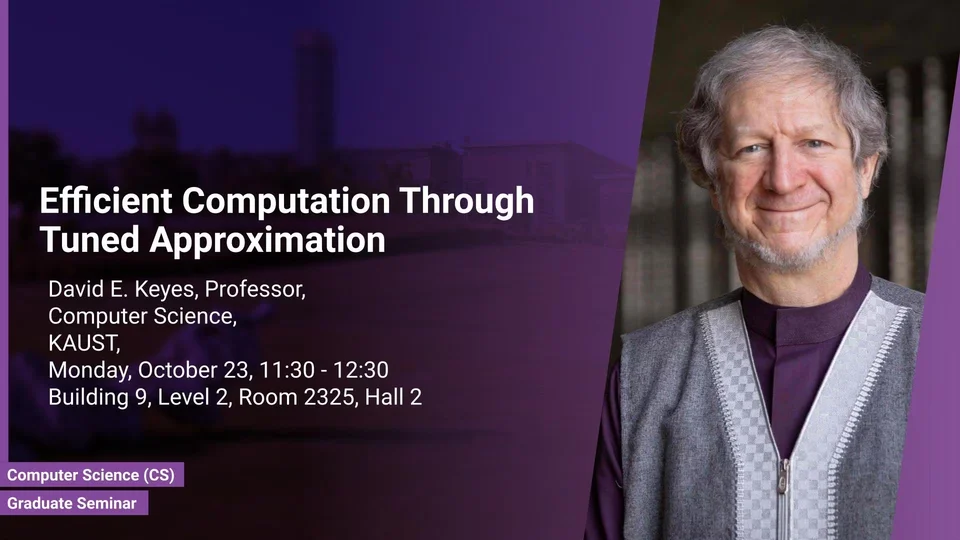
Efficient Computation Through Tuned Approximation David Keyes, Professor, Applied Mathematics and Computational Science Oct 23, 11:30 - 12:30 B9 L2 R2322 H1 computation approximation software Numerical software is being reinvented to provide opportunities to tune dynamically the accuracy of computation to the requirements of the application, resulting in savings of memory, time, and energy. Floating point computation in science and engineering has a history of “oversolving” relative to expectations for many models. So often are real datatypes defaulted to double precision that GPUs did not gain wide acceptance until they provided in hardware operations not required in their original domain of graphics. However, computational science is now reverting to employ lower precision arithmetic where possible. Many matrix operations considered at a blockwise level allow for lower precision and many blocks can be approximated with low rank near equivalents.
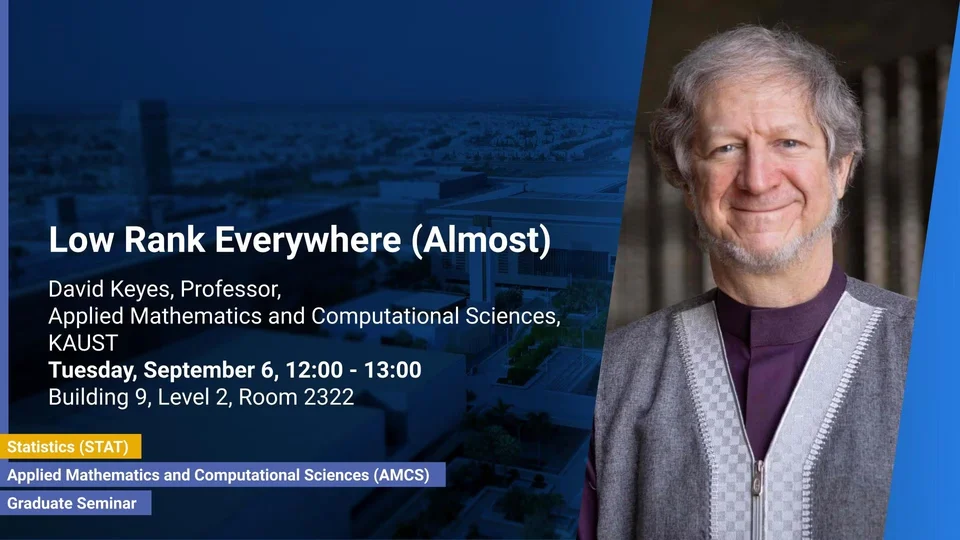
Low Rank Everywhere (Almost) David Keyes, Professor, Applied Mathematics and Computational Science Sep 6, 12:00 - 13:00 B9 L2 R2322 computational science low rank hierarchical low rank data sparsity Tile low-rank and hierarchical low-rank matrices can exploit the data sparsity that is discoverable all across computational science. We illustrate in large-scale applications and hybridize with similarly motivated mixed precision representations while featuring ECRC research in progress with many collaborators.
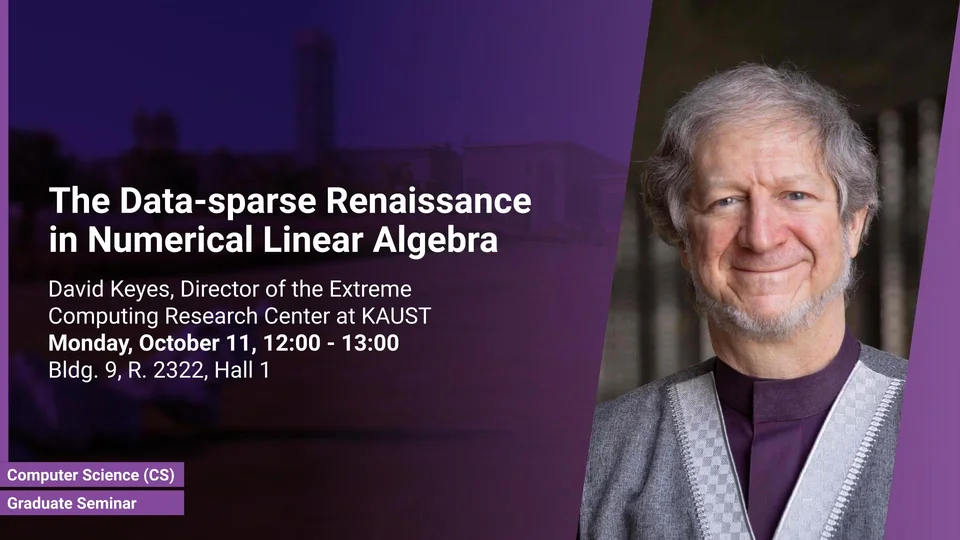
The Data-sparse Renaissance in Numerical Linear Algebra David Keyes, Professor, Applied Mathematics and Computational Science Oct 11, 12:00 - 13:00 B9 R2322 H1 A traditional goal of algorithmic optimality, squeezing out operations, has been superseded because of evolution in architecture. Algorithms must now squeeze memory, data transfers, and synchronizations, while extra operations on locally cached data cost relatively little time or energy. Hierarchically low-rank matrices realize a rarely achieved combination of optimal storage complexity and high-computational intensity in approximating a wide class of formally dense operators that arise in exascale applications.
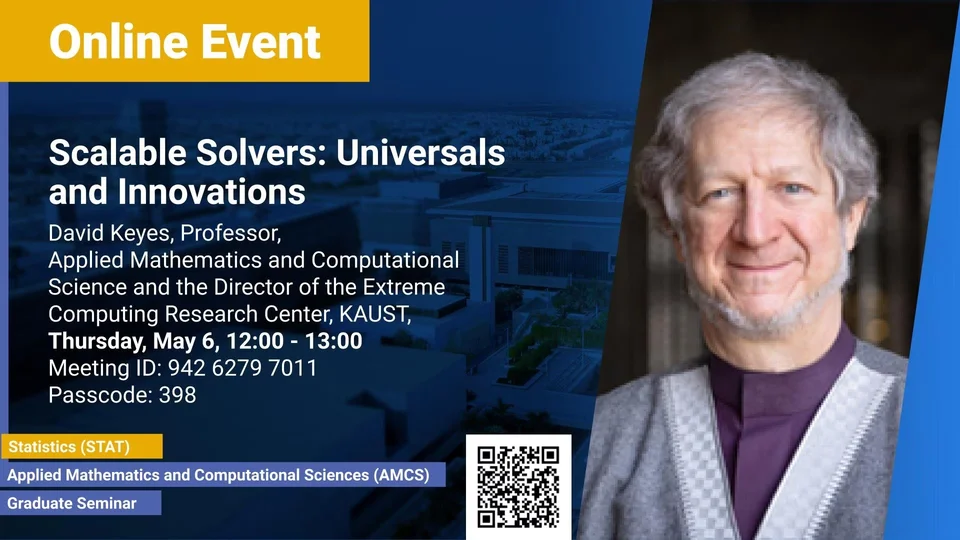
Scalable Solvers: Universals and Innovations David Keyes, Professor, Applied Mathematics and Computational Science May 6, 12:00 - 13:00 KAUST Abstract As simulation and analytics enter the exascale era, numerical algorithms must span a widening gap between ambitious applications and austere architectures. We present fifteen universals for researchers in scalable solvers and some innovations that allow approaching lin-log complexity in storage and operation count in many important algorithmic kernels. Applications are becoming ambitious in many senses: large physical space, phase space or parameter dimensions; resolution of many scales of space and/or time; high fidelity physical modeling; linking together of multiple complex models
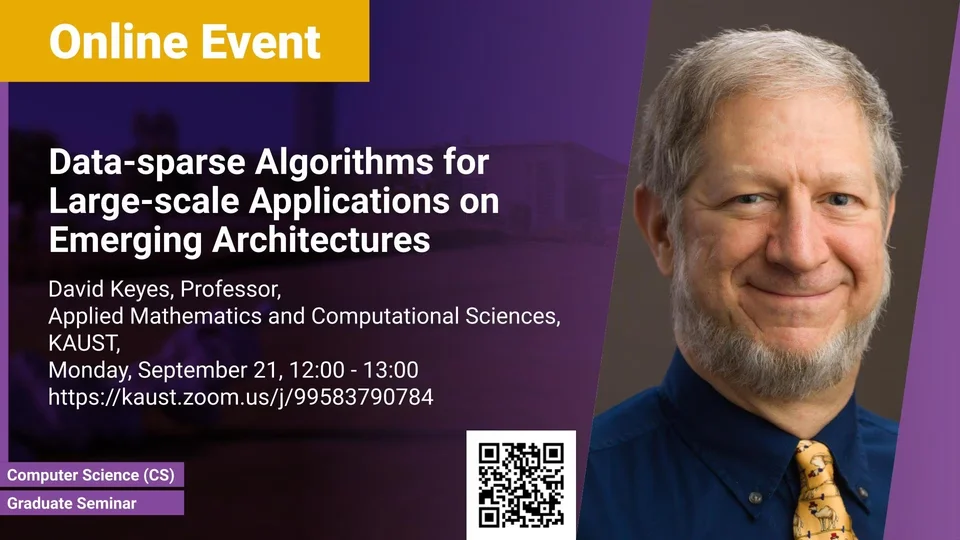
Data-sparse Algorithms for Large-scale Applications on Emerging Architectures David Keyes, Professor, Applied Mathematics and Computational Science Sep 21, 12:00 - 13:00 KAUST A traditional goal of algorithmic optimality, squeezing out operations, has been superseded because of evolution in architecture. Algorithms must now squeeze memory, data transfers, and synchronizations, while extra operations on locally cached data cost relatively little time or energy. Hierarchically low-rank matrices realize a rarely achieved combination of optimal storage complexity and high-computational intensity in approximating a wide class of formally dense operators that arise in exascale applications. They may be regarded as algebraic generalizations of the fast multipole method.
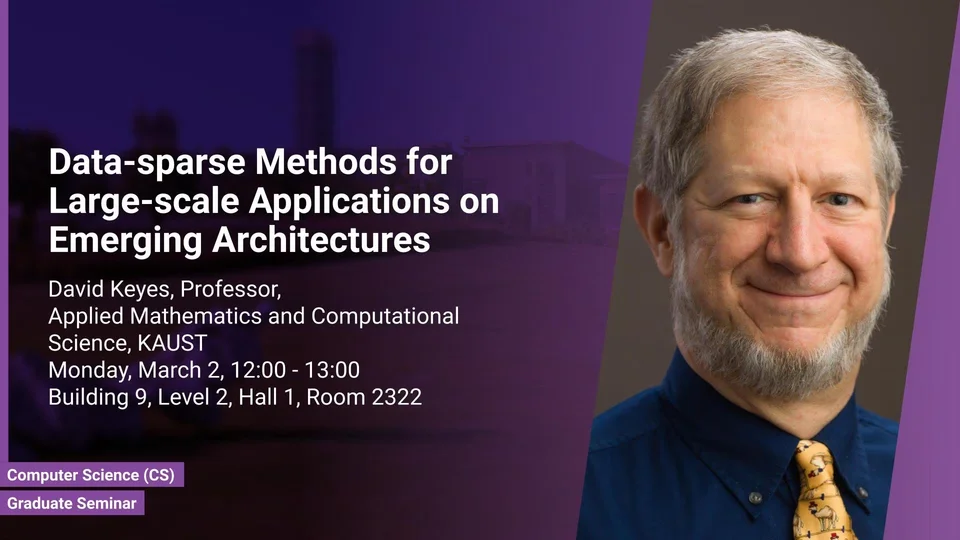
Data-sparse Methods for Large-scale Applications on Emerging Architectures David Keyes, Professor, Applied Mathematics and Computational Science Mar 2, 12:00 - 13:00 B9 L2 H1 R2322 hierarchical computations A traditional goal of algorithmic optimality, squeezing out operations, has been superseded because of evolution in architecture. Arithmetic operations no longer serve as a reasonable proxy for all aspects of complexity. Instead, algorithms must now squeeze memory, data transfers, and synchronizations, while extra operations on locally cached data represent only small costs in time and energy. Hierarchically low-rank matrices realize a rarely achieved combination of optimal storage complexity and high-computational intensity in approximating a wide class of formally dense operators that arise in applications for which exascale computers are being constructed. We describe modules of a KAUST-built software toolkit, Hierarchical Computations on Manycore Architectures (HiCMA), that illustrate these features and are building blocks of KAUST mission applications, such as matrix-free higher-order methods in optimization and large-scale spatial statistics. Early modules of this open-source project have undergone industrial-rigor testing are distributed in the software libraries of major vendors.
PCCFD - Predictive Complex Computational Fluid Dynamics David Keyes, Professor, Applied Mathematics and Computational Science May 22, 08:45 - May 24, 05:00 B9 L2 H1 CFD algorithms applied mathematics numerical analysis Computer science The PCCFD workshop will focus on cutting-edge research in the field of algorithmic development for CFD and multi-scale complex flow simulations.
Scalable Hierarchical Algorithms for eXtreme Computing Workshop David Keyes, Professor, Applied Mathematics and Computational Science Apr 28, 08:00 - Apr 30, 16:00 KAUST scientific computing The 2012 SHAX-C workshop focuses international expert attention on the prospects for the three great hierarchical algorithms of scientific computing: multigrid, fast transforms, and fast multipole methods. These methods are kernels in simulations based on formulations of partial differential equations, integral equations, and interacting particles – in short, they are scientific and engineering workhorses.
Engage ORCID KAUST Academic Portal KAUST Repository Scopus LinkedIn ShareClipboard Related Sites Computer Science (CS) Applied Mathematics and Computational Science (AMCS) Mechanical Engineering (ME) Flow Simulation at the Exascale (Exaflow) Hierarchical Computations on Manycore Architectures (HiCMA) Related Content Articles 46 Events 11