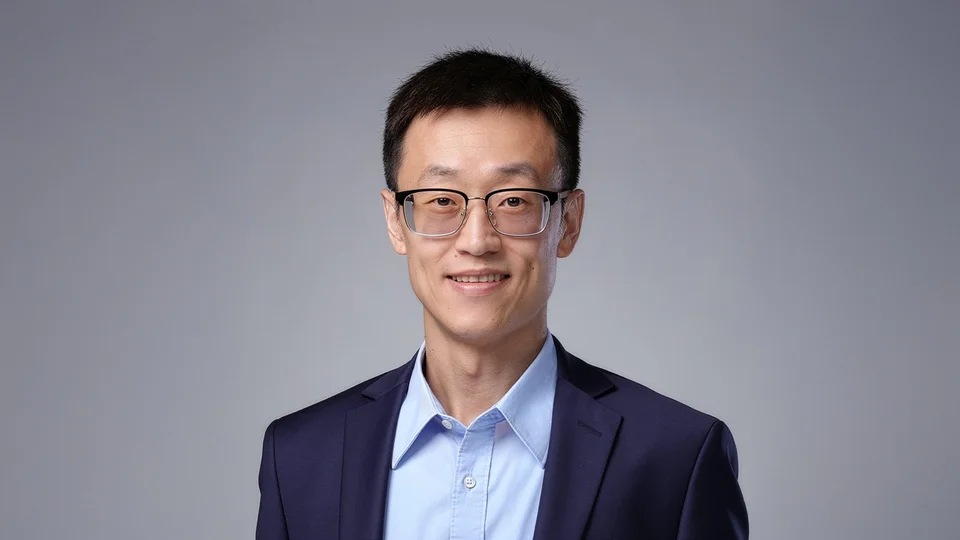
About Xin Gao Xin Gao Professor, Computer Science bioinformatics Computational biology machine learning big data Professor Gao is a world-leading expert in developing novel AI solutions for challenges in biology, biomedicine, and health and wellness, with a focus on AI-based drug development, large language models in biomedicine, biomedical imaging analysis, and omics-based disease detection and diagnostics. Events Presented Events Apr 30 - May 6, 2023 Student Poster Competition: The KAUST Research Conference on Computational Advances in Structural Biology Xin Gao, Professor, Computer Science May 2, 12:15 - 14:00 B9 Hallway structural biology The Computational Bioscience Research Center (CBRC) will be holding a student poster competition as part of its yearly conference. This poster competition is open to KAUST students whose research is relevant to the conference theme ‘Computational Advances in Structural Biology’. To register, please click on the register button below. Once registered, you will receive instructions and submission codes for uploading your poster electronically. Register The deadline for submissions is April 1, 2023. The poster competition will be judged by an external panel of experts, and prizes will be awarded KAUST Research Conference 2023 on Computational Advances in Structural Biology Xin Gao, Professor, Computer Science May 1, 08:00 - May 3, 17:00 B4 B5 A0215 structural biology Computational Bioscience Research Center (CBRC) is pleased to announce the KAUST Research Conference 2023 on Computational Advances in Structural Biology. The conference will be held from May 1-3, 2023 at the Auditorium between Building 4 & 5. The visualization of the structure of a molecule, organelle or larger entity is key to understanding its biological function. Thus, structural biology is an extremely powerful means of unraveling the fundaments of life, but also of diseases. Consequently, structural biology is at the heart of medical therapies, including drug design, and has enabled the Apr 16 - Apr 22, 2023 CT-based COVID-19 Diagnosis and Prognosis through Novel AI Model Development Xin Gao, Professor, Computer Science Apr 18, 16:00 - 17:00 B2 L5 R5220 CT-based COVID-19 Diagnosis Prognosis novel methodology model development During the recent pandemic, urgent advances have been made by the scientific community in developing artificial intelligence (AI)-based computer-aided systems for CT-based COVID-19 diagnosis. In this talk, I will introduce our work on a fully-automatic, rapid, accurate, and machine-agnostic method that can segment and quantify the infection regions on CT scans from different sources. Apr 4 - Apr 10, 2021 A Rapid, Accurate and Machine-agnostic Segmentation and Quantification Method for CT-based COVID-19 Diagnosis Xin Gao, Professor, Computer Science Apr 8, 12:00 - 13:00 KAUST COVID-19 COVID-19 has caused a global pandemic and become the most urgent threat to the entire world. Tremendous efforts and resources have been invested in developing diagnosis. Despite the various, urgent advances in developing artificial intelligence (AI)-based computer-aided systems for CT-based COVID-19 diagnosis, most of the existing methods can only perform classification, whereas the state-of-the-art segmentation method requires a high level of human intervention. In this talk, I will introduce our recent work on a fully-automatic, rapid, accurate, and machine-agnostic method that can segment and quantify the infection regions on CT scans from different sources. Our method is founded upon three innovations: 1) an embedding method that projects any arbitrary CT scan to a same, standard space, so that the trained model becomes robust and generalizable; 2) the first CT scan simulator for COVID-19, by fitting the dynamic change of real patients’ data measured at different time points, which greatly alleviates the data scarcity issue; and 3) a novel deep learning algorithm to solve the large-scene-small-object problem, which decomposes the 3D segmentation problem into three 2D ones, and thus reduces the model complexity by an order of magnitude and, at the same time, significantly improves the segmentation accuracy. Comprehensive experimental results over multi-country, multi-hospital, and multi-machine datasets demonstrate the superior performance of our method over the existing ones and suggest its important application value in combating the disease. Feb 28 - Mar 6, 2021 Novel computational models in biological imaging Xin Gao, Professor, Computer Science Mar 1, 12:00 - 13:00 KAUST In this talk, I will introduce our recent efforts on developing novel computational models in the field of biological imaging. I will start with the examples in electron tomography, for which I will introduce a robust and efficient scheme for fiducial marker tracking, and then describe a novel constrained reconstruction model towards higher resolution sub-tomogram averaging. I will then show our work on developing deep learning methods for super-resolution fluorescence microscopy. Nov 22 - Nov 28, 2020 Towards Accurate Biomedical Genomics Anywhere Anytime - Public Colloquium Xin Gao, Professor, Computer Science Nov 24, 14:00 - 15:30 KAUST In this talk, I will first give an overview of the research activities in Structural and Functional Bioinformatics Group (http://sfb.kaust.edu.sa). I will then focus on our efforts on developing computational methods to tackle key open problems in Nanopore sequencing. In particular, I will introduce our recent works on developing a collection of computational methods to decode raw electrical current signal sequences into DNA sequences, to simulate raw signals of Nanopore, and to efficiently and accurately align electrical current signal sequences with DNA sequences. I will further introduce their applications in biomedicine and healthcare. Apr 12 - Apr 18, 2020 Quantitative understanding of transcription factor regulation at network- and molecular-levels through optimization and deep learning Xin Gao, Professor, Computer Science Apr 16, 12:00 - 13:00 KAUST transcription factor optimization Deep learning Transcription factors are an important family of proteins that control the transcription rate from DNAs to messenger RNAs through the binding to specific DNA sequences. Transcription factor regulation is thus fundamental to understanding not only the system-level behaviors of gene regulatory networks, but also the molecular mechanisms underpinning endogenous gene regulation. In this talk, I will introduce our efforts on developing novel optimization and deep learning methods to quantitatively understanding transcription factor regulation at network- and molecular-levels. Specifically, I will talk about how we estimate the kinetic parameters from sparse time-series readout of gene circuit models, and how we model the relationship between the transcription factor binding sites and their binding affinities. Feb 16 - Feb 22, 2020 Towards Accurate Biomedical Genomics Anywhere Anytime - Graduate Seminar Xin Gao, Professor, Computer Science Feb 17, 12:00 - 13:00 B9 L2 H1 R2322 biomedicine DNA sequencing Abstract Current genetic diagnosis by next-generation sequencing requires a large investment of resources and offers little point-of-care portability. Furthermore, it is unable to detect many types of genetic variations - including large deletions, duplications, and balanced translocations - that are relevant to human diseases and health. Comparing to other sequencing technologies, Nanopore sequencing owns the advantages of point-of-care (i.e., sequencing anywhere anytime), long reads (i.e., assembly-free to detect various genetic variations), and PCR free (i.e., sample preparation is easy) Sep 1 - Sep 7, 2019 Zero in on computational challenges in Nanopore sequencing Xin Gao, Professor, Computer Science Sep 2, 12:00 - 13:00 B9 L2 H1 bioinformatics machine learning Nanopore Sequencing DNA sequences In this talk, I will first give an overview of the research activities in Structural and Functional Bioinformatics Group (http://sfb.kaust.edu.sa). I will then focus on our efforts on developing computational methods to tackle key open problems in Nanopore sequencing. In particular, I will introduce our recent works on developing a collection of computational methods to decode raw electrical current signal sequences into DNA sequences, to simulate raw signals of Nanopore, and to efficiently and accurately align electrical current signal sequences with DNA sequences. Then, I will further introduce their applications in clinical and environmental fields. Mar 18 - Mar 24, 2018 Computational and Statistical Interface to Big Data Xin Gao, Professor, Computer Science Mar 19, 08:00 - Mar 21, 17:00 B9 L2 H2 We are now in the fourth paradigm of science: Data Science. The massive amount of structured and unstructured data has posed new challenges and opportunities to the fields of computer science and statistics. Traditional computational and statistical methods for data storage, curation, sharing, querying, updating, visualization, analysis, and privacy have been shown to fail in the big data scenario due to the unprecedented volume, velocity, variety, veracity and value of the big data. This conference will bring together a number of prominent researchers in Computer Science and Statistics with common interests and active research in big data, as well as the researchers at KAUST who regularly generate or face big data, such as those in bioscience and red sea research.
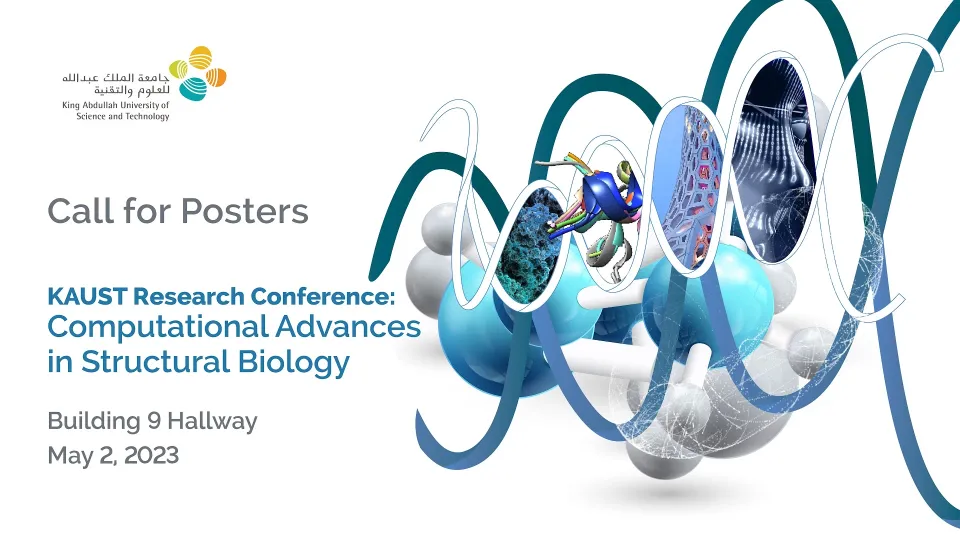
Student Poster Competition: The KAUST Research Conference on Computational Advances in Structural Biology Xin Gao, Professor, Computer Science May 2, 12:15 - 14:00 B9 Hallway structural biology The Computational Bioscience Research Center (CBRC) will be holding a student poster competition as part of its yearly conference. This poster competition is open to KAUST students whose research is relevant to the conference theme ‘Computational Advances in Structural Biology’. To register, please click on the register button below. Once registered, you will receive instructions and submission codes for uploading your poster electronically. Register The deadline for submissions is April 1, 2023. The poster competition will be judged by an external panel of experts, and prizes will be awarded
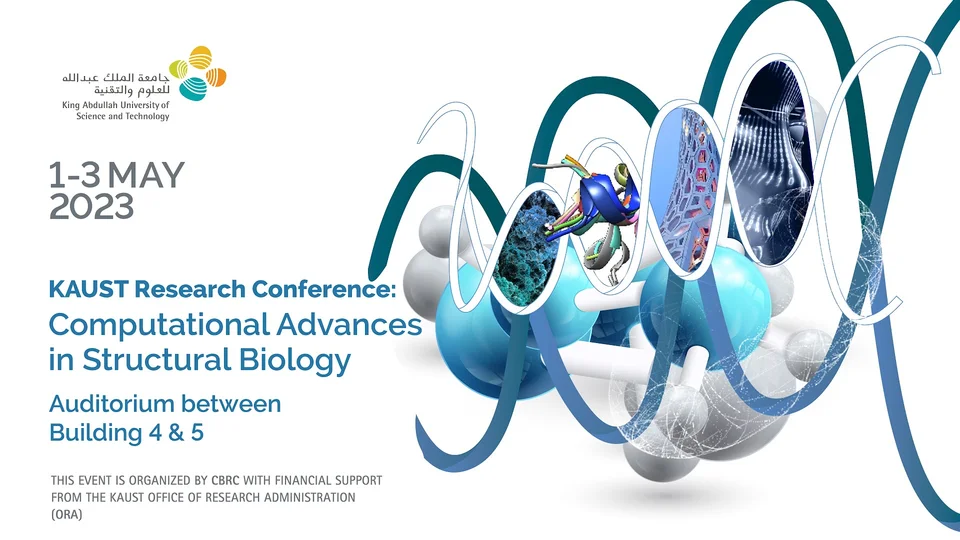
KAUST Research Conference 2023 on Computational Advances in Structural Biology Xin Gao, Professor, Computer Science May 1, 08:00 - May 3, 17:00 B4 B5 A0215 structural biology Computational Bioscience Research Center (CBRC) is pleased to announce the KAUST Research Conference 2023 on Computational Advances in Structural Biology. The conference will be held from May 1-3, 2023 at the Auditorium between Building 4 & 5. The visualization of the structure of a molecule, organelle or larger entity is key to understanding its biological function. Thus, structural biology is an extremely powerful means of unraveling the fundaments of life, but also of diseases. Consequently, structural biology is at the heart of medical therapies, including drug design, and has enabled the
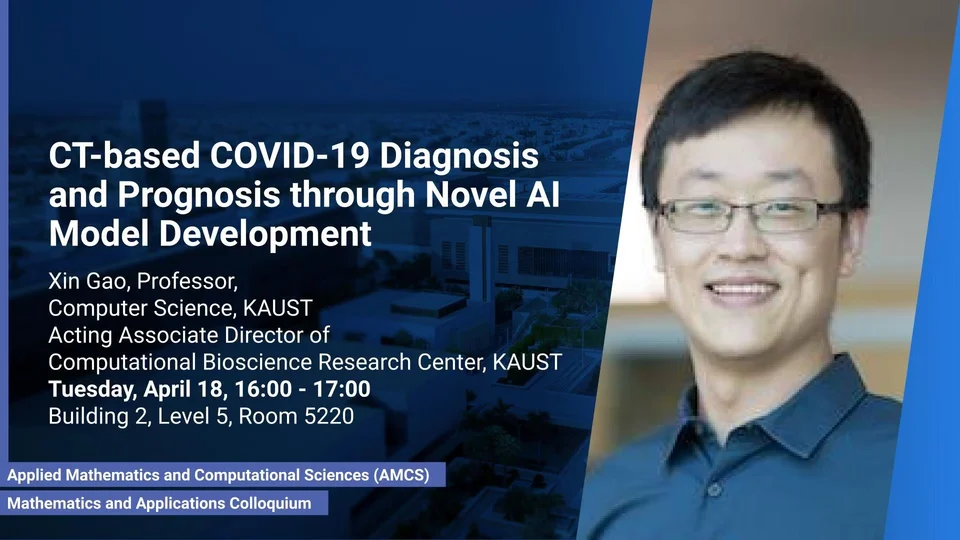
CT-based COVID-19 Diagnosis and Prognosis through Novel AI Model Development Xin Gao, Professor, Computer Science Apr 18, 16:00 - 17:00 B2 L5 R5220 CT-based COVID-19 Diagnosis Prognosis novel methodology model development During the recent pandemic, urgent advances have been made by the scientific community in developing artificial intelligence (AI)-based computer-aided systems for CT-based COVID-19 diagnosis. In this talk, I will introduce our work on a fully-automatic, rapid, accurate, and machine-agnostic method that can segment and quantify the infection regions on CT scans from different sources.
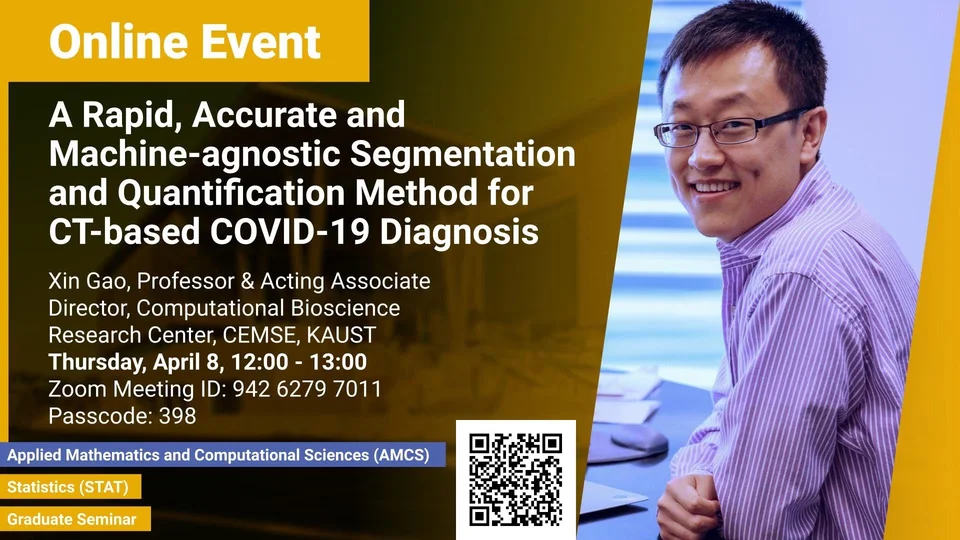
A Rapid, Accurate and Machine-agnostic Segmentation and Quantification Method for CT-based COVID-19 Diagnosis Xin Gao, Professor, Computer Science Apr 8, 12:00 - 13:00 KAUST COVID-19 COVID-19 has caused a global pandemic and become the most urgent threat to the entire world. Tremendous efforts and resources have been invested in developing diagnosis. Despite the various, urgent advances in developing artificial intelligence (AI)-based computer-aided systems for CT-based COVID-19 diagnosis, most of the existing methods can only perform classification, whereas the state-of-the-art segmentation method requires a high level of human intervention. In this talk, I will introduce our recent work on a fully-automatic, rapid, accurate, and machine-agnostic method that can segment and quantify the infection regions on CT scans from different sources. Our method is founded upon three innovations: 1) an embedding method that projects any arbitrary CT scan to a same, standard space, so that the trained model becomes robust and generalizable; 2) the first CT scan simulator for COVID-19, by fitting the dynamic change of real patients’ data measured at different time points, which greatly alleviates the data scarcity issue; and 3) a novel deep learning algorithm to solve the large-scene-small-object problem, which decomposes the 3D segmentation problem into three 2D ones, and thus reduces the model complexity by an order of magnitude and, at the same time, significantly improves the segmentation accuracy. Comprehensive experimental results over multi-country, multi-hospital, and multi-machine datasets demonstrate the superior performance of our method over the existing ones and suggest its important application value in combating the disease.
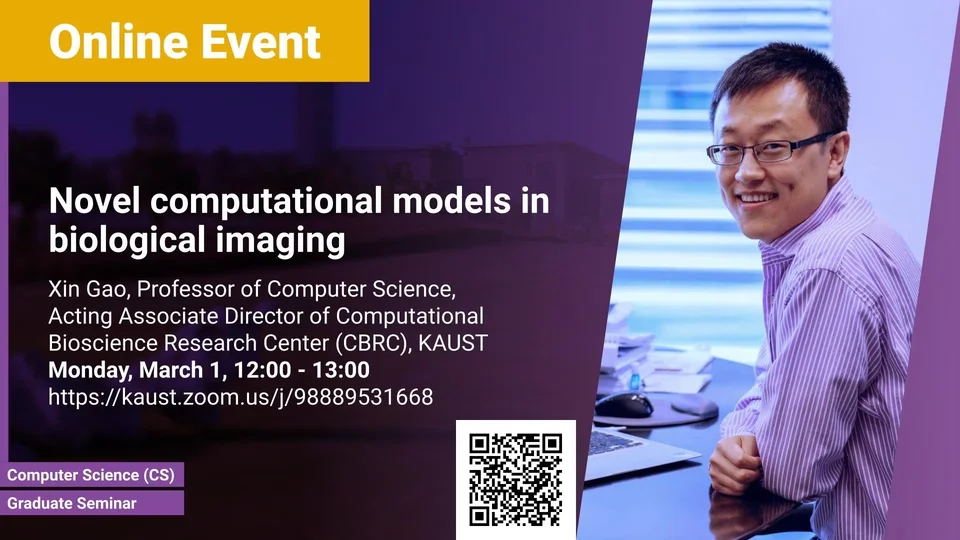
Novel computational models in biological imaging Xin Gao, Professor, Computer Science Mar 1, 12:00 - 13:00 KAUST In this talk, I will introduce our recent efforts on developing novel computational models in the field of biological imaging. I will start with the examples in electron tomography, for which I will introduce a robust and efficient scheme for fiducial marker tracking, and then describe a novel constrained reconstruction model towards higher resolution sub-tomogram averaging. I will then show our work on developing deep learning methods for super-resolution fluorescence microscopy.
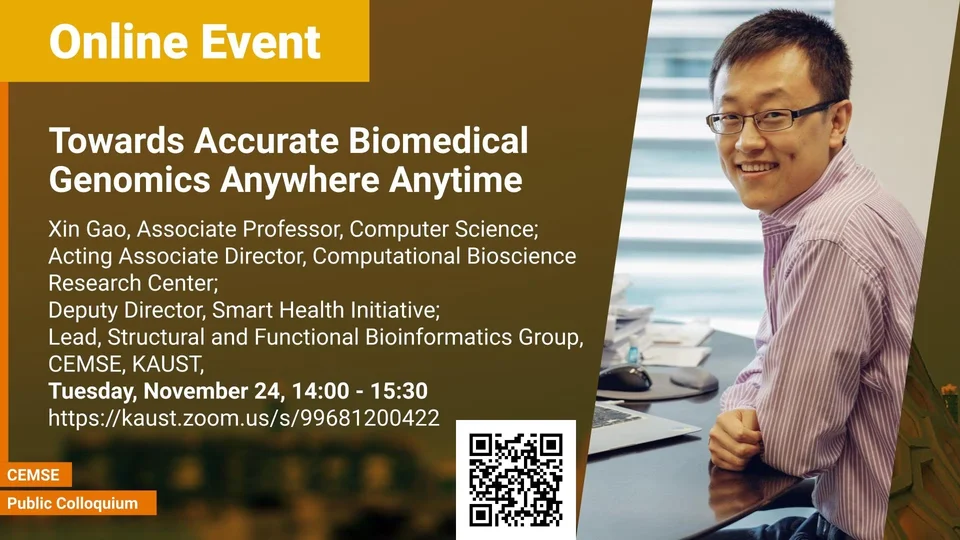
Towards Accurate Biomedical Genomics Anywhere Anytime - Public Colloquium Xin Gao, Professor, Computer Science Nov 24, 14:00 - 15:30 KAUST In this talk, I will first give an overview of the research activities in Structural and Functional Bioinformatics Group (http://sfb.kaust.edu.sa). I will then focus on our efforts on developing computational methods to tackle key open problems in Nanopore sequencing. In particular, I will introduce our recent works on developing a collection of computational methods to decode raw electrical current signal sequences into DNA sequences, to simulate raw signals of Nanopore, and to efficiently and accurately align electrical current signal sequences with DNA sequences. I will further introduce their applications in biomedicine and healthcare.
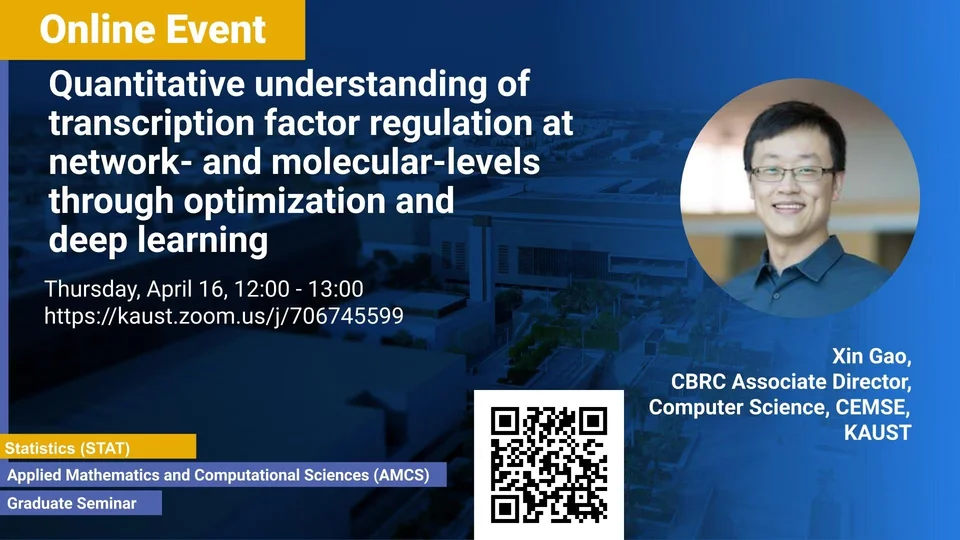
Quantitative understanding of transcription factor regulation at network- and molecular-levels through optimization and deep learning Xin Gao, Professor, Computer Science Apr 16, 12:00 - 13:00 KAUST transcription factor optimization Deep learning Transcription factors are an important family of proteins that control the transcription rate from DNAs to messenger RNAs through the binding to specific DNA sequences. Transcription factor regulation is thus fundamental to understanding not only the system-level behaviors of gene regulatory networks, but also the molecular mechanisms underpinning endogenous gene regulation. In this talk, I will introduce our efforts on developing novel optimization and deep learning methods to quantitatively understanding transcription factor regulation at network- and molecular-levels. Specifically, I will talk about how we estimate the kinetic parameters from sparse time-series readout of gene circuit models, and how we model the relationship between the transcription factor binding sites and their binding affinities.
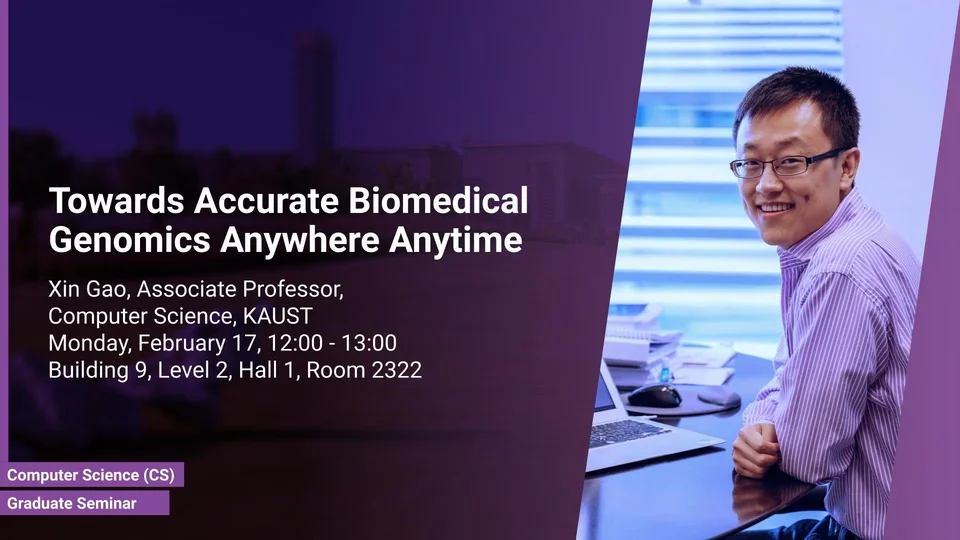
Towards Accurate Biomedical Genomics Anywhere Anytime - Graduate Seminar Xin Gao, Professor, Computer Science Feb 17, 12:00 - 13:00 B9 L2 H1 R2322 biomedicine DNA sequencing Abstract Current genetic diagnosis by next-generation sequencing requires a large investment of resources and offers little point-of-care portability. Furthermore, it is unable to detect many types of genetic variations - including large deletions, duplications, and balanced translocations - that are relevant to human diseases and health. Comparing to other sequencing technologies, Nanopore sequencing owns the advantages of point-of-care (i.e., sequencing anywhere anytime), long reads (i.e., assembly-free to detect various genetic variations), and PCR free (i.e., sample preparation is easy)
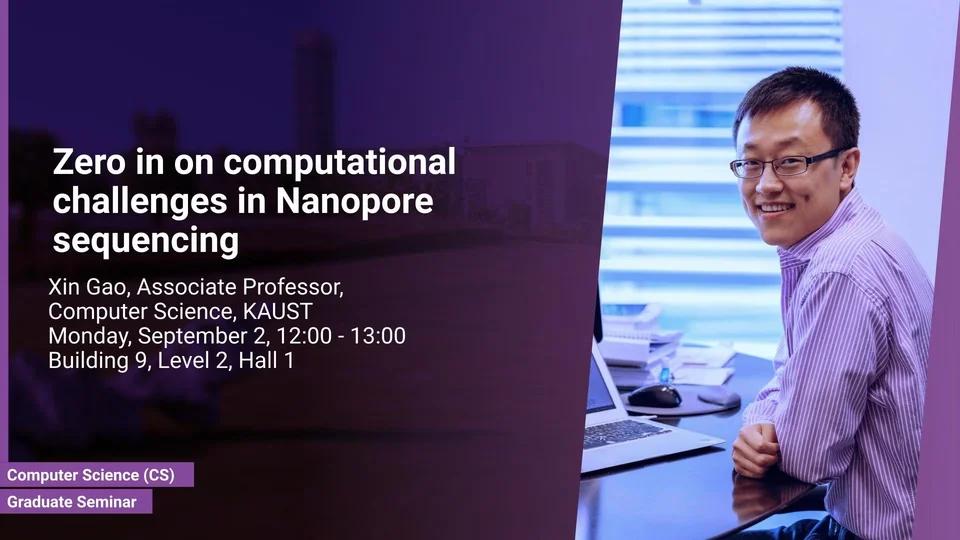
Zero in on computational challenges in Nanopore sequencing Xin Gao, Professor, Computer Science Sep 2, 12:00 - 13:00 B9 L2 H1 bioinformatics machine learning Nanopore Sequencing DNA sequences In this talk, I will first give an overview of the research activities in Structural and Functional Bioinformatics Group (http://sfb.kaust.edu.sa). I will then focus on our efforts on developing computational methods to tackle key open problems in Nanopore sequencing. In particular, I will introduce our recent works on developing a collection of computational methods to decode raw electrical current signal sequences into DNA sequences, to simulate raw signals of Nanopore, and to efficiently and accurately align electrical current signal sequences with DNA sequences. Then, I will further introduce their applications in clinical and environmental fields.
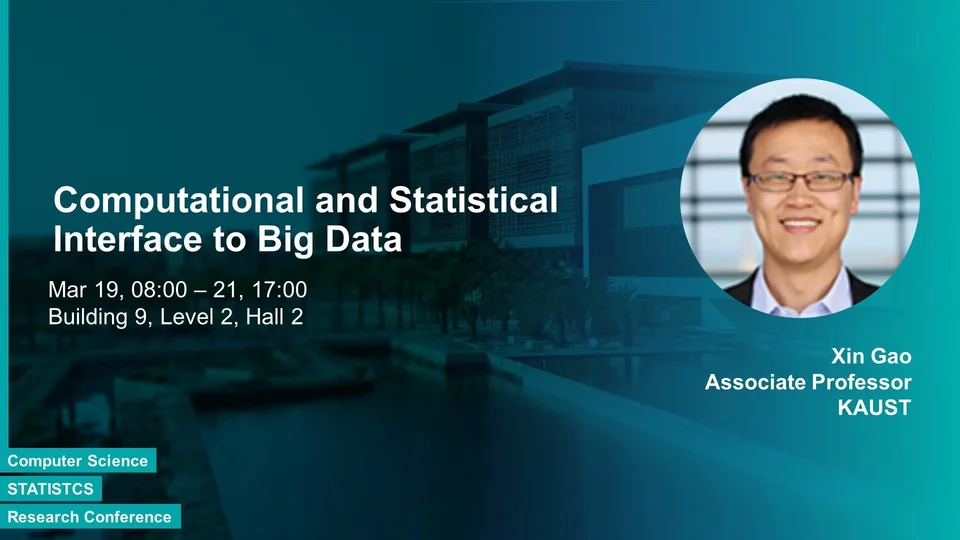
Computational and Statistical Interface to Big Data Xin Gao, Professor, Computer Science Mar 19, 08:00 - Mar 21, 17:00 B9 L2 H2 We are now in the fourth paradigm of science: Data Science. The massive amount of structured and unstructured data has posed new challenges and opportunities to the fields of computer science and statistics. Traditional computational and statistical methods for data storage, curation, sharing, querying, updating, visualization, analysis, and privacy have been shown to fail in the big data scenario due to the unprecedented volume, velocity, variety, veracity and value of the big data. This conference will bring together a number of prominent researchers in Computer Science and Statistics with common interests and active research in big data, as well as the researchers at KAUST who regularly generate or face big data, such as those in bioscience and red sea research.
Engage ORCID KAUST Repository KAUST Academic Portal Scopus ShareClipboard Related Sites Computer Science (CS) Statistics (STAT) Bioengineering (BioE) Bioscience (B) Center of Excellence for Smart Health (KCSH) Center of Excellence for Generative AI (GenAI) Structural and Functional Bioinformatics (SFB) Related Content Articles 75 Events 10