About Hatem Ltaief Hatem Ltaief Principal Research Scientist, Applied Mathematics and Computational Science High Performance Computing parallel numerical algorithms Performance optimization Dr. Hatem Ltaief is a Principal Research Scientist at KAUST. He works on mixed-precision algorithms and performance optimizations to help HPC scientific applications address the exascale challenges. His innovations have been recognized with the ACM Gordon Bell Prize (shared) for Climate Modeling in 2024. Articles Related News November 2024 KAUST wins the “Nobel” of high-performance computing for climate modeling 1 min read · Fri, Nov 22 2024 News Clip News HPC climate projections extreme computing computational simulations uncertainty quantification KAUST has been awarded the “Nobel" prize of high-performance computing—the ACM Gordon Bell Prize for Climate Modelling—in partnership with the NSF National Center for Atmospheric Research, U.S. and other partner institutions. August 2024 KAUST researchers earn dual Bell finalist selections 1 min read · Thu, Aug 1 2024 News Clip Awards KAUST has achieved a historic double finalist selection for the ACM Gordon Bell Prize and the ACM Gordon Bell Prize for Climate Modeling, recognizing two innovative research projects in collaboration with global partners that demonstrate the power of interdisciplinary teamwork in high-performance computing and climate science. July 2024 KAUST team selected as ACM Gordon Bell Prize for Climate Modelling finalists 4 min read · Tue, Jul 23 2024 News A new exascale climate emulator marks a significant advancement as the first to generate, display and evaluate hourly emulations. This breakthrough secured an interdisciplinary research team from KAUST, working alongside the NSF National Center for Atmospheric Research in the U.S. and other partner institutions, a spot as a finalist for the prestigious Gordon Bell Prize in Climate Modelling. May 2023 Compress to impress with AI hardware 2 min read · Thu, May 18 2023 News Scientists can speed up simulations of complex systems by using compression algorithms running on AI hardware. October 2022 A predictive eye on the prize 3 min read · Sun, Oct 16 2022 Awards News HPC weather forecast climate science Climate prediction models have had a mathematical makeover that has won attention from a computer science award. September 2022 Designing Tomorrow's Algorithms on Today's Architectures: a Case Study with Stencil Computations Using AMD 3D V-Cache™ Technology 2 min read · Mon, Sep 12 2022 News HPC Performance optimization seismic imaging Regular stencil computations constitute the main core kernel in many temporally explicit approaches for structured grid finite-difference, finite-volume, and finite-element discretizations of partial differential equation conservation laws. For various blocking dimensions, the Spatial Blocking (SB) approach enables data reuse within multiple cache levels. However, the straightforward generalization of SB to manycore architectures, with each core owning an exclusive share of cache may leave performance on the table. The next two figures show the typical 25-point 3D star stencil used in seismic August 2022 A model for millions of locations 1 min read · Tue, Aug 23 2022 News climate change Environmental Statistics modeling statistics CEMSE statisticians developed a framework which enables modeling of a range of meteorological and environmental datasets from up to 2 million locations globally. July 2021 Mixing precision for model acceleration 1 min read · Mon, Jul 26 2021 News extreme computing supercomputing big data statistics A mixed-precision approach for modeling large geospatial datasets can achieve benchmark accuracy with a fraction of the computational run time. May 2021 Our Masked Guest Speakers Series 1 min read · Sun, May 2 2021 News Masked Guest Speakers High Performance Computing numerical linear algebra Performance optimization Every week, we have a masked guest speaker opening our HiCMA weekly meeting by giving a remote talk on broad topics related to numerical linear algebra, high performance computing, programming models and performance optimizations. Our motto is fun and science! February 2021 ECRC contributions to SIAM CSE21 4 min read · Sat, Feb 27 2021 News research conference HPC computational science and engineering ECRC @ SIAM CSE21! Follow us @KAUST_ECRC As in previous SIAM conferences on Parallel Processing (PP) and Computational Science and Engineering (CSE), ECRC members and their collaborators will have a strong presence at SIAM CSE21, nominally in Fort Worth, Texas, but held virtually due to the pandemic. ************************************************** SIAM CSE21 will run virtually with live sessions. ************************************************** Registration to SIAM CSE is required to gain access to the online platform and attend live sessions. Once registered, please use your personal November 2020 Keep the data coming 1 min read · Mon, Nov 9 2020 News big data extreme computing applied mathematics computational science A continuous data supply ensures data-intensive simulations can run at maximum speed. September 2020 Turning your desktop to a Supercomputer with ExaGeoStatR 1 min read · Mon, Sep 7 2020 News Maximum Likelihood HPC Environmental Statistics Turning your desktop to a Supercomputer with ExaGeoStatR Download at https://github.com/ecrc/exageostatR. Remember the old times where you had to leave your R simulations running for the whole night on your desktop due to a large climate/weather dataset? ExaGeoStatR combines the user productivity of R with high performance computing linear algebra software libraries to deliver supercomputing-style environment right below your desk. ExaGeoStatR enables computing the maximum likelihood using large environmental datasets on R, while extracting performance from the underlying hardware resources August 2020 Tariq receives his best paper award at EuroPar'2020 1 min read · Thu, Aug 27 2020 News High Performance Computing GPU Computing burst buffer scientific computing Parallel and Distributed Computing Maximizing I/O Bandwidth for Out-of-Core HPC Applications on Heterogeneous Large-Scale Systems Best Paper Presentation by Tariq Alturkestani PhD Student, Computer Science, KAUST Thursday, Aug 27, 3:30pm - 4:00pm (AST) https://zoom.us/j/99947879910 Tariq will present his best paper at EuroPar'2020 at the virtual EuroPar'2020 conference in Warsaw, Poland. The reverse time migration (RTM) method is critical in seismic imaging for oil and gas industries. He demonstrates the effectiveness of his Multilayer Buffer System (MLBS) framework on Shaheen-2 (using 2048 compute nodes) and Summit July 2020 PhD Defense of Tariq AlTurkestani 1 min read · Sun, Jul 5 2020 News PhD Defense HPC scientific computing parallel simulations Parallel and Distributed Computing Maximizing I/O Bandwidth for Out-of-Core HPC Applications on Heterogeneous Large-Scale Systems PhD Dissertation Defense by Tariq Alturkestani PhD Student, Computer Science Thursday, July 9, 16:00 - 17:00, https://kaust.zoom.us/j/94054511362 Contact Person: Tariq Alturkestani The execution rate of floating-point operations has typically increased by an order of magnitude every four years during the last 30 years of modern comput ing. This exponential growth in terms of computational power has benefited from the hardware technology scaling. However, memory and storage systems have not maintained June 2020 KAUST scientists win prestigious Gauss Award for supercomputing excellence 2 min read · Fri, Jun 26 2020 News HPC supercomputing numerical linear algebra parallel computing KAUST Ph.D. graduate Dr. Noha Al-Harthi and doctoral student Rabab Alomairy, have won the German Gauss Center for Supercomputing (GCS) Award for original research that best advances high-performance computing. This makes KAUST the first Middle Eastern institution to receive this prestigious award. May 2019 Cutting datasets down to size 1 min read · Thu, May 16 2019 News applied mathematics computational science statistics environment A powerful statistical tool could significantly reduce the burden of analyzing very large datasets. October 2018 Award-winning algorithm takes search for habitable planets to the next level 1 min read · Tue, Oct 16 2018 News telescope astronomy NVIDIA PASC singular-value-decomposition-MOAO An international team of scientists, including KAUST high performance computing experts and astronomers from the Paris Observatory and the National Astronomical Observatory of Japan (NAOJ), in collaboration with NVIDIA, is taking the search for habitable planets and observation of first epoch galaxies to the next level. August 2018 Award-winning algorithm aids observation 1 min read · Mon, Aug 27 2018 News astronomy telescope extreme computing Researchers at the Extreme Computing Research Center (ECRC) at KAUST have developed a new algorithm that uses supervised machine learning to control a small high-speed deformable mirror inside the exoplanet imaging camera to compensate for atmospheric turbulence in the Subaru Telescope, which has an 8.2 meter diameter. July 2018 Superior seismic imaging for better drilling 1 min read · Sun, Jul 8 2018 News seismic imaging fossil fuels extreme computing data analysis Software could transform underground imaging of fossil fuel reserves by providing unprecedented detail in record time. February 2018 ECRC brings astronomy back home 4 min read · Tue, Feb 20 2018 News optical telescope GPU Computing parallel algorithms Astronomy research excellence is coming back home to the Middle East, where it took its first steps around 1200 BC. Custome new software developed by the KAUST Extreme Computing Research Center (ECRC) was released at the end of 2017. Named MOAO - Multiple Object Adaptive Optics â the software will contribute to the activities of the world's largest future optical telescope to be deployed in Chile in 2024. January 2017 New cost-effective GPUs solver redesigns the computational game 2 min read · Thu, Jan 12 2017 News exascale High Performance Computing parallel computing Prof. David Keyes and his team proposed a GPUs light architecture to solve systems of multiple equations involving a large amount of data. Broadly used in computer gaming, mobile, and PC graphics - GPUs allow customizing an effective result-driven support to create a computational framework for increasing the number of processors while reducing the memory required to temporarily store the data. Taking graphics cards beyond gaming 1 min read · Mon, Jan 9 2017 News graphic card computing applied mathematics computational science A highly efficient mathematical solver designed to run on graphics processors gives scientists and engineers a powerful new tool for a common computational problem.
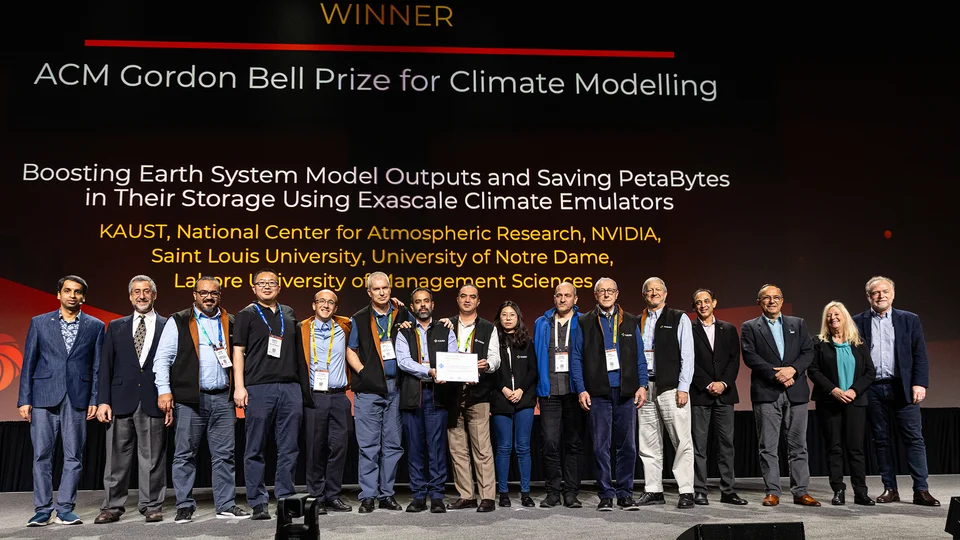
KAUST wins the “Nobel” of high-performance computing for climate modeling 1 min read · Fri, Nov 22 2024 News Clip News HPC climate projections extreme computing computational simulations uncertainty quantification KAUST has been awarded the “Nobel" prize of high-performance computing—the ACM Gordon Bell Prize for Climate Modelling—in partnership with the NSF National Center for Atmospheric Research, U.S. and other partner institutions.
KAUST researchers earn dual Bell finalist selections 1 min read · Thu, Aug 1 2024 News Clip Awards KAUST has achieved a historic double finalist selection for the ACM Gordon Bell Prize and the ACM Gordon Bell Prize for Climate Modeling, recognizing two innovative research projects in collaboration with global partners that demonstrate the power of interdisciplinary teamwork in high-performance computing and climate science.
KAUST team selected as ACM Gordon Bell Prize for Climate Modelling finalists 4 min read · Tue, Jul 23 2024 News A new exascale climate emulator marks a significant advancement as the first to generate, display and evaluate hourly emulations. This breakthrough secured an interdisciplinary research team from KAUST, working alongside the NSF National Center for Atmospheric Research in the U.S. and other partner institutions, a spot as a finalist for the prestigious Gordon Bell Prize in Climate Modelling.
Compress to impress with AI hardware 2 min read · Thu, May 18 2023 News Scientists can speed up simulations of complex systems by using compression algorithms running on AI hardware.
A predictive eye on the prize 3 min read · Sun, Oct 16 2022 Awards News HPC weather forecast climate science Climate prediction models have had a mathematical makeover that has won attention from a computer science award.
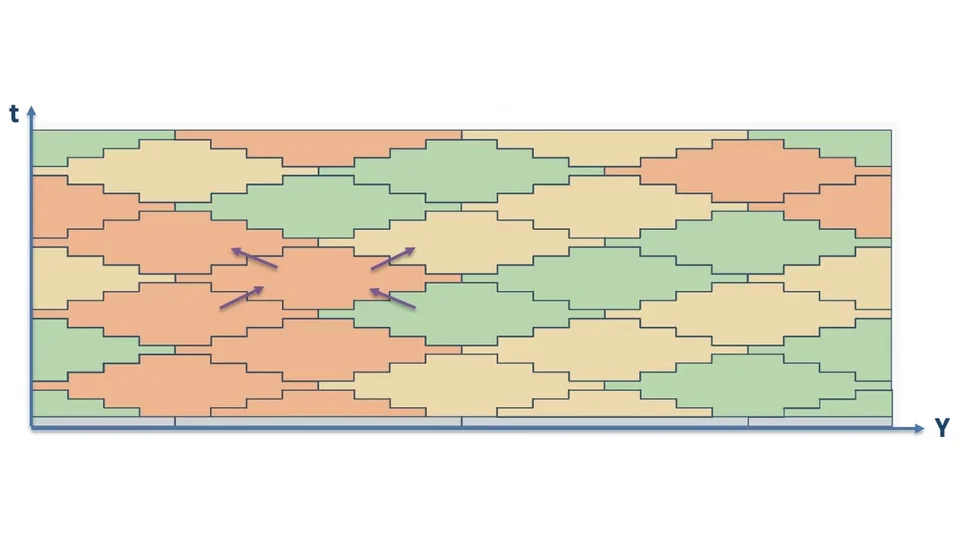
Designing Tomorrow's Algorithms on Today's Architectures: a Case Study with Stencil Computations Using AMD 3D V-Cache™ Technology 2 min read · Mon, Sep 12 2022 News HPC Performance optimization seismic imaging Regular stencil computations constitute the main core kernel in many temporally explicit approaches for structured grid finite-difference, finite-volume, and finite-element discretizations of partial differential equation conservation laws. For various blocking dimensions, the Spatial Blocking (SB) approach enables data reuse within multiple cache levels. However, the straightforward generalization of SB to manycore architectures, with each core owning an exclusive share of cache may leave performance on the table. The next two figures show the typical 25-point 3D star stencil used in seismic
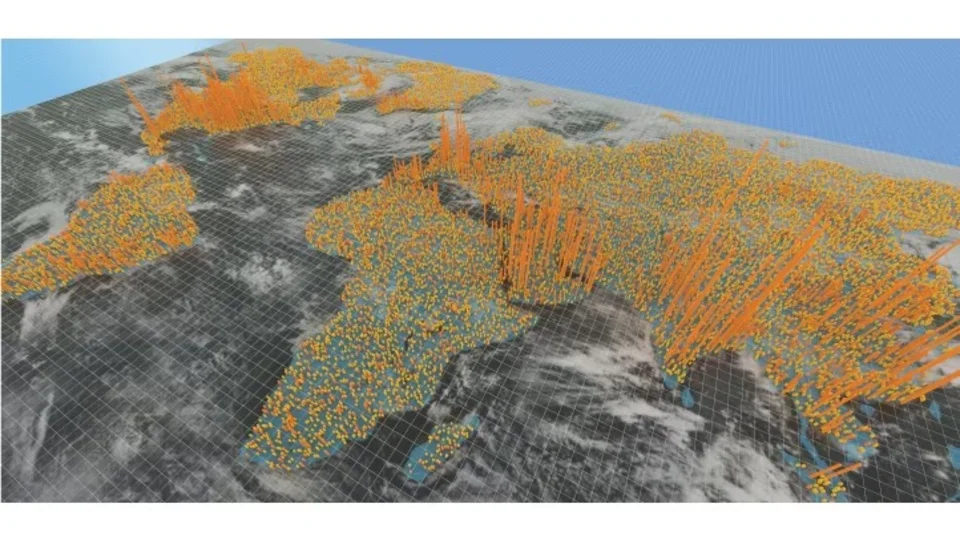
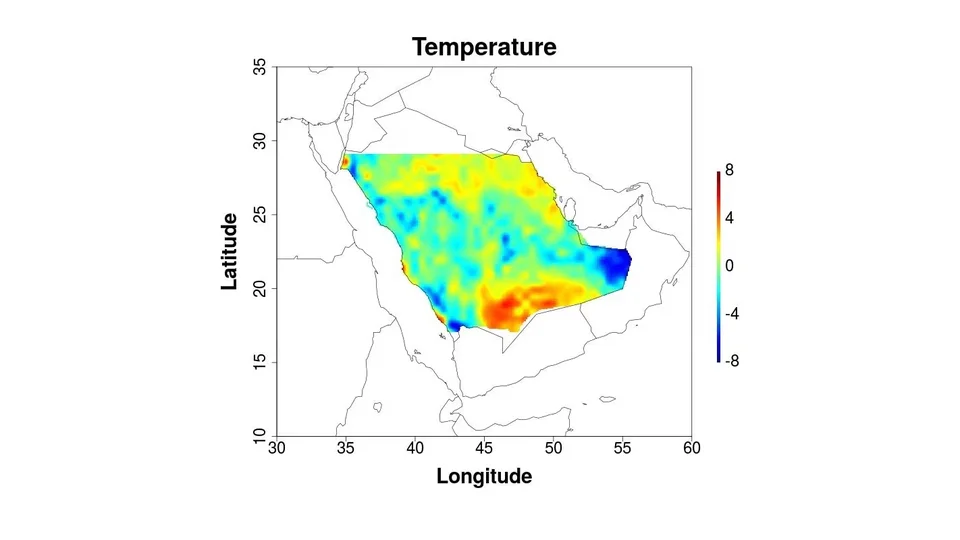
A model for millions of locations 1 min read · Tue, Aug 23 2022 News climate change Environmental Statistics modeling statistics CEMSE statisticians developed a framework which enables modeling of a range of meteorological and environmental datasets from up to 2 million locations globally.
Mixing precision for model acceleration 1 min read · Mon, Jul 26 2021 News extreme computing supercomputing big data statistics A mixed-precision approach for modeling large geospatial datasets can achieve benchmark accuracy with a fraction of the computational run time.
Our Masked Guest Speakers Series 1 min read · Sun, May 2 2021 News Masked Guest Speakers High Performance Computing numerical linear algebra Performance optimization Every week, we have a masked guest speaker opening our HiCMA weekly meeting by giving a remote talk on broad topics related to numerical linear algebra, high performance computing, programming models and performance optimizations. Our motto is fun and science!
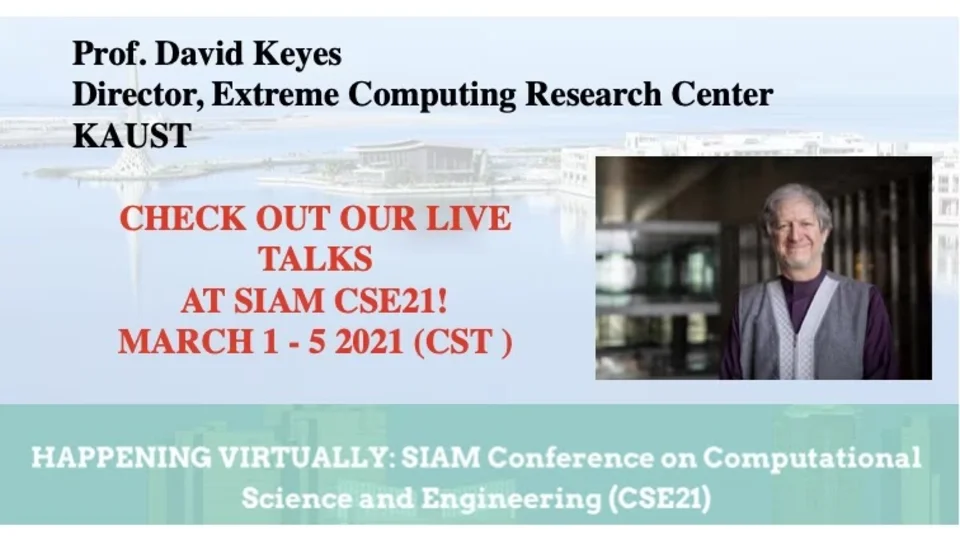
ECRC contributions to SIAM CSE21 4 min read · Sat, Feb 27 2021 News research conference HPC computational science and engineering ECRC @ SIAM CSE21! Follow us @KAUST_ECRC As in previous SIAM conferences on Parallel Processing (PP) and Computational Science and Engineering (CSE), ECRC members and their collaborators will have a strong presence at SIAM CSE21, nominally in Fort Worth, Texas, but held virtually due to the pandemic. ************************************************** SIAM CSE21 will run virtually with live sessions. ************************************************** Registration to SIAM CSE is required to gain access to the online platform and attend live sessions. Once registered, please use your personal
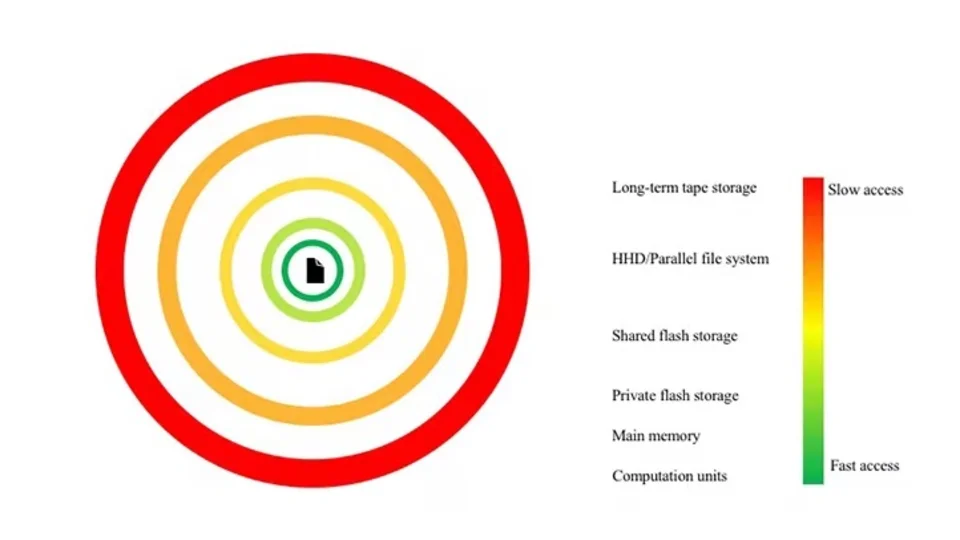
Keep the data coming 1 min read · Mon, Nov 9 2020 News big data extreme computing applied mathematics computational science A continuous data supply ensures data-intensive simulations can run at maximum speed.
Turning your desktop to a Supercomputer with ExaGeoStatR 1 min read · Mon, Sep 7 2020 News Maximum Likelihood HPC Environmental Statistics Turning your desktop to a Supercomputer with ExaGeoStatR Download at https://github.com/ecrc/exageostatR. Remember the old times where you had to leave your R simulations running for the whole night on your desktop due to a large climate/weather dataset? ExaGeoStatR combines the user productivity of R with high performance computing linear algebra software libraries to deliver supercomputing-style environment right below your desk. ExaGeoStatR enables computing the maximum likelihood using large environmental datasets on R, while extracting performance from the underlying hardware resources
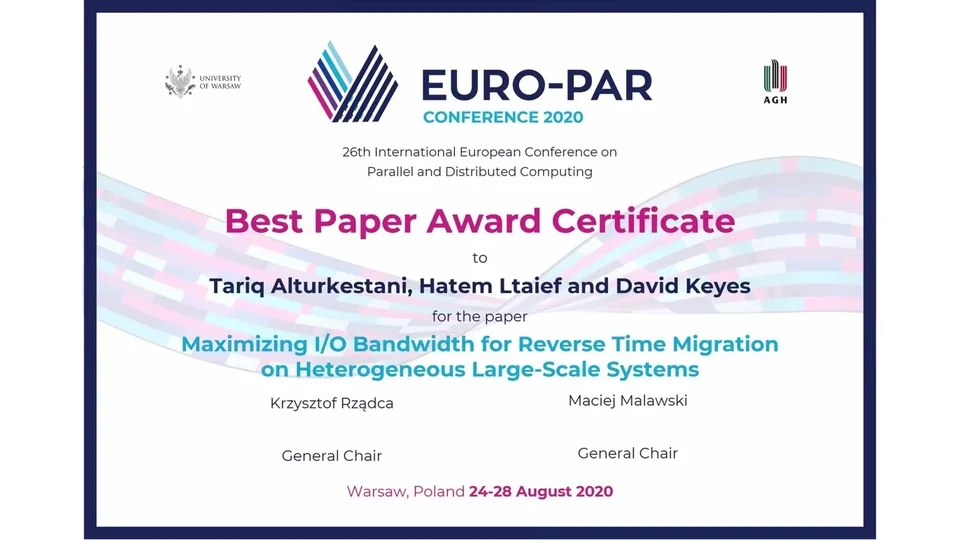
Tariq receives his best paper award at EuroPar'2020 1 min read · Thu, Aug 27 2020 News High Performance Computing GPU Computing burst buffer scientific computing Parallel and Distributed Computing Maximizing I/O Bandwidth for Out-of-Core HPC Applications on Heterogeneous Large-Scale Systems Best Paper Presentation by Tariq Alturkestani PhD Student, Computer Science, KAUST Thursday, Aug 27, 3:30pm - 4:00pm (AST) https://zoom.us/j/99947879910 Tariq will present his best paper at EuroPar'2020 at the virtual EuroPar'2020 conference in Warsaw, Poland. The reverse time migration (RTM) method is critical in seismic imaging for oil and gas industries. He demonstrates the effectiveness of his Multilayer Buffer System (MLBS) framework on Shaheen-2 (using 2048 compute nodes) and Summit
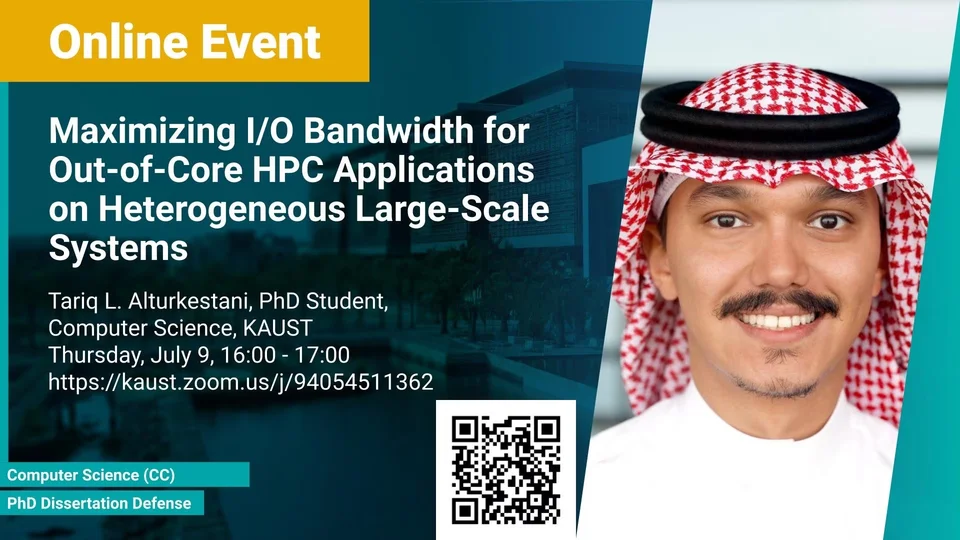
PhD Defense of Tariq AlTurkestani 1 min read · Sun, Jul 5 2020 News PhD Defense HPC scientific computing parallel simulations Parallel and Distributed Computing Maximizing I/O Bandwidth for Out-of-Core HPC Applications on Heterogeneous Large-Scale Systems PhD Dissertation Defense by Tariq Alturkestani PhD Student, Computer Science Thursday, July 9, 16:00 - 17:00, https://kaust.zoom.us/j/94054511362 Contact Person: Tariq Alturkestani The execution rate of floating-point operations has typically increased by an order of magnitude every four years during the last 30 years of modern comput ing. This exponential growth in terms of computational power has benefited from the hardware technology scaling. However, memory and storage systems have not maintained
KAUST scientists win prestigious Gauss Award for supercomputing excellence 2 min read · Fri, Jun 26 2020 News HPC supercomputing numerical linear algebra parallel computing KAUST Ph.D. graduate Dr. Noha Al-Harthi and doctoral student Rabab Alomairy, have won the German Gauss Center for Supercomputing (GCS) Award for original research that best advances high-performance computing. This makes KAUST the first Middle Eastern institution to receive this prestigious award.
Cutting datasets down to size 1 min read · Thu, May 16 2019 News applied mathematics computational science statistics environment A powerful statistical tool could significantly reduce the burden of analyzing very large datasets.
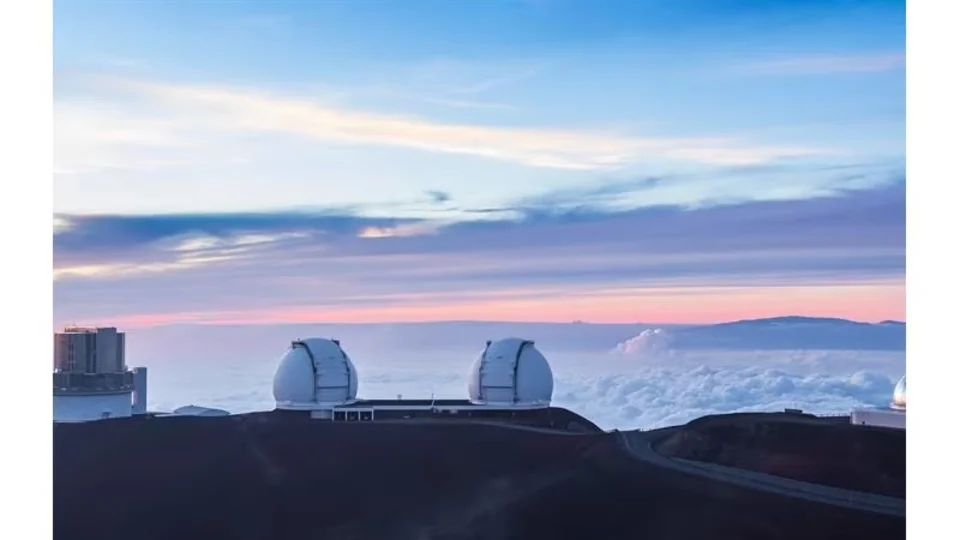
Award-winning algorithm takes search for habitable planets to the next level 1 min read · Tue, Oct 16 2018 News telescope astronomy NVIDIA PASC singular-value-decomposition-MOAO An international team of scientists, including KAUST high performance computing experts and astronomers from the Paris Observatory and the National Astronomical Observatory of Japan (NAOJ), in collaboration with NVIDIA, is taking the search for habitable planets and observation of first epoch galaxies to the next level.
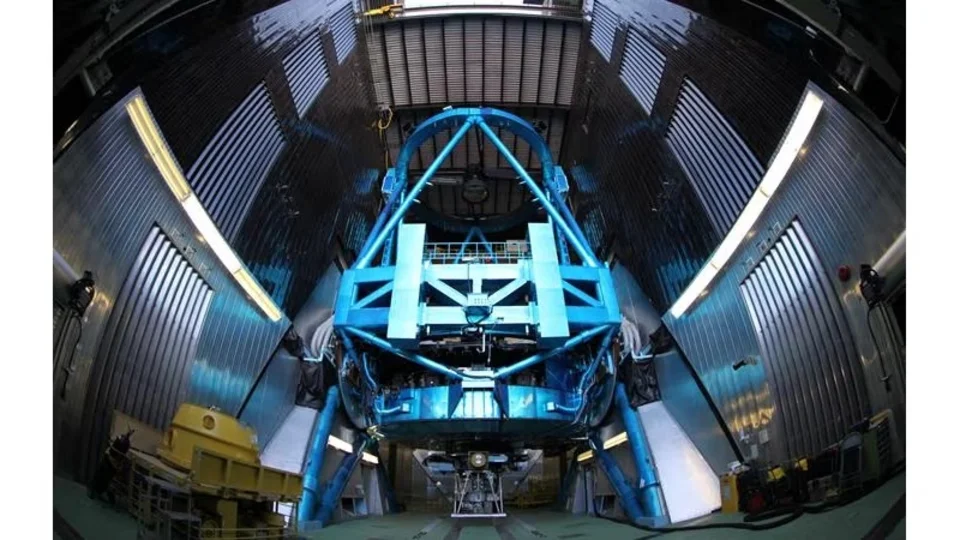
Award-winning algorithm aids observation 1 min read · Mon, Aug 27 2018 News astronomy telescope extreme computing Researchers at the Extreme Computing Research Center (ECRC) at KAUST have developed a new algorithm that uses supervised machine learning to control a small high-speed deformable mirror inside the exoplanet imaging camera to compensate for atmospheric turbulence in the Subaru Telescope, which has an 8.2 meter diameter.
Superior seismic imaging for better drilling 1 min read · Sun, Jul 8 2018 News seismic imaging fossil fuels extreme computing data analysis Software could transform underground imaging of fossil fuel reserves by providing unprecedented detail in record time.
ECRC brings astronomy back home 4 min read · Tue, Feb 20 2018 News optical telescope GPU Computing parallel algorithms Astronomy research excellence is coming back home to the Middle East, where it took its first steps around 1200 BC. Custome new software developed by the KAUST Extreme Computing Research Center (ECRC) was released at the end of 2017. Named MOAO - Multiple Object Adaptive Optics â the software will contribute to the activities of the world's largest future optical telescope to be deployed in Chile in 2024.
New cost-effective GPUs solver redesigns the computational game 2 min read · Thu, Jan 12 2017 News exascale High Performance Computing parallel computing Prof. David Keyes and his team proposed a GPUs light architecture to solve systems of multiple equations involving a large amount of data. Broadly used in computer gaming, mobile, and PC graphics - GPUs allow customizing an effective result-driven support to create a computational framework for increasing the number of processors while reducing the memory required to temporarily store the data.
Taking graphics cards beyond gaming 1 min read · Mon, Jan 9 2017 News graphic card computing applied mathematics computational science A highly efficient mathematical solver designed to run on graphics processors gives scientists and engineers a powerful new tool for a common computational problem.
Engage ORCID ShareClipboard Related Sites Applied Mathematics and Computational Science (AMCS) Hierarchical Computations on Manycore Architectures (HiCMA) Flow Simulation at the Exascale (Exaflow) Computer Science (CS) Related Content Articles 22 Events 3