KAUST Rising Stars in Robotics Jan 12, 08:00 - 17:00 KAUST robotics autonomous control The Rising Stars in Robotics Symposium will convene emerging researchers working across robotics to exchange research, build connections across disciplines and explore new directions in robotics research and applications.
Pre-Authentication Attacks on 5G Cellular Systems Ammar El Falou, Research Scientist, Computer Science Nov 30, 12:00 - 13:00 B9 R2325 5G cybersecurity DoS denial-of-service radio resource control Non-Terrestrial Networks terrestrial networks This talk presents pre-authentication attacks on 5G systems and proposes effective mitigation techniques.
Stochastic Numerics and Statistical Learning: Theory and Applications Workshop 2026 Nov 22, 14:00 - Nov 26, 18:00 Workshops stochastic algorithm numerical analysis statistical learning Bringing together experts in stochastic algorithms, numerical analysis and statistical learning.
Nonlinear Optimal Control and Filtering beyond the HJB Equation Alessandro Astolfi, Professor, Applied Mathematics and Computational Science Nov 19, 12:00 - 13:00 B9 R2325 nonlinear optimal control optimal control Filtering theory PDEs non-linear feedback A novel set of sufficient conditions - equivalent to the HJB equation for the solution of nonlinear optimal control problems.
Mathematical and Computational Models of Fluid-Solid Interactions in the Subsurface Maryam Alghannam, Ibn Rushd Assistant Professor, Earth Systems Science and Engineering Nov 12, 12:00 - 13:00 B9 R2325 computational models fluid dynamics computational fluid dynamics
Efficient Deep Neural Network Inference with Near-Edge Accelerator Offload Hao Liu, Ph.D. Student, Computer Science Nov 11, 09:30 - 11:30 B2 R5220 edge computing Efficient AI accelerators multi-stage optimization algorithm distributed computing Distributed algorithms This thesis develops efficient distributed inference strategies for deep neural networks that exploit near-edge accelerators through edge, near-edge, and cloud tier offloading, optimized model partitioning, and collaborative expert-based processing to achieve low-latency, energy-efficient, and accurate AI inference on resource-constrained edge systems.
AI for Sports Silvio Giancola, Research Scientist, Electrical and Computer Engineering Nov 9, 12:00 - 13:00 B9 R2325 AI Sports This talk will explore how computer vision and multimodal AI can help us understand sports, using football as a central example.
Polytopal Element Methods In Mathematics and Engineering (POEMS) 2026 Nov 9, 08:00 - Nov 12, 17:00 KAUST - Auditorium between B2 & B3 polytopal elements virtual elements Discontinuous Galerkin Join POEMS 2026 to explore advances in polytopal numerical methods and their applications in fluid-structure interactions, porous media, geoscience, biology and fracture mechanics. Register by Oct. 31.
Key Devices and Applications of Visible Light Communication for 6G Zengyi Xu, Postdoctoral Research Fellow, Electrical and Computer Engineering Nov 8, 12:00 - 13:00 B9 R2325 GaN GaN-based LED MIMO vlc Visible light communications communication systems This talk will explores a joint theoretical modeling method for GaN‑based light‑emitting diodes, develops high‑speed integrated LED transmitter chips, implements high‑performance GaN‑based short‑wavelength photodetector receivers for multi‑access MIMO VLC networks, and pioneers a perovskite superlattice fluorescent‑antenna‑based wide‑field‑of‑view receiver to break the rate‑field‑of‑view‑effective‑area trade‑off limitation of VLC receivers.
KAUST Statistics Research Day Nov 3, 08:55 - 16:30 B19, Hall1 Bayesian Statistics Biostatistics spatial statistics geospatial statistics computational statistics extreme statistics Join KAUST Statistics Research Day to explore the latest work by KAUST researchers in statistical modeling, machine learning, biostatistics and spatial analysis.
Quantum Communications Salama Ikki, Full Professor, Electrical and Computer Engineering Department, Lakehead University (LakeheadU), Canada Nov 2, 12:00 - 13:00 B9 R2325 wireless communication quantum communication
Bayesian Decision-Theoretic Privacy Christian P. Robert, Full Professor, Department of Applied Mathematics (CEREMADE), Paris Dauphine-PSL University; Nov 2, 12:00 - 13:00 B3 R5209 Data Privacy statistical privacy bayesian adversial privacy privacy-preserving machine learning privacy-preserving AI bayesian methods This seminar introduces two Bayesian decision-theoretic frameworks, persuasive privacy and Bayesian adversarial privacy, that quantify statistical privacy by evaluating how data releases influence adversarial beliefs and decisions while offering contextual alternatives to conventional differential privacy.
On the Difficulties of Assessing Statistical Privacy Christian P. Robert, Full Professor, Department of Applied Mathematics (CEREMADE), Paris Dauphine-PSL University; Nov 1, 12:00 - 13:00 B9 R2325 Bayesian Statistics statistical privacy privacy bayesian adversial privacy This distinguished lecture examines the limitations of statistical disclosure control and differential privacy and explores robust, deliberately insufficient statistics combined with Bayesian inference as an alternative approach to protecting individuals in shared data.
Fine-Grained Visual Representations through Sparse Selection of Localized Features Fatimah Zohra, Ph.D. Student, Computer Science Oct 30, 14:00 - 16:00 B1 R2202 vision transformer implicit neural representation spatio-temporal modeling Vision Foundation Models visual computing This thesis studies and develops sparse localized feature selection techniques for vision transformer (ViT) models to improve representation of fine-grained visual details across images and videos to capture fine-grained spatial and temporal structure that are often lost in global representations of current ViT foundation models.
Low-Dimensional Copper Halide Scintillators for X-Ray Imaging and Dosimetry Murilo Calil Faleiros, Ph.D. Student, Electrical and Computer Engineering Oct 29, 15:00 - 16:00 B4/5 A0215 material fabrication scintillators halides microdoping X-ray Imaging This thesis investigates the material, fabrication, and system-level barriers limiting the deployment of low-dimensional copper halide scintillators for X-ray detection to achieve high-performance, low-cost, and application-ready imaging, dosimetry, timing, and quality-assurance technologies.
Fourier-Spectral Methods for the Vlasov-Poisson System Giovanni Russo, Full Professor of Numerical Analysis, Department of Mathematics and Computer Science, University of Catania (UNICT) Oct 29, 12:00 - 13:00 B9 R2325 Vlasov-Poisson system fourier spectral methods splitting methods adaptive methods In this talk we present an adaptive method for the numerical solution of the Vlasov-Poisson system in one space dimension with periodic boundary conditions in both space and velocity, which is based on Fourier discretisation in x and v and on high order fractional step method in time, allowing high accuracy and efficiency.
Efficient Computation of the Semiclassical Limit of the Schrödinger Equation Giovanni Russo, Full Professor of Numerical Analysis, Department of Mathematics and Computer Science, University of Catania (UNICT) Oct 26, 15:00 - 16:00 B1 R3426 Schrödinger equation numerical analysis Gaussian Wave Packet initial-value problem Hagedorn wave packets This talk presents the Gaussian Wave Packet Transform, an efficient numerical framework for solving the semiclassical Schrödinger equation that reduces spatial and temporal stiffness, enables accurate simulation of highly oscillatory quantum dynamics in multiple dimensions, and supports efficient computation using Gaussian and Hagedorn wave packet representations.
Saudi HPC/AI Conference 2026 Oct 26, 08:00 - Oct 28, 17:00 KAUST HPC AI big data Data Analytics machine learning artificial intelligence Join researchers, technology experts and industry leaders to explore how HPC and AI are advancing research and innovation.
Geometry-Aware Visual Understanding and Stereoscopic Video Generation Jian Shi, Ph.D. Student, Computer Science Oct 26, 03:00 - 05:00 B1 R2202 3D understanding 3D reconstruction geometry modeling stereo video synthesis generative ai This thesis develops a geometry-aware dissolving transformation that selectively removes unnecessary fine-grained visual and geometric detail while preserving coarse structural information, to achieve more robust representation learning, higher-quality stereoscopic video synthesis, and more efficient multi-view geometry processing.
Safety Embedded Autonomy: From Barrier States to Intelligent and Differentiable Control Hassan A. Almubarak, Assistant Professor, Department of Control and Instrumentation Engineering, King Fahd University of Petroleum and Minerals (KFUPM) Oct 25, 12:00 - 13:00 B9 R2325 autonomous systems Advanced control systems engineering safe autonomy reliability barrier states adaptive control control systems engineering This talk presents a safety-embedded approach to autonomy that builds safety directly into the control dynamics through Barrier States, then extends it with adaptive and differentiable control so that autonomous systems can stay safe, adapt to changing dynamics, and improve through physical interaction.
Reading Theorems in Lean Diogo Gomes, Associate Dean for Students, Computer, Electrical and Mathematical Sciences and Engineering Oct 22, 12:00 - 13:00 B9 R2325 proof assistant Computational mathematics Applied Machine Learning mathematics mathematical modelling This seminar introduces the Lean proof assistant from the perspective of reading and auditing mathematical statements, exploring its role in auto-formalization and its capacity to expose tacit assumptions in mathematical research.
Diogo Gomes, Associate Dean for Students, Computer, Electrical and Mathematical Sciences and Engineering
Event Status: Cancelled | Towards Trustworthy Acceleration for AI Systems Yuchen Yang, Assistant Professor, Privacy and Cybersecurity Informatics, The Pennsylvania State University (PSU) Oct 22, 12:00 - 13:00 B4 R5209 Trustworthy AI Efficient AI accelerators trustworthy machine learning privacy-preserving AI Security and Privacy secure AI secure system design In this talk, I will show how inference acceleration can not only weaken safety and security but also become a tool for attackers, and how these findings guide secure system design.
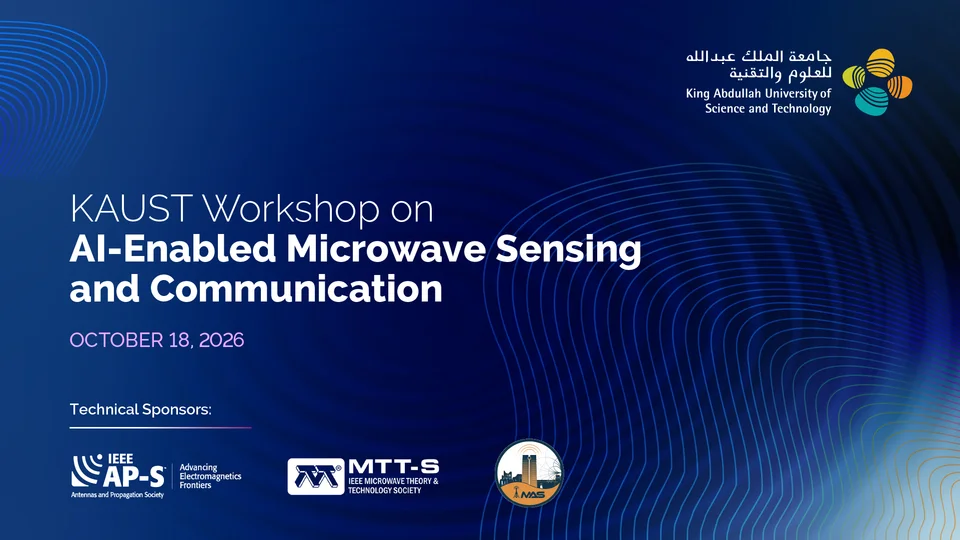
KAUST Workshop on AI-Enabled Microwave Sensing and Communication Oct 18, 08:30 - 18:45 B9 L2 R2325 microwave sensing coding techniques for Terahertz Integrated Sensing and Communications AI wearable and flexible antennas computational electromagnetics Exploring research developments and challenges across AI-enabled microwave engineering, millimeter-wave imaging, and wearable RF sensing for healthcare and communications applications.
Solvers That Don't Choose Sides Esmail Abdul Fattah, Postdoctoral Research Fellow, Statistics Oct 15, 12:00 - 13:00 B9 R2325 sparse computation scientific computing programming abstractions dense linear algebra Sparse Linear Algebra sTiles In this talk, I will present sTiles, a direct solver that decides sparse or dense tile by tile instead of once for the whole matrix, covering the full range from sparse to fully dense and outpacing established sparse direct solvers on the repeated factorizations that drive large-scale inference.
Unbiased and Multilevel Monte Carlo Methods for Parameter Inference in Latent Stochastic Systems Miguel Angel Alvarez Ballesteros, Ph.D. Student, Applied Mathematics and Computational Science Oct 14, 11:00 - 13:00 B2 R5209 Monte carlo methods Monte Carlo stochastic optimization markov chains approximation This thesis develops efficient Monte Carlo methods for score-based parameter inference in such systems, mainly hidden Markov models driven by diffusion processes, and for the related problem of conditional stochastic optimization.
From Abstraction to Acceleration: Productive, Precision-Aware Scientific Computing Rabab Alomairy, Ibn Rushd Assistant Professor, Computer Science Oct 12, 12:00 - 13:00 B9 R2325 programming abstractions algorithms software/hardware co-design scientific computing HPC This talk explores how high-level programming abstractions, precision-aware algorithms, and hardware-conscious design can work together to accelerate scientific computing while improving productivity, scalability, and energy efficiency.
Transformers from Compressed Representations Juan Carlos L. Alcazar, Research Scientist, Electrical and Computer Engineering Oct 11, 12:00 - 13:00 B9 R2325 transformers representation learning TEMPEST visual computing AI machine learning This talk explores how transformers can effectively be trained on compressed byte streams in order to gain computational and memory efficiencies.
Approximate Bayesian inference for structural equation models Haziq Jamil, Research Specialist, Statistics Oct 8, 12:00 - 13:00 B9 R2325 Laplace approximation Bayes estimators copulas R This talk reviews a fast approximate Bayesian SEM method that combines Laplace, variational Bayes, and Gaussian copula techniques to deliver near-MLE speed with MCMC-like inference, and is implemented in the R package INLAvaan.
Last-Iterate Convergence of Optimistic Multiplicative Weights Update Francesco Orabona, Associate Professor, Computer Science Oct 5, 12:00 - 13:00 B9 R2325 gradient descent operation optimistic gradient descent ascent convex optimization saddle-point problems This talk will show how OMWU converges asymptotically for smooth convex-concave saddle-point problems, with a small enough constant learning rate.
Integrated Learning and Optimization and Computationally Efficient Model Predictive Control for Power Systems Applications Imran Pervez, Ph.D. Student, Electrical and Computer Engineering Oct 4, 17:00 - 19:00 B4 R5209; Zoom Meeting 96126193341 MCP power systems integrated machine learning optimization Advanced control systems engineering This dissertation studies novel model predictive control and integrated learning-optimization methodologies that enable computationally efficient, robust, and scalable real-time control and decision-making in modern power systems, improving renewable microgrid operation, electricity market performance, and optimization under uncertainty.
Integrated Silicon Photonics with Quantum Dot On-Chip Lasers: Enabling Scalable and Energy-Efficient Photonic Systems Yating Wan, Assistant Professor, Electrical and Computer Engineering Oct 4, 12:00 - 13:00 B9 R2325 quantum dot lasers Silicon photonics photonic systems energy efficiency This talk presents integrated silicon photonics with quantum dot on-chip lasers that enable development of scalable and energy-efficient photonic systems.
Finite Element Approximation of Fluid-Structure Interaction Problems Fabio Credali, Postdoctoral Research Fellow, Applied Mathematics and Computational Science Oct 1, 12:00 - 13:00 B9 R2325 finite element method approximation fluid dynamics Computer simulations We review the main strategies for the finite element approximation of fluid-structure interaction problems and then focus on one of them, the fictitious domain method, analyzing its formulation and convergence properties.
Differentially Private Training in the LLM Era Di Wang, Assistant Professor, Computer Science Sep 28, 12:00 - 13:00 B9 R2325 privacy-preserving AI LLM LLM training systems stochastic gradient descent optimization This seminar explores how to make differentially private training practical and scalable for large language models and new methods that enable stronger privacy guarantees without sacrificing performance.
From Circuits to Startups The Unexpected Journy of an Engineer Talal Al Attar, Instructional Professor, Electrical and Computer Engineering Sep 27, 00:00 - 01:00 B9 R2325 Professional Development engineering electronic circuits Simulations Technology Transfer innovation This talk presents a real-world story of an engineer’s unexpected journey from designing circuits to building technology startups—sharing the challenges, turning points, successes, failures, and lessons learned far beyond the classroom.
The Broximal Point Method and Its Impact on Optimization Theory and Machine Learning Peter Richtarik, Professor, Computer Science Sep 21, 12:00 - 13:00 B9 R2325 Broximal Point Method proximal algorithms machine learning gradient methods This talk introduces the Broximal Point Method (BPM), a condition-number-free alternative to classical proximal methods, that replaces proximal penalties with ball constraints, surveys its theoretical extensions and distributed variants, and explains how approximate non-Euclidean Brox updates underpin practical machine learning optimizers.
Experimental Demonstration and Performance Analysis of Free Space Optical Communication with Multiple Lenses Jongmin Kim, Ph.D., Electrical and Computer Engineering Sep 20, 15:00 - 16:30 B1 R3123; Zoom Meeting 91224858133 FSO systems optical design adaptive control Free Space Optics This dissertation studies experimental demonstration and performance analysis of free space optical (FSO) systems with multiple lenses to develop practical design guidelines for reliable, high-capacity, and adaptive multi-lens FSO systems.
Ultrawide Bandgap Semiconductors for Future of Moore's Law Xiaohang Li, Program Chair, Electrical and Computer Engineering Sep 20, 12:00 - 13:00 B9 R2325 advanced semiconductors ultra-wide bandgap Ultrawide bandgap materials This talk will explore why the ultrawide bandgap semiconductor is called the 4th generation semiconductor?
Physics-Informed Spatiotemporal Surrogate Modeling and Robust Operational Optimization for CO₂ Applications in Subsurface Flow under Permeability Uncertainty Zhao Beichen, Visiting Student, Applied Mathematics and Computational Science Sep 17, 12:00 - 13:00 B9 R2325 Physics-informed Neural Networks Deep learning numerical simulations uncertainty quantification subsurface fluid flow This talk presents a physics-informed spatiotemporal surrogate that predicts coupled CO₂ storage and geothermal responses under geological uncertainty and enables rapid, risk-aware optimization of staged well controls.
NVIDIA Days at KAUST Sep 15, 20:45 - Sep 17, 17:00 B2/3 A0215 HPC NVIDIA agentic AI systems Physical AI digital twins robotics weather GPU quantum computing Join us (registration required) for the KAUST Supercomputing Lab (KSL) NVIDIA Days from September 15 to 17, 2026, a three-day program supporting the community's ongoing work in AI and High Performance Computing (HPC) through expert-led sessions, personalized clinics, and hands-on training.
SADIQ: An Intelligent Context-Aware IoT System Basem Shihada, Program Chair, Computer Science Sep 14, 12:00 - 13:00 B9 R2325 SDN Quality of service IoT software defined network This talk will identify the unique quality of service (QoS) needs of emerging IoT applications and propose SADIQ, which is a software-defined network (SDN) system that addresses these needs.
From Mirror to Companion: AI and the Next Era of Digital Twins Abdulmotaleb El Saddik, Distinguished Professor, School of Electrical Engineering and Computer Science, University of Ottawa Sep 13, 12:00 - 13:00 B9 R2325 AI digital twins immersive technologies Smart Cities LLM Multi-Modal Large Language Models In this talk, I will share how AI is changing digital twins from tools into transformative forces that shape our future.
Threshold Dynamics and Delayed Closure in a Moving-Boundary Model of Epidermal Wound Healing Zhang Zhiwen, Postdoctoral Research Fellow, Applied Mathematics and Computational Science Sep 10, 12:00 - 13:00 B9 R2325 healthcare technologies numerical analysis analytical tools numerical simulations healthcare analytics We analyze how growth-factor production, diffusion, decay, activation thresholds, and wound geometry interact to determine whether epidermal wound closure begins, proceeds continuously, experiences repeated delays, or stops before completion.
Algorithmically Faithful and System-Efficient Optimization for Large Language Models Liangyu Wang, Ph.D. Student, Computer Science Sep 8, 13:30 - 16:30 B4 R5209; Zoom Meeting 99767080624 LLM Neural Network training algorithms Optimization for Machine Learning LLM training systems The thesis develops an optimizer-aware systems view in which these methods are treated as structured computations with algorithmic invariants, memory behavior, communication objects, and scheduling constraints.
The Event Horizon Telescope: From the First Images to the First Movies of Black Holes Laurent Loinard, Professor of Astronomy, Institute for Radio Astronomy and Astrophysics (IRyA), National Autonomous University of Mexico (UNAM) Sep 7, 16:00 - 17:00 B20 Auditorium Astrophysics Visualization High Performance Computing algorithms telescope statistical inference computational analysis galaxy black holes astrometry This lecture explores the Event Horizon Telescope's groundbreaking achievements in imaging supermassive black holes, details the complex global and computational infrastructure enabling these discoveries, and outlines the future transition from static images to dynamic, real-time movies of the universe's most extreme environments.
The Dark Side of Metaverse: Unmasking the Threats from eXtended Reality (XR) Systems Tao Ni, Assistant Professor, Computer Science Sep 7, 12:00 - 13:00 B9 R2325 extended reality XR cyber-physical systems privacy cybersecurity This talk reveals how the seamless integration of computation, networking, and physical components in XR devices turns every layer of the system into an attack surface that non-intrusively leaks user privacy, ranging from what users type and do to what they perceive in virtual scenes.
Integrated Silicon Photonics with Quantum Dot On-Chip Lasers: Enabling Scalable and Energy-Efficient Photonic Systems Yating Wan, Assistant Professor, Electrical and Computer Engineering Sep 6, 14:00 - 15:30 B2/3 A0215; Zoom Meeting 96429698106 quantum dot lasers integrated photonics energy efficiency photonic systems This talk presents how quantum dot lasers integrated on silicon provide the missing on-chip light source for scalable photonic systems spanning AI computing, hardware security, and coherent LiDAR sensing.
Manufacturing and Integration Strategies for Flexible Electronics Across Form Factors Wedyan Babatain, Ibn Rushd Assistant Professor, Electrical and Computer Engineering Sep 6, 12:00 - 13:00 B9 R2325 advanced manufacturing high-density Circuits circuit design Fabrication Methods fabrication This talk presents manufacturing and integration strategies for flexible electronics across form factors, from E-LIG, a laser-enabled additive process for functional flexible printed circuit boards, to FiberCircuits, which embed complete circuits within fibers for interactive textiles.
Geospatial Data Science for Public Health Surveillance Paula Moraga, Associate Professor, Statistics Sep 3, 12:00 - 13:00 B9 R2325 geospatial data analysis health monitoring spatio-temporal disease data climate data health policy This talk will provide an overview of statistical methods and computational tools for geospatial health data analysis and disease surveillance, with a focus on forecasting climate-sensitive diseases, the integration of health, climate, and digital data, and their role in informing public health policy.
Engineering the Data Layer for Physical AI: Newton Simulation, Eval, Ego Data and Deployment Louis Lian, VP of Partnerships and Strategy, Lightwheel Aug 31, 14:00 - 15:00 B4 R5220 AI Physical AI Newton NVIDIA Lightwheel This talk explores how Lightwheel is overcoming Physical AI's data bottleneck by developing trusted, highly correlated physics simulations and robust evaluation infrastructure to bridge the gap between virtual models and real-world deployment.
Computer Science: Research, Innovation & AI at the Frontier Basem Shihada, Program Chair, Computer Science Aug 31, 12:00 - 13:00 B9 R2325 AI Cyber Security HPC Computational biology Computer Information Systems industry Computer science Higher Education KAUST's Computer Science department is a research-intensive graduate program covering AI, systems, security, HPC, and computational biology, with strong faculty, industry partnerships, and citation impact.